
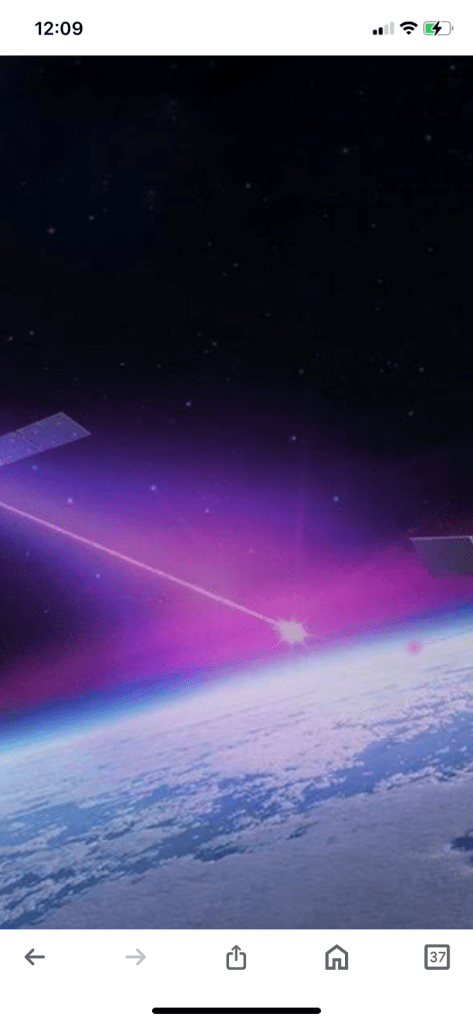
n 2002, a gamma-ray burst from a distant supernova explosion disturbed Earth’s ionosphere. The burst lasted 800 seconds and had enough energy to activate lightning detectors in India. Instruments in Germany also picked up signs of the disturbance
The ionosphere is a layer of Earth’s upper atmosphere that contains electrically charged gases called plasma. It’s ionized by solar radiation and plays a role in atmospheric electricity. The ionosphere also influences radio propagation and GPS signals.
The gamma-ray burst that disturbed Earth’s ionosphere was triggered by a supernova explosion in a galaxy about two billion light-years away.
Scientists are studying the potential risks of a similar event happening closer to Earth. However, the chance of such an event happening is very low.
Well, in 2002, a burst of gamma rays lasting 800 seconds actually impacted our planet. They came from a powerful and very distant supernova explosion. Its gamma-ray bombardment disturbed our planet’s ionosphere and activated lightning detectors in India
Yes, Earth’s atmosphere blocks gamma rays. The atmosphere also blocks most ultraviolet rays, X-rays, infrared radiation, and low energy radio waves.
Gamma rays are high energy radiation that can damage cells and organisms. The atmosphere’s blocking of gamma rays protects life on Earth.
However, this blocking makes it difficult for astronomers to study gamma rays. To study gamma rays, astronomers must use detectors on weather balloons, in rockets, or in satellites. They can also build observatories on mountaintops where the atmosphere is thinner.
Earth’s magnetic shield also protects us from cosmic radiation. The shield is strongest at the equator and weakest near the poles.
The ozone layer protects Earth from harmful rays from the sun, including ultraviolet (UV) radiation. The ozone layer absorbs 97–99% of the sun’s medium-frequency UV light. The ozone layer is located in the lower part of Earth’s atmosphere
However, gamma-ray radiation from a nearby star explosion could deplete up to half of the ozone layer. Chlorofluorocarbons (CFCs) are continuously depleting the ozone layer.
Gamma rays can be stopped by a dense material. The most effective materials are those with high atomic numbers, such as lead or depleted uranium. A few inches of lead or a few feet of concrete can stop gamma rays.
Gamma rays are also stopped by Earth’s atmosphere. The atmosphere is about as thick to gamma rays as a 12-foot thick plate of aluminum. The atmosphere absorbs most gamma rays, but the ones that do reach the atmosphere are absorbed when they hit another particle. This interaction produces secondary particles that can be more damaging.
Gamma rays do reach Earth, but most are absorbed by the atmosphere. The atmosphere’s interaction with gamma rays depends on the strength of the gamma ray, the angle, and how much atmosphere it passes through.
Gamma rays are a type of electromagnetic radiation with the shortest wavelengths. They are produced by the radioactive decay of atomic nuclei. Gamma rays can travel tens or hundreds of feet in air.
The atmosphere is transparent to visible light, but it blocks most ultraviolet light, X-rays, and gamma rays. This is why astronomers use detectors on weather balloons, rockets, and satellites to study these types of light.
Gamma rays can be used to treat living cells. Doctors use gamma rays in treatment.
Estimates say that a gamma-ray burst (GRB) occurs in our galaxy or a nearby galaxy about once every five million years. However, the radiation from a GRB is unlikely to affect Earth. A GRB would need to occur very close to Earth to have an effect
GRBs are beams of gamma radiation that come from the magnetic poles of black holes. These black holes are formed when ancient stars collapse.
In October 2022, Earth was hit by a GRB that was two billion light-years away. This was the closest GRB ever recorded.
Earth is bombarded by gamma rays from distant galaxies for a few seconds every day. On average, astronomers detect about one gamma-ray burst per day. However, they only detect those that beam their radiation in the general direction of Earth.
The average person is hit by more than 200 million gamma rays per hour. These gamma rays come from radioactive material in the soil and buildings.
Gamma rays can pass completely through the human body. As they pass through, they can cause ionizations that damage tissue and DNA
Yes, Earth was hit by a gamma-ray burst (GRB) on March 19, 2008. The GRB, named GRB 080319B, was detected by the Swift satellite. It was visible to the naked eye for about 30 seconds and had a peak visual apparent magnitude of 5.7. The GRB was bright enough to see without a telescope.
GRBs are created when something energetic happens in space. They are the most powerful explosions known in the universe. A GRB could vaporize anything in its beams out to about 200 light-years
The most recent gamma-ray burst (GRB) was on October 9, 2022. The GRB, named GRB 221009A, was the brightest GRB ever observed. It was nicknamed “BOAT” for “brightest of all time”
The GRB lasted about seven minutes, but was detectable for more than ten hours. It was bright enough to be seen by amateur astronomers for several hours.
The GRB was detected by many satellites orbiting close to Earth, including the European Space Agency’s Integral space observatory. Astronomers used the world’s most powerful telescopes to study the event.
The GRB’s behavior was unexpected, which may help scientists understand how GRBs occur.
The first gamma-ray burst (GRB) was discovered by accident in 1967 by the Vela satellites. The satellites were designed to detect nuclear weapons tests. The first GRB was found in 1969 in gamma-ray data from 1967. The results were declassified and published in 1973.
GRBs are flashes of intense radiation in space that are often just seconds long. They’ve been one of the leading astrophysical mysteries ever since.(ful article source google)
https://a7fe9gps22vsb-mjp5r-yntpig.hop.clickbank.net Universe discoveries