
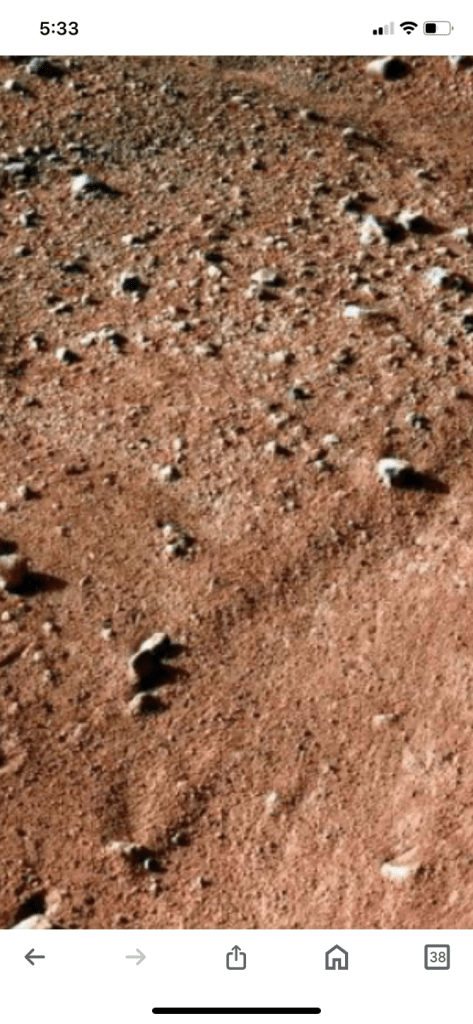
The scientists believe the buried polygons resulted from freeze-thaw cycles on Mars billions of years ago, but they could also be volcanic, from cooling lava flows. The Zhurong roverlanded on Mars on May 15, 2021, making China the second country ever to successfully land a rover on Mars.
The polygons on Mars are thought to be the result of:
- Freeze-thaw cycles
- Cooling lava flows
- Water ice freezing in the soil
- Seasonal changes
The polygons are visible from orbit and look like a honeycomb or spider web. The edges of the polygons crack in the spring as surface ice turns into gas through a process called sublimation.
The polygons could also be evidence of past wet-dry cycles, which may have helped alien life emerge on Mars.
The University of Arizona says that the mysterious polygons on Mars are caused by water ice that freezes in the soil and splits it apart. In the spring, the edges of the polygons crack as the surface ice turns into gas through a process called sublimation
The polygons are formed from an ongoing process of seasonal change from water ice and carbon dioxide. From orbit, the landscape looks like a lacy honeycomb or a spider web.
Other unusual features on Mars include:
- Transverse aeolian ridges: These small-scale features are commonly found in topographic depressions on Mars.
- Circular sand dunes: These dunes are common on Mars and come in many shapes and sizes.
- Doughnut-shaped rock: NASA’s Perseverance Mars rover captured this rock in Jezero Crater on June 22, 2023
This is not the first time that strange polygons have been spotted on the Martian surface. In March 2022, much larger polygons with white outlines were photographed from above by NASA’s Mars Reconnaissance Orbiter. These puzzling shapes were created by hidden reservoirs of ice butting up against the Martian surface
The spider-like object on Mars is a pattern that comes from the sublimation of ice below the surface. Sublimation is when a substance goes directly from a solid state to a gaseous state. The patterns have been spotted in other areas of Mars.
The seasonal frosting and defrosting of carbon dioxide ice also results in other features, such as dark dune spots with spider-like rilles or channels below the ice. These channels are carved between the ground and the carbon dioxide ice, giving it an appearance of spider webs
There is no evidence of past or present life on Mars. However, there is evidence that Mars may have been habitable for microorganisms in the past.
Explanation
Early Mars was warmer and wetter than it is today. It may have had liquid water and an atmosphere that could support life. However, conditions on the surface may have become too harsh for life.
NASA’s Perseverance rover is designed to look for chemical traces of life, but it can’t find fossilized remains. In 1996, scientists claimed to have found fossilized bacteria in a Martian meteorite, but the claim was later rejected.
Some scientists believe that evidence of ancient life may have been erased from parts of Mars. However, there are still places on Mars that could be habitable, such as the deep subsurface. These places could have fluids where organisms could live, protected from the harmful radiation on the surface.
Mars and Earth formed from the same materials and were similar when the solar system formed over four billion years ago. Both are terrestrial planets with a central core, a rocky mantle, and a solid crust
Mars may have been more Earth-like in the past:
- Atmosphere: Mars may have had a thicker atmosphere than it does today. It may have been rich in carbon dioxide and had no free oxygen.
- Water: Mars may have had extensive oceans that were sometimes frozen. It may have had liquid water in deep craters and rivers.
- Temperature: Mars may have had a climate similar to Earth’s when life emerged on Earth.
- Magnetic field: Mars may have had an internal magnetic field.
However, Mars is smaller than Earth and has a weaker gravitational pull. This may have made it difficult for Mars to retain its atmosphere. Mars may have lost its water and become drier.
NASA’s Perseverance rover spotted a donut-shaped rock on Mars on June 22, 2023. The rock was found in Jezero Crater, about 328 feet away. It’s a large, dark stone with a hole in the middle. The rock is surrounded by similar-colored stones
Scientists believe the rock may be a meteorite that crashed onto Mars. The SETI Institute tweeted that the rock could be a large meteorite surrounded by smaller pieces. One scientist speculates that wind may have enlarged any pre-existing pits or cavities in the rock.
The Perseverance rover’s Remote Microscopic Imager (RMI) captured the image
Transverse aeolian ridges (TARs) are small, bright, wave-like formations of sediment that are found on Mars. They are similar in appearance to terrestrial ripples and Martian dunes. TARs are a few meters tall and spaced a few tens of meters apart. They are found in topographic depressions at low to mid-latitudes in the northern and southern hemispheres.
Sand dunes come in many shapes and sizes. Circular sand dunes are unusual, but they are common on Mars
NASA’s Mars Reconnaissance Orbiter has captured images of almost perfectly circular sand dunes. The dunes are slightly asymmetrical, with steep slip faces on the south ends. This indicates that sand generally moves to the south.
Sand dunes can also be found in the Thar Desert in Rajasthan, India. The Thar Desert has five types of sand dunes: Parabolic, Barchan, Longitudinal, Transverse, Sand sheet.(full article source google)
Best science fiction books on discount on Amazon
https://a7fe9gps22vsb-mjp5r-yntpig.hop.clickbank.net Universe discoveries
Good 👍
LikeLiked by 1 person
Thanks a lot frank🌹
LikeLiked by 1 person
You too nice to meet you here
LikeLike
Very interesting! Thanks for the info.
LikeLiked by 2 people
Thanks a lot 🌹
LikeLiked by 2 people
Good information about 🎇
LikeLike