
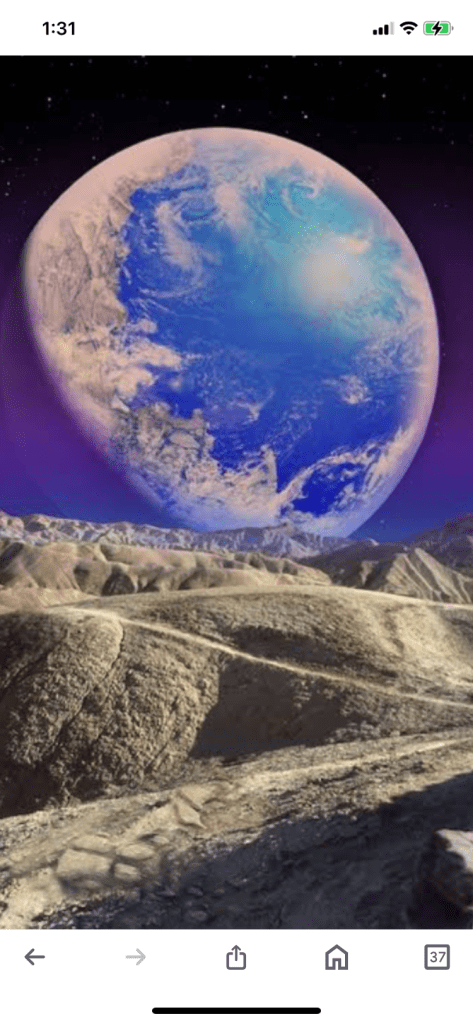
The James Webb Space Telescope (JWST) has found water and organic carbon molecules near a massive, active young star that’s situated in a faraway star-forming region of space, suggesting Earth-like exoplanets could form even in the harshest environments in our Milky Way Galaxy.
The James Webb Space Telescope (JWST) has found that Earth-like planets may form in the harshest environments in our Milky Way Galaxy. The JWST observed water and organic carbon molecules near a young, massive star in a star-forming region of space. This suggests that Earth-like planets could form in regions with extreme conditions, such as harsh ultraviolet radiation from massive stars.
The JWST observed the inner region of a disk that surrounds a young star. The star has a mass similar to that of Earth’s sun and is located in a star-forming nebula known as NGC 6357. The XUE program targeted 15 discs in three areas of the Lobster Nebula, which is roughly 5,500 light-years away from Earth.
The results suggest that the conditions for terrestrial planet formation can occur in a wider range of environments than previously thought.
The James Webb Space Telescope (JWST) has discovered a number of potentially habitable planets:
- LHS 475 b: A rocky planet that’s nearly the same size as Earth and is located 41 light years away
- A potentially habitable world: A planet that’s more than eight times larger than Earth
- A 7-planet system: A system with potentially habitable worlds
The JWST can also observe planets, satellites, comets, asteroids, and Kuiper belt objects. It can also monitor the weather of planets and their moons.
The JWST can detect life or alien civilizations on exoplanets within 40 light-years of Earth. Some believe it could detect signs of extraterrestrial life up to 50 light-years from Earth.
The James Webb Space Telescope (JWST) will revolutionize our understanding of the universe. Here are some things the JWST will tell us:
- How early galaxies formed: The JWST can look back in time to see the first galaxies that formed in the early universe.
- If other planets could support life: The JWST can detect signs of life on other planets.
- The birth and death of stars: The JWST can look inside the dusty clouds where stars form, and study the gas and dust ejected from dying stars.
- Black holes: The JWST can study black holes from a different angle.
The James Webb Space Telescope (JWST) can tell us the composition of the atmospheres of exoplanets. It can observe planetary atmospheres through the transit technique. A transit is when a planet moves across the disc of its parent star. Webb also carries coronographs to enable photography of exoplanets near bright stars (if they are big and bright and far from the star), but they will be only “dots,” not grand panoramas. Consider how far away exoplanets are from us, and how small they are by comparison to this distance.
Webb is able to characterize the atmospheres of Earth-sized exoplanets. The team attempted to assess what is in the planet’s atmosphere by analyzing its transmission spectrum. Although the data shows that this is an Earth-sized terrestrial planet, they do not yet know if it has an atmosphere.
Webb has discovered methane, carbon dioxide, sulfur dioxide, and water in the atmospheres of exoplanets. It may have even found the building blocks of life elsewhere in the universe.
According to a study published in the Astrophysical Journal Letters, Earth-like planets could form in the harshest star-forming environments. The James Webb Space Telescope (JWST) found water and organic carbon molecules near a young star in a star-forming region of space. The harsh environments near massive stars also contain water, so it’s possible that planets in these regions could even support life.
Earth-like planets are roughly the size of Earth and are located in the habitable zone of their host star system. The habitable zone is the distance at which a planet has the potential to hold liquid water, and therefore life.
Astronomers estimate there could be anywhere from 300-million to upwards of 40-billion Earth-like worlds in the Milky Way. Some researchers have suggested that there could be billions of planets that are similar to Earth.
Some of the most Earth-like planets in the Milky Way include:
- Gliese 667Cc: Orbits a red dwarf star that is considerably cooler than the sun
- Kepler-452b: Slightly bigger than Earth and in the habitable zone of its star
Astronomers have identified over 4,000 planets orbiting other stars. The most common types of planets in the Milky Way are super-Earths and mini-Neptunes
Here are some other Earth-like planets in the Milky Way:
- Kepler-452b This planet is 60% larger than Earth and is considered a “super-Earth”. It’s located in the habitable zone of a G-type star that’s similar to our sun.
- Proxima Centauri b This planet is the closest known exoplanet to Earth, located just four light-years away. It has a mass that’s 1.27 times that of Earth.(full article source google)
 Universe discoveries