
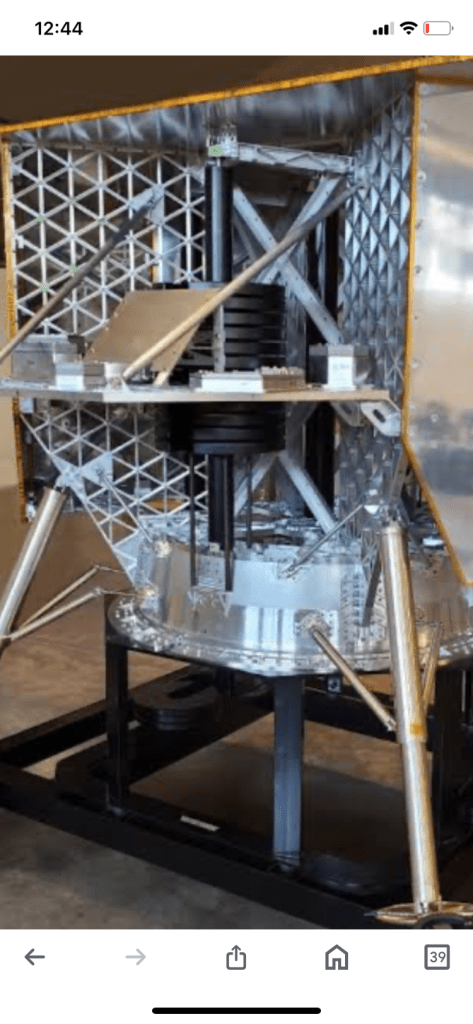
More than 50 years after the last Apollo mission, the United States will try once again to land a craft on the Moon on January 25, said the head of what could be the first private company to successfully touch down on the lunar surface.
The Peregrine Lunar Lander, also known as Peregrine Mission 1 (TO2-AB), is a spacecraft that will carry scientific and other payloads to the moon. The spacecraft is scheduled to launch no earlier than December 24, 2023.
The Peregrine Lunar Lander has the following properties:
- Launch mass: 1,283 kg (2,829 lb)
- Rocket: Vulcan Centaur
- Payload mounts: Flexible to accommodate various payload types
- Engines: Five main engines for major maneuvers
The Peregrine Lunar Lander is scheduled to land on the moon’s Sinus Viscositatis. If launched on December 24, it will land on January 25.
The Peregrine Lunar Lander has arrived at Cape Canaveral, Florida, where it will be integrated with the United Launch Alliance (ULA)’s Vulcan for launch
The Peregrine Lunar Lander’s payload capacity for Mission One is 90 kg. The mission will carry about 10 payloads, including:
Scientific instruments, Technologies, Mementos, DNA samples, Greetings, Cremated remains.
The payloads will come from six countries, hundreds of individuals, and dozens of science teams.
The Peregrine Lunar Lander was selected by NASA’s Commercial Lunar Payload Services (CLPS). It was privately developed by Astrobotic Technology for the Google Lunar-X-Prize
The Peregrine Mission One (PM1) is a private mission to land on the moon. It will be the first commercial mission to land on another planet. The mission’s scientific objectives include:
- Studying the lunar exosphere
- Examining the thermal properties of the lunar regolith
- Measuring the hydrogen abundance of the lunar regolith
- Studying magnetic fields
- Studying the radiation environment
The mission will advance lunar scientific knowledge, exploration capabilities, and commercial lunar development.
The Peregrine Mission One will deliver payloads from NASA and commercial entities. Payloads can be mounted above or below the decks, inside or outside of enclosures, and can remain attached or deployed.
Peregrine Mission 1 (PM1) is the first commercial mission to land on another planetary body. Astrobotic Technology, a space robotics company, was selected by NASA’s Commercial Lunar Payload Services (CLPS) program to deliver up to 14 NASA payloads to the Moon
The Peregrine Mission 1 is about 1.9 meters high and 2.5 meters across. It can carry up to 120 kilograms of payloads.
The Peregrine Mission 1 will be launched on United Launch Alliance (ULA)’s Vulcan.
The Peregrine Lunar Lander is also featured on Wikimedia Commons. The category “Peregrine (lunar lander)” has six files.
The Peregrine Lunar Lander will carry a payload of about 10 different types of items. The payload capacity of the lander is 90 kg. One of the payloads will be a “lunar library” created by the Arch Mission Foundation. The library will include the contents of Wikipedia.
Astrobotic also offers another lander called Griffin. The Griffin lander has a payload capacity of 500 kilograms. (Full article source google)
https://19b9dnhp62u-irkj5jcy-8dhft.hop.clickbank.net Universe discoveries