
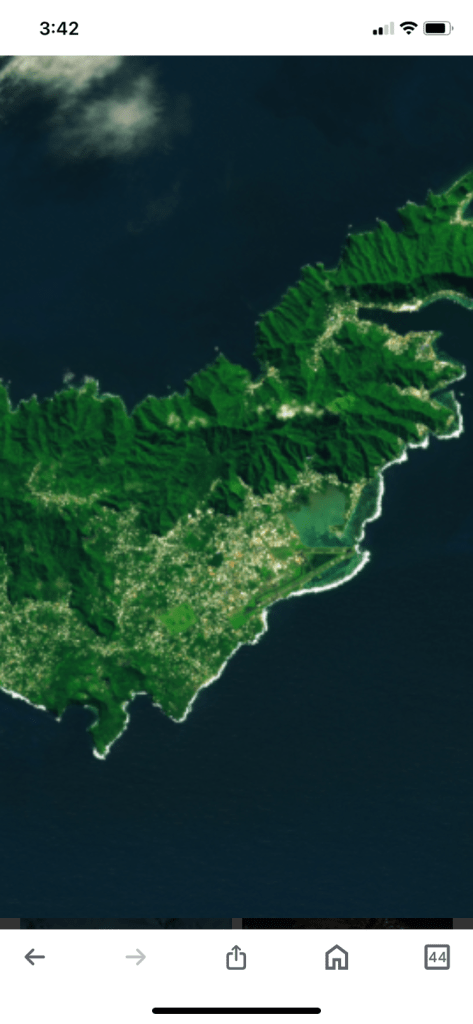
Here’s some information about American Samoa from space:
- Location: American Samoa is located in the South Pacific Ocean, halfway between New Zealand and Hawaii. It is the eastern part of the Samoan archipelago, a volcanic island chain that is 301 miles long.
- Islands: American Samoa is made up of five volcanic islands and two coral atolls:
- Volcanic islands: Tutuila, Aunu’u, Tau, Ofu, and Olosega
- Coral atolls: Rose and Swains
- Largest island: Tutuila, which is a tropical island
- Northernmost island: Swains Island, which is 340 km northwest of Tutuila
American Samoa is the only U.S. territory south of the equator. It became a U.S. territory in 1900 when the local chiefs of Tutuila ceded the island to the United States.
Here are some places to see images of American Samoa from space:
- ESA: The Copernicus Sentinel-2 mission has a view of Tutuila
- NASA: The Visible Earth story has images of Tutuila
- Zoom Earth: Has live satellite images and weather forecasts
Swains Island is located in the southwestern Pacific Ocean. It’s about 200 miles northwest of Tutuila and 320 km north of the Samoan hot spot track.
Swains Island is a coral atoll that’s 15–25 feet above sea level. It’s circular in shape, with 8 miles of shoreline. The island is about 2.4 km long and has a freshwater lagoon. It’s also home to a brackish water lake that’s cut off from the ocean.
Swains Island is geologically part of the Tokelau volcanic chain. Culturally, it belongs to Tokelau, but politically, it’s a territory of the United States
The main difference between American Samoa and Samoa is that American Samoa is an unincorporated territory of the United States, while Samoa is an independent country
The Samoan Islands were divided in 1899 after years of civil war. The division was the result of an agreement between the United States, Germany, and the United Kingdom in the Tripartite Convention of 1899. The Treaty of Berlin settled the international rivalries.
The division created two spheres of influence:
Western Samoa Germany took control of the western islands, including Savai’i and Upolu.
American Samoa The United States took control of the eastern islands, including Tutuila and Manu’a.
The British withdrew their claims to Samoa in exchange for parts of the Solomon Islands.
Western Samoa became an independent country in 1962. In 1997, the Legislative Assembly of Western Samoa changed the name to Samoa. This change caused controversy in American Samoa, where some people felt that the name change implied that American Samoa was just an American appendix
Here’s some information about American Samoa:
- Governance: The U.S. Navy controlled American Samoa until 1951. Today, the U.S. Department of the Interior governs it.
- Constitution: American Samoa’s constitution was ratified in 1966 and took effect in 1967.
- Citizenship: People born in American Samoa are US nationals, not US citizens.
- Population: As of November 23, 2023, the population of American Samoa is 43,766.
- Immigration: American Samoa has its own immigration laws for foreign visitors. US passport holders can travel freely to and from American Samoa.
As of December 2, 2023, the population of American Samoa is 43,757. This is 0.00055% of the world’s population.
Here is some demographic information about American Samoa:
- 2020: 49,710 people, with 50.8% male and 49.2% female
- 2022: 45,443 people, with most being indigenous ethnic Samoans
The largest city in American Samoa is Pago Pago, with a population of 12,576.
According to the Pew Research Center, 98.3% of the population of American Samoa is Christian. The breakdown of Christian denominations is as follows:
- Protestant: 59.5%
- Roman Catholic: 19.7%
- Other Christians: 19.2%
The Congregational Christian Church has the largest following among Protestant denominations. Slightly less than one-sixth of the population is Mormon.
Christianity arrived in the islands in 1830 through missionaries. The Christian faith integrated with Samoans’ beliefs in gods for the sun, earth, heavens, and sea. Today, most Samoans identify as Christian and attend church services at least once a week.
The first missionaries to Samoa were the Reverend John Williams and the Reverend Charles Barff. They arrived on July 16, 1830, anchoring off the south coast of the island of Savai’i. Williams was part of the London Missionary Society (LMS). He established a church that would later become the Congregational Christian Church of Samoa (CCCS), the largest denomination in Samoa(full article source google)
Best men woman clothing on heavy discount on Amazon Universe discoveries