
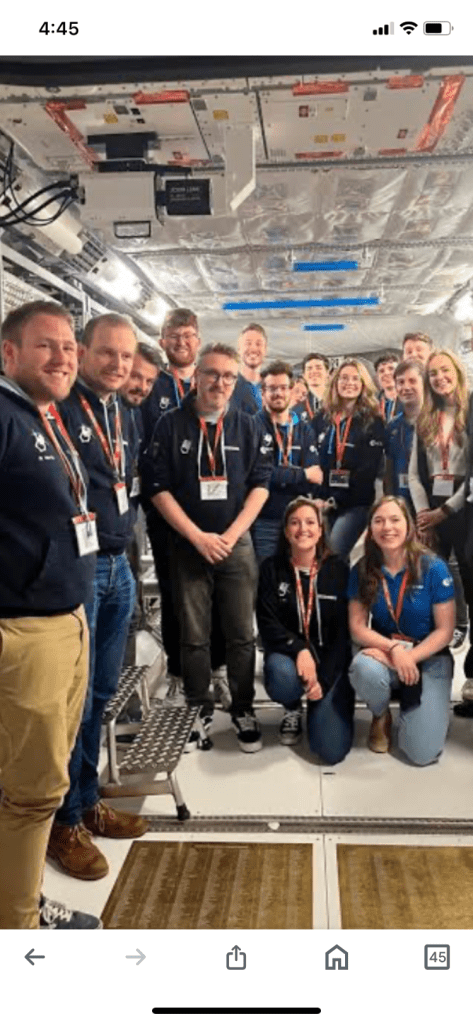
EIRSAT-1 (Educational Irish Research Satellite-1) launched into orbit on December 1, 2023. It became Ireland’s first satellite. The launch took place at Vandenberg Space Force Base in California on a SpaceX Falcon 9 rocket.
The 2U CubeSat was developed and built by students at University College Dublin (UCD). The European Space Agency (ESA) sponsored the project. The satellite cost around €1.5 million to create.
EIRSAT-1 is a small satellite, measuring 10.7cm x 10.7cm x 22.7cm. It has several payloads, including:
- An experiment to detect gamma rays
- An attitude control system
- A protective coating technology
On 1 December 2023, EIRSAT-1 launched on a Falcon 9 rocket from Vandenberg Space Force Base, California. Upon reaching orbit, it became Ireland’s first satellite
The Soviet Union launched the first artificial satellite, Sputnik 1, into space on October 4, 1957. The satellite was about the size of a beach ball and weighed 83.6 kilograms. It orbited the Earth every 96.2 minutes at a speed of 29,000 kilometers per hour
The launch of Sputnik 1 shocked the world and marked the beginning of the Space Age. The United States had hoped to be the first to launch a satellite.
Four years later, on April 12, 1961, Russian Lt. Yuri Gagarin became the first human to orbit Earth in Vostok 1.
EIRSAT-1 will carry three Irish developed experiments, or payloads.
GMOD – The Gamma-ray Module
The first payload element (called the ‘Gamma-ray Module’ or ‘GMOD’) is a miniaturised sensor for use in the detection of gamma-rays from both cosmic and atmospheric phenomena. The sensor is called a silicon photomultiplier (SiPM) and has been developed by SensL Ltd. in County Cork (currently part of ON Semiconductor). The SiPM has the potential to revolutionise in-situ and remote sensing of gamma-rays in space by removing the need for conventional photomultiplier tubes that are typically very bulky, fragile and require high voltages to operate.
EMOD – the ENBIO Moduleedit
The second payload element (called the ‘ENBIO Module’ or ‘EMOD’) will provide in-orbit demonstration of novel protective oxide surface treatments made by ENBIO Ltd. (SolarWhite and SolarBlack).These surface treatments have been developed for use on the ESA Solar Orbiter mission, and EIRSAT-1 will provide the opportunity for these coatings to be thermally tested. The temperature of the coatings will be measured throughout the mission.
WBC – Wave Based Control
The third payload is a novel, software-based attitude control system developed by the Dynamics and Control Group in the UCD School of Mechanical and Materials Engineering. A spacecraft’s “attitude” is its orientation in space. In this case it will use the Earth’s magnetic field to turn itself in any desired direction.The UCD control technique is called “Wave-Based Control” (WBC).EIRSAT-1 will use a standard control system initially. At some time into the mission, in response to an instruction from Earth, the on-board computer will start using WBC to control the satellite’s attitude, thereby evaluating its performance and, it is hoped, qualifying WBC for space flight.
EIRSAT-1, or Educational Irish Research Satellite-1, is Ireland’s first satellite. It was launched on December 1, 2023 from Vandenberg Space Force Base in California. The satellite was developed and built by students at University College Dublin (UCD) in Ireland. The European Space Agency (ESA) sponsored the project
EIRSAT-1 is a 2U CubeSat, which is a miniature cube satellite. It is equipped with three experiments. The project cost €1.5 million and involved more than 50 students. Testing the satellite took 20,000 man hours.
The launch of EIRSAT-1 has been called a “major milestone” for Ireland’s space sector.
The EIRSAT-1 team includes students and professors from University College Dublin (UCD). The team can be followed on Twitter at @EIRSAT1.
The team includes:
- Pádraig: Graduated from Trinity College in 2023 with a degree in Physics. He is currently studying for a PhD in Space Science at UCD.
In 2017, UCD was one of six universities selected to take part in the ESA FYS2 program( full article source google)
Best desktops on heavy discount on Amazon
https://19b9dnhp62u-irkj5jcy-8dhft.hop.clickbank.net
Best men woman clothing on heavy discount on Amazon Universe discoveries