
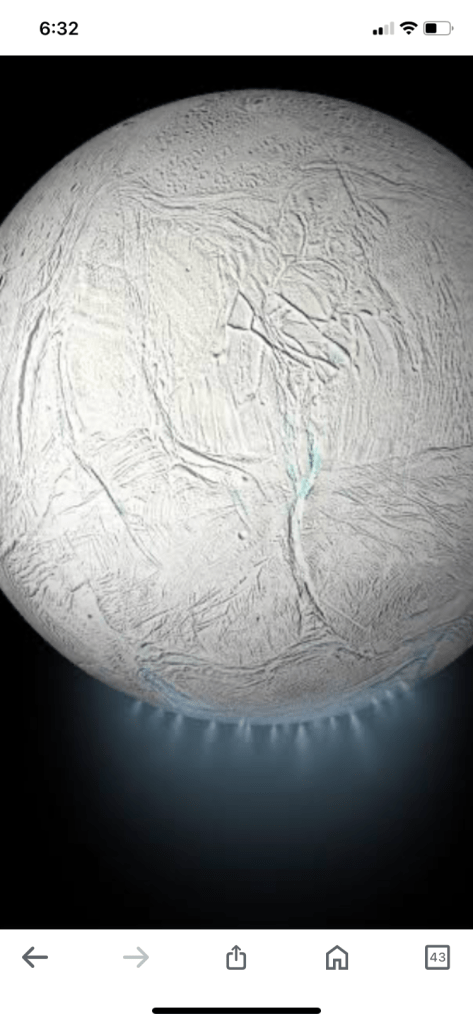
In new research, scientists at the University of California San Diego found laboratory evidence that amino acids — an important class of biosignature molecules — transported in these ice plumes can survive impact speeds of up to 4.2 km/s (2.6 miles per second), supporting their detection during sampling by spacecraft.
A study suggests that the ice plumes of Saturn’s moon Enceladus may contain amino acids. The plumes shoot water vapor and ice grains into space. They originate from fractures at the moon’s south pole, and create the E-ring, which traces Enceladus’ orbit around Saturn.
Researchers from the University of California, San Diego have shown that amino acids in these ice plumes can withstand impact speeds of up to 4.2 km/s. This supports their detection during sampling by spacecraft.
Enceladus is a prime target in the search for life in the Solar System. NASA has identified it as the second-highest priority site for a flagship mission in the next decade.
Here are some facts about Enceladus:
- Discovered on August 28, 1789
- Diameter: 313 miles (504 kilometers)
- Orbital Period: 32.9 hours
- Mass: About 680 times less than Earth’s Moon
Amino acids that may be present in Enceladus’ plumes include:
Glycine, Serine, α-Alanine, α-Aminoisobutyric acid, Isovaline, Asn + Ala, Asp, Glutamic acid.
The amino acids alanine and serine were fired at aluminum and indium foils at speeds of up to 2 kilometers per second. This simulated the conditions of a future fly-through mission.
Enceladus’ ocean is the only one outside of Earth known to contain all six elements needed for life. These elements are:
Carbon, Hydrogen, Oxygen, Nitrogen, Phosphorus, Sulfur.
Enceladus also contains: Liquid water, Silicates, Iron, Phosphates, Molecular hydrogen.
Phosphorus is a key ingredient in human bones and teeth. It’s also the rarest bio-essential ingredient in the cosmos.
NASA’s Cassini spacecraft has discovered molecular hydrogen in Enceladus’ plumes. This could be a potential food source for bacteria.
Enceladus also has a source of energy, like sunlight or chemical energy.
Enceladus has molecular hydrogen, which could be a food source for microbes. The moon’s ocean also has evidence of hydrothermal reactions that produce H2.
However, it’s not clear if any life in Enceladus could use molecular hydrogen as a food source. The high concentrations of gases could indicate a lack of living organisms to consume them
Yes, Enceladus has an energy source. The moon has hydrothermal activity that provides energy to heat its subsurface ocean. The ocean’s water seeps through the icy crust and encounters hot rocks, which generates heat and energy.
Enceladus also has a source of chemical energy. The moon’s plume contains molecular hydrogen, which indicates that there is free energy in the ocean. This chemical energy could be useful for microbes
Enceladus is powered by tidal heating because of its unique position and geological features.
Explanation
Tidal heating occurs when the gravitational forces between two celestial bodies cause one or both bodies to heat up. Enceladus is in a 2:1 orbital resonance with Dione, Saturn’s moon. This resonance causes time-varying tides that deform the moon. Since Enceladus is not perfectly elastic, some of the tidal energy is converted into heat.
The heat generated by tidal heating is thought to be responsible for Enceladus’ volcanic activity. The heat also keeps the moon’s subsurface ocean liquid. Other consequences of tidal heating include geysers and tectonically deformed terrains.
Enceladus is geologically active because of tidal heating and heat generated by its porous core.
- Tidal heating Enceladus’s orbit is elliptical because of Dione’s gravity. This causes tidal heating, which generates heat within the moon.
- Heat from core As Enceladus orbits Saturn, the rocks in its porous core rub together, generating heat. Water from the ocean can also percolate deep into the core, where it heats up and rises.
Enceladus’s geological activity includes:
- Tectonic fractures: These fractures, called “tiger stripes”, are located at the moon’s south pole. They spew jets of water vapor, ice particles, and other gases.
- Water vapor geysers: These geysers erupt from the moon’s south pole.
Enceladus is a promising candidate for life because it has most of the chemical ingredients needed for life:
- Energy: Enceladus has hydrothermal activity and an energy source.
- Shelter: The moon’s ocean provides shelter from radiation.
- Temperature: Internal heating keeps the ocean at temperatures that could support life.
- Chemical ingredients: Enceladus has carbon, hydrogen, nitrogen, oxygen, and sulfur.
- Hydrothermal vents: Enceladus likely has hydrothermal vents that release hot, mineral-rich water into its ocean.
However, life has not been found on Enceladus. Having the ingredients may not be enough for life to exist.
NASA is interested in Enceladus because it has a global ocean of liquid water under its icy surface. This discovery has increased scientists’ interest in Enceladus and the role of water in the development of life in the solar system.
NASA has proposed two missions to Enceladus:
- Enceladus Life Finder (ELF): This mission would assess the habitability of Enceladus’ internal ocean.
- Enceladus Orbilander: This mission would orbit Enceladus for a year and a half, sampling its water plumes. It would then land on the surface for two years to study materials for evidence of life.
Enceladus is also the most reflective object in the solar system, reflecting about 90 percent of the sunlight that hits it.
Scientists are excited about Enceladus because it may be the best place in our solar system to search for life. The moon has a subsurface ocean that could potentially support life. The ocean is salty, has hydrothermal vents, and contains organic molecules. The moon’s plumes also contain hydrocarbons.
Scientists are also excited about Titan because it could have life. Titan is Saturn’s largest moon and the second largest moon in the solar system. It’s covered in a dense orange smog that makes Saturn’s rings mostly invisible. Scientists are interested in Titan because it reminds them of Earth billions of years ago before life existed. (full article source google)
Best clothes for men and women on heavy discount on Amazon
https://7da8drmr1v-xcxf8mlyt125o11.hop.clickbank.net Universe discoveries