
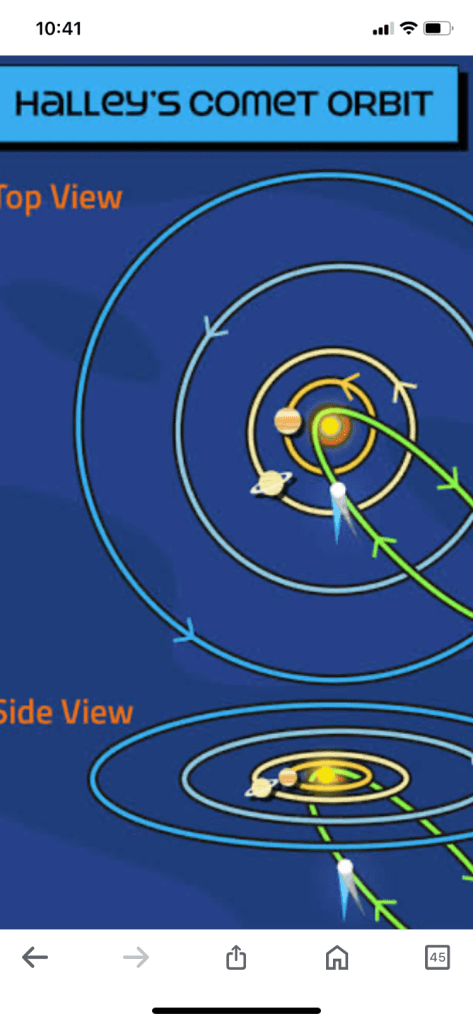
Comet Halley reached aphelion, its farthest point from the sun, on December 9, 2023. Aphelion is a hallmark point in the comet’s 75-year journey through the solar system
Halley’s Comet is a “periodic” comet that returns to Earth’s vicinity about every 75 years. It was last seen in 1986 and is projected to return in 2061. On July 28-29, 2061, Halley’s Comet will pass perihelion, inferior conjunction, and closest approach to Earth.
Halley’s Comet was recorded by Edmund Halley in 1682. It was seen again in 1758, 1835, 1910, and 1986
Halley’s Comet reached aphelion, its farthest point from the sun, on December 9, 2023. Aphelion is 35.143 AU from the sun, which is beyond the orbit of Neptune. The comet was traveling at 0.91 km/s (2,000 mph) relative to the sun
Halley’s Comet is currently in the constellation Hydra. It will head back towards the sun and arrive in the solar system by 2061.
Here are some other facts about Halley’s Comet:
- Perihelion: The closest point to the sun during orbit. Halley’s Comet reaches perihelion every 75 to 79 years.
- Orbit: Halley’s Comet has been in its present orbit for at least 16,000 years.
- Meteor showers: Halley’s Comet is associated with two annual meteor showers: the April-May Eta Aquariids, and the October Orionids
2061. The next perihelion of Halley’s Comet is 28 July 2061, when it will be better positioned for observation than during the 1985–1986 apparition, as it will be on the same side of the Sun as Earth. The closest approach to Earth will be one day after perihelion.
Halley’s Comet will reach perihelion on July 28, 2061. It will be closest to Earth one day after perihelion
Halley’s Comet is a periodic comet, which means it returns to Earth’s vicinity every 75–76 years. It was last seen in 1986.
Halley’s Comet will be brighter than in 1986 because Earth will be closer to the comet. It will also be in a better viewing position than in 1985–1986 because it will be on the same side of the Sun as Earth
In 1989, Boris Chirikov and Vitold Vecheslavov performed an analysis of 46 apparitions of Halley’s Comet taken from historical records and computer simulations. These studies showed that its dynamics were chaotic and unpredictable on long timescales. Halley’s projected lifetime could be as long as 10 million years
Halley’s Comet is a short-period comet, which means it has an orbit of 200 years or less. It’s estimated that Halley’s Comet could have a lifetime of up to 10 million years. However, some say that Halley’s Comet will completely sublimate and disappear after about 10,000 years, which is a typical lifetime for a comet.
Halley’s Comet is estimated to lose about 100 million tons of material when it’s close to the Sun. If we divide the estimated mass of 2.2⋅1017g by the estimated 1910 mass loss of 2.8⋅1014g, we get about 60,000 years. After about 200,000 years, the remnant of Halley’s Comet will probably resemble an asteroid.
Halley’s Comet is arguably the most famous comet in history. As a “periodic” comet, it returns to Earth’s vicinity about every 75 years, making it possible for a person to see it twice in their lifetime. It was last here in 1986, and it is projected to return in 2061
It’s possible to see Halley’s Comet twice in a lifetime.
Halley’s Comet is the only short-period comet that’s regularly visible to the naked eye from Earth. It’s also the only naked-eye comet that can appear twice in a human lifetime.
Other comets appear about two or three times every 15 to 20 years
Halley’s Comet orbits the sun every 75–76 years, making it visible for about six months at a time. It’s visible to the naked eye from Earth, and it’s possible to see it twice in a lifetime
Halley’s Comet was discovered in 1758 and recorded by Edmund Halley in 1682. The comet is named after Halley, who realized in 1705 that the comet’s periodic returns were actually re-appearances of the same comet.
Halley’s Comet is 8 km wide and 16 km long. It moves backward around the sun, opposite to Earth’s motion(full article source google)
Best health and beauty products on heavy discount on Amazon
https://7da8drmr1v-xcxf8mlyt125o11.hop.clickbank.net Universe discoveries