
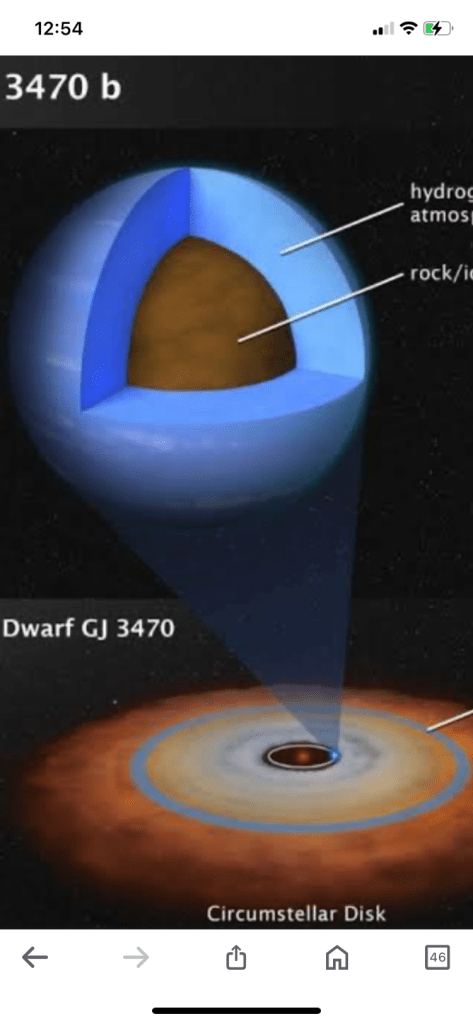
The ESA has just approved the construction of its Ariel mission, which will give us our first large survey of exoplanet atmospheres. The space telescope will help us answer fundamental questions about how planets form and evolve.
The European Space Agency (ESA) approved the construction of the Ariel mission on December 6, 2023. The mission’s goal is to study the atmospheres of hundreds of planets orbiting distant stars. The mission will provide the first large survey of exoplanet atmospheres.
The Ariel mission will:
- Identify chemical elements in exoplanetary atmospheres
- Analyze the starlight that has passed through an exoplanet’s atmosphere
- Determine the composition of the atmosphere based on molecular signatures
- Answer fundamental questions about how planets form and evolve
The mission’s prime contractor is Airbus Defence and Space Toulouse. The contract to build Ariel was awarded to Airbus on December 7, 2021. The targeted launch date is 2029.
The mission will go through the following phases:
- Preliminary Design Review
- Critical Design Review
- Flight model
The Ariel mission has two scientific instruments:
- Infrared spectrometer Has a spectral resolution of about 100 and can detect wavelengths between 2 and 8 micrometers
- Fine guidance sensor Ensures the pointing is stable and charts variations in the planets’ atmospheres
The Ariel mission’s payload is a cryogenic infrared telescope. The instruments are so sensitive that they may discover the first Earth-like planet on an Earth-like orbit
The Ariel mission is part of the European Space Agency’s Cosmic Vision program. The mission’s goals are to:
- Study exoplanets
- Determine the chemical composition of exoplanets
- Characterize the thermal structures of exoplanets
- Identify the atoms and molecules in exoplanet atmospheres
- Determine the temperatures and chemical processes of exoplanet atmospheres
- Explore how an exoplanet’s host star shapes conditions on the planet
The Ariel mission will survey a diverse sample of about 1,000 exoplanets. The mission will use the transit method to observe at least 1,000 known exoplanets. The results will have wide wavelength coverage in both infrared and visible light.
The ARIEL (Atmospheric Remote-sensing Infrared Exoplanet Large-survey) mission is a space telescope from the European Space Agency (ESA). It’s designed to study the chemical composition and thermal structures of exoplanets. The mission’s objectives include:
- Identifying the atoms and molecules in an exoplanet’s atmosphere
- Determining the temperatures of exoplanets
- Understanding the chemical processes of exoplanets
- Studying the formation and evolution of exoplanets
- Examining the conditions for planet formation and the emergence of life
ARIEL is the fourth medium-class mission in the ESA’s Cosmic Vision program. It’s scheduled for launch in 2028.
The mission’s goal is to study the atmospheres of about 1,000 exoplanets. ARIEL will examine the chemical composition and thermal structures of the atmospheres. The mission will also observe the nature of planets orbiting stars in other systems.
ARIEL will perform observations in three photometric bands and three spectroscopic bands. The mission will cover the 0.5-7.8 micron spectral range. ARIEL will also have an infrared spectrometer for wavelengths between 2 and 8 micrometers.
ARIEL is the fourth medium-class mission in the ESA’s Cosmic Vision program. The mission’s objectives include:
- Answering fundamental questions about how planetary systems form and evolve
- Getting a better understanding of exoplanet diversity and evolution
- Addressing the conditions for planet formation and the emergence of life
ARIEL’s main instrument is a two-channel infrared spectrometer (AIRS) that covers the wavelength range of 1.25–7.8 μm. The spectrometer has two channels that cover the ranges of 1.95–3.9 μm and 3.9–7.8 μm.
ARIEL’s telescope will operate at visible and infrared wavelengths. The telescope has three photometric channels and three spectroscopic channels that cover wavelengths continuously from 0.5–0.78 microns.
ARIEL’s observations are organized into four tiers. Tier 1 is a reconnaissance survey
ARIEL will be able to characterize the atmospheres of about 1,000 exoplanets. The mission will have about 75–80% of its lifetime available for exposure time.
ARIEL’s target is warm exoplanets, which have well-mixed atmospheres. This means that studying the upper layers of the atmosphere can provide an accurate picture of the whole atmosphere. Warm planets also likely have fewer clouds that could interfere with measurements.
ARIEL will produce rare isotope beams of neutron-rich nuclei through photo-fission. These nuclei are synthesized in the r-process in the Cosmos.
The Ariel Data Challenge 2023 invited AI and machine learning experts to help astronomers understand exoplanets.(full article source google)
Best travel accessories on heavy discount on Amazon
https://255efcmo12q0dw8l1jjbz6kj4t.hop.clickbank.net Universe discoveries