
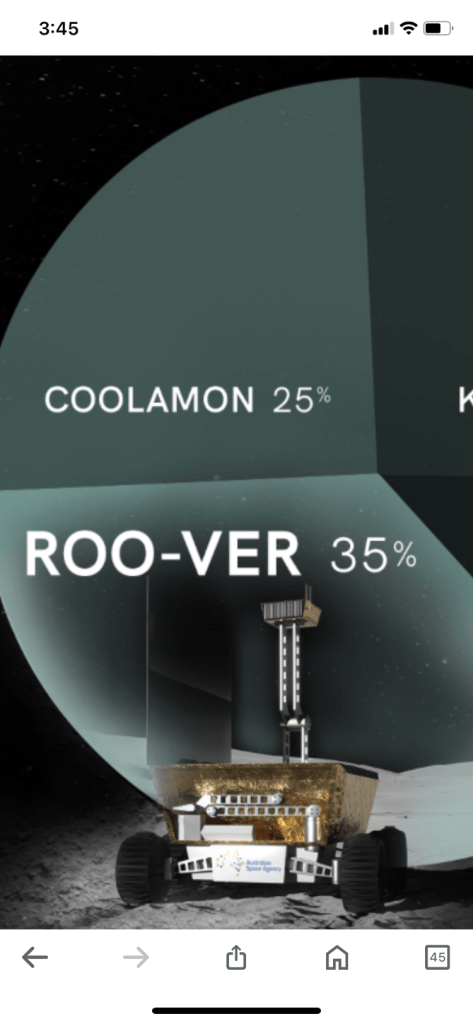
Australia’s first lunar rover will be called “Roo-ver” following a public vote to name the space vehicle. The Australian Space Agency is building a semi-autonomous rover that will launch to the moon as early as 2026 in partnership with NASA and the agency’s Artemis program.
The Australian Space Agency (ASA) has named Australia’s first lunar rover “Roo-ver” after a public vote. The name won 36% of the vote, beating out the other four shortlisted names:
- Coolamon: An Indigenous tool used for gathering
- Kakirra: An Indigenous name for the Moon
- Mateship
The ASA received more than 8,000 submissions and almost 20,000 votes. The name “Roo-ver” was chosen because it incorporates the country’s iconic kangaroo and is instantly recognizable as Australian.
The semi-autonomous rover will travel to the moon as part of a NASA mission as soon as 2026. It will collect lunar soil, called regolith, to deliver to a NASA facility to extract oxygen. Oxygen is critical for rocket fuel and to help sustain any future permanent base on the surface.
Australia’s first moon rover mission is part of NASA’s Artemis program. The rover will be launched as early as 2026.
Australia is working with NASA to design the rover. The rover will be about the size of a check-in suitcase and weigh around 20 kilograms.
Only four countries have operated a rover on the moon:
- The United States
- The Soviet Union
- China
- India
Australia’s rover mission is a significant milestone for the country’s space industry.
The rover will be about the size of a check-in suitcase and weigh about 20 kilograms. It’s expected to land near the lunar south pole.
The rover will spend about 14 Earth days (half of one lunar day) collecting lunar soil. It’s expected to have a top speed of 6 miles per hour.
Two Australian consortiums are working on early-stage rover concepts. The Australian Space Agency will select one to design and develop for the mission.
The rover is expected to land near the moon’s south pole. The Artemis 3 mission is scheduled to land near the south pole in late 2025 or 2026.
The Australian Space Agency (ASA) plans to launch the rover as part of NASA’s Artemis program. The Artemis program is scheduled to launch no earlier than late November 2024. Artemis 3 is planned for 2025, and will be the first crewed lunar landing.
The ASA will select one of two local collaborations to design and develop the rover: AROSE, ELO2.
The rover will be operated remotely from Australia.
Australia played a key role in the first moon landing:
- Tracking: Australian teams tracked and communicated with the lunar module and command module. The Carnarvon tracking station in Western Australia provided the “go/no go” confirmation to send the Apollo spacecraft out of Earth’s orbit.
- Biomedical readings: Australian teams monitored the astronauts’ biomedical readings.
- TV broadcast: Australia broadcast the moonwalk to the world, which was watched by an estimated 650 million people.
Australia had three tracking stations:
Honeysuckle Creek The main NASA tracking station, located near Canberra. This station tracked the command module in lunar orbit.
Tidbinbilla A deep space tracking station. This station tracked the lunar module on the lunar surface.
Parkes A radio telescope located approximately 380km west of Sydney. This station was originally planned to download images of the moonwalk.
Broadcasting the moon landingAustralia also played a crucial role in helping NASA bring TV images of the first Moonwalk to the world. As Neil Armstrong climbed out of the Lunar Module, 3 stations received the signals: Goldstone, in California, Honeysuckle Creek and Parkes radio Telescope, in NSW.(full article source google)
https://14dccknr38owbs7n0nh-ngnid1.hop.clickbank.net Universe discoveries