
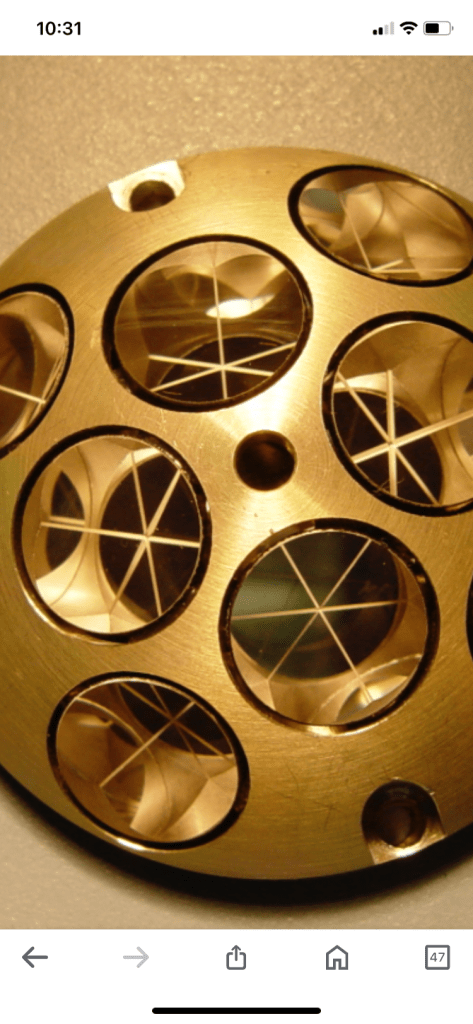
Laser retroreflector arrays make it possible to do laser ranging – using small bursts of laser light to detect distances between objects. Pulses of laser light from a ground station are directed toward an orbiting satellite, which then reflect off the array and return to the station
NASA and other federal agencies are using laser retroreflector arrays (LRAs)to improve the accuracy of Earth measurements. The LRAs can improve the location accuracy of measurements down to the millimeter.
The primary benefit of LRAs is to improve the geolocation of Earth observations. This can lead to breakthroughs in fields like:
- Weather forecasting
- Climate change monitoring
- Land-use prediction
Some of the agencies working with NASA on this project include:
- U.S. Space Force
- U.S. Space Command
- U.S. Naval Research Laboratory
- National Geospatial-Intelligence Agency
NASA uses laser instruments for climate change in a number of ways:
- GLAS The Geoscience Laser Altimeter System is a lidar instrument that makes atmospheric observations for the ESE climate change program.
- C02 laser A laser that will measure carbon dioxide from space.
- Airborne lasers NASA researchers shoot lasers at the wind to improve climate and weather predictions.
- ICESat-2 The Advanced Topographic Laser Altimeter System (ATLAS) measures changes in ice height.
- GRACE-FO The Laser Ranging Interferometer (LRI) measures intersatellite distance changes.
- Ice, Cloud and land Elevation Satellite-2 The mission measures ice-sheet elevation, sea-ice thickness, and tree-canopy height.
Other NASA satellites that use laser ranging and laser retroreflector arrays include:
- SWOT (Surface Water and Ocean Topography)
- GRACE-FO (Gravity Recovery)
A laser retroreflector array (LRA) is a passive reflector that bounces laser pulses back to their origin. LRAs are used for:
- Calibrating the Precise Orbit Determination system on spacecraft
- Determining the altitude of a satellite within millimeters
- Determining the location of a lander and the distance to the lunar surface
- Serving as permanent fiducial markers for landing sites
LRAs have been used for:
- Laser ranging to Earth-orbiting satellites from ground stations
- Lunar laser ranging from Earth
Large LRAs were placed on the Moon by the Apollo astronauts and the Russian lunar landers.
The Laser Retroreflector Array (LRA) is designed to use reflected laser light from orbiting spacecraft laser (typically a laser altimeter or light detection and ranging – lidar) to precisely determine the location of the lander, as a fiducial marker, and the distance to that point on the lunar surface with respect to(full article source google)
Best telescopes on heavy discount on Amazon
https://14dccknr38owbs7n0nh-ngnid1.hop.clickbank.net Universe discoveries