
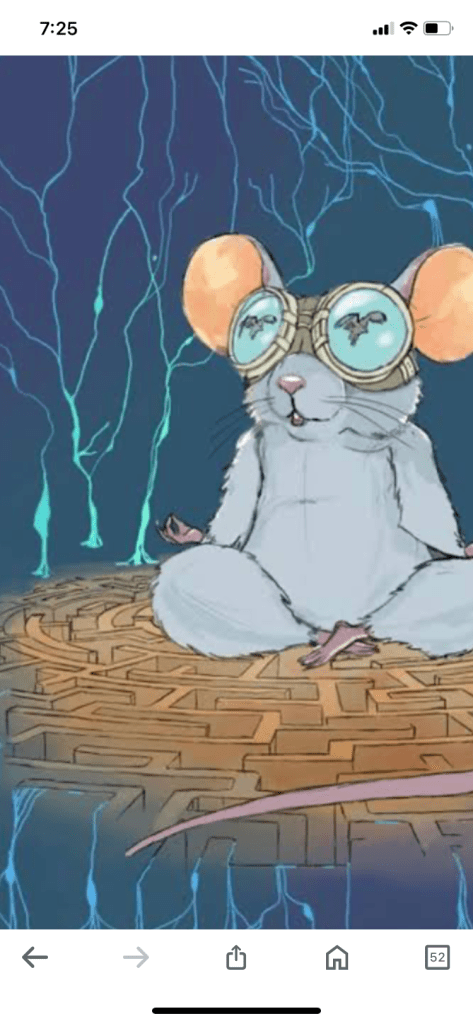
Scientists have developed virtual reality (VR) goggles for mice to study their brain activity and behaviors. The goggles create realistic worlds and immerse the rodents in various scenarios. For example, scientists can project a dark disk at the top of the mice’s field of view to simulate an overhead threat. The mice either froze or ran faster when they noticed the disk
Researchers at Northwestern University developed the VR goggles. They published their results in the journal Neuron.
The goggles allow scientists to study: Behaviors, Brain activity, Memories
Researchers at Northwestern University have developed virtual reality (VR) goggles for mice. The goggles are called Miniature Rodent Stereo Illumination VR (iMRSIV). They have two lenses and two screens, one for each eye, to give the mice a 3D picture. The goggles also provide a 180-degree field of view
The goggles immerse the mice in various scenarios, such as navigating mazes and experiencing predator threats. This allows scientists to study the mice’s brain activity and behaviors in a more realistic way. Scientists believe that the mice will behave more naturally because they are more convinced of the illusion.
The goggles allow researchers to keep the mouse in place on a treadmill. This allows them to use tools to view and map the brain as the mouse moves through a virtual space
VR can have several benefits for animals:
- Animal rehabilitation: VR can provide a safe environment for animals to interact with.
- Emotional benefits: VR can reduce stress in animals.
- Minimize mistreatment: VR can help reduce the mistreatment of animals in captivity.
VR can also be used for animal research:
- Study behaviors: VR can study behaviors and physiology.
- Study spatial cognition: VR can study spatial cognition abilities.
VR can also be used for animal handling training
One of the primary benefits of VR technology for animal rehabilitation is the ability to provide a safe and controlled environment for animals to interact with. In a virtual world, the animal is not exposed to any external risks or dangers and can explore the environment at their own pace.
Virtual reality (VR) has many benefits, including:
- Immersive learning: VR can provide students with immersive learning experiences.
- Increased engagement: VR can increase engagement.
- Focus: VR can help leaders stay focused during training.
- Customizable learning: VR can help students and instructors discover the best ways to make decisions, solve problems, and do their jobs better.
- Safety: VR can help identify and eliminate threats, and increase employee safety.
- Collaborative learning: VR can improve teamwork and social skills.
- Prototyping: VR can help engineers visualize future products, analyze layouts, and diagnose errors.
- Financial sustainability: VR can create a more agile workforce. VR can be used in education, training, and experiential learning(full article source google)
 Universe discoveries