
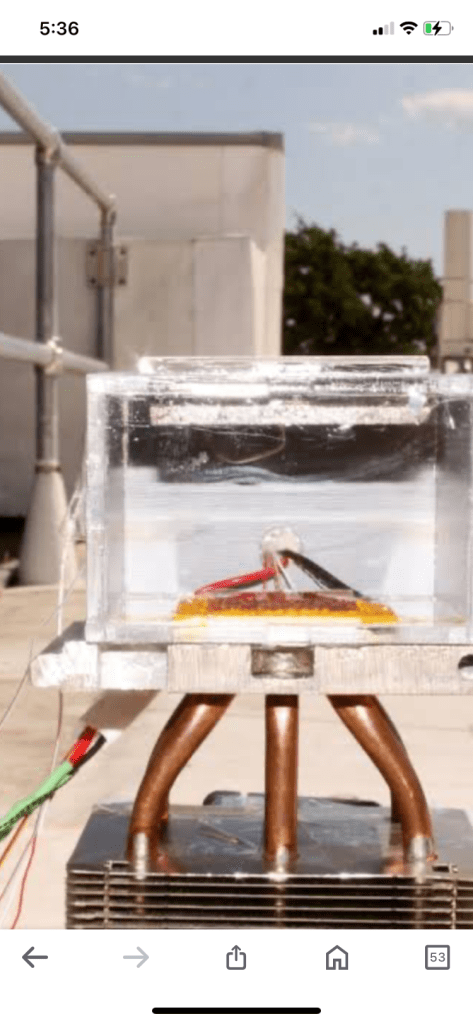
Researchers from Shanghai Jiao Tong University in China developed a promising new solar-powered atmospheric water harvesting technology that could help provide enough drinking water for people to survive in those difficult, dryland areas. They published their work in Applied Physics Reviews, an AIP Publishing journal
Solar-powered technology can extract moisture from the air and turn it into drinking water. This technology could help provide drinking water to people in dry, sunny areas.
Here are some solar-powered technologies that can turn air into water:
- Shanghai Jiao Tong University Researchers at this university in China developed a solar-powered technology that could provide enough drinking water for people in dry areas.
- Northumbria University Scientists at this university in the UK developed a technology that can extract moisture from the air and turn it into clean drinking water.
- Solar2Water This patented system can produce a constant amount of water, regardless of the outside air humidity.
- MIT and the University of Berkeley Scientists at these universities created a device that can retrieve water from atmospheric humidity.
Some ways to extract water from the air include:
- Condensation
- Exposing the air to desiccants
- Using membranes that only pass water vapor
- Collecting fog
- Pressurizing the air
Here’s some more information about extracting water from the air:
- Condensation This method involves changing the air’s pressure or temperature to cause water vapor to stick to a surface. The likelihood of water condensing increases as the air’s temperature and/or pressure increases.
- Desiccants This method involves using desiccants to absorb water molecules in the air.
- Membranes This method involves using membranes that only pass water vapor. Water vapor selective membranes can reduce the energy required to extract water from humid air by more than 50%.
- Dew point This method involves using the dew point, which is the temperature at which air becomes saturated with moisture. At this point, the moisture can condense out of the air.
Water vapor in the air can be extracted either by condensation – cooling the air below its dew point, exposing the air to desiccants, using membranes that only pass water vapor, collecting fog, or pressurizing the air
Researchers from Shanghai Jiao Tong University in China have developed a new solar-powered atmospheric water harvesting technology. The technology could help provide drinking water for people in dryland areas. The researchers published their work in the journal Applied Physics Reviews.
The technology uses a hydrogel to harvest water from the air. The hydrogel can be used in areas with water scarcity.
Other atmospheric water harvesting technologies include:
- Heat exchanger technologies These devices use a fan to draw in air and guide it over cooled plates where water vapor condenses into liquid water.
- MOF-303 This material can harvest 0.7 liters of water per kilogram at 10% RH and 27 °C. The water is drinkable and doesn’t need to be treated.
- Hygroscopic gel This gel can absorb water. In dry conditions, a kilogram of dry gel can absorb 1.18 kilograms of water.
- Fog-harvesting strategy This strategy captures water from wind-driven fog
In a new paper published in Applied Physics Reviews, researchers from China’s Shanghai Jiao Tong University present a solar-powered atmospheric water harvesting technology that can pull enough water out of arid desert air to help provide drinking water to those in difficult, dryland areas
Atmospheric water harvesting can provide several benefits, including:
- Clean water Atmospheric water generators can provide clean water that’s free of chemicals and other toxic substances.
- Emergency water Atmospheric water generators can be used for emergency and medical purposes.
- Water supply resilience Atmospheric water harvesting can enhance water supply resilience for communities and cities.
- Minimal infrastructure Atmospheric water harvesting requires minimal infrastructure, low space requirements, and is easy to install.
- Emergency response Atmospheric water harvesting can provide a rapid emergency response capability.
Atmospheric water harvesting (AWH) faces some challenges:
- Fairness: It’s difficult to compare different AWH technologies.
- Direction: The future direction of AWH is unclear.
- Fog collection: Fog collection is limited to humid areas with near-saturated or super-saturated water vapor.
- Power consumption: Active systems consume a lot of power per kilogram of water collected. This is affected by ambient temperature, humidity, and equipment efficiency
Researchers have developed a solar-powered technology that can harvest water from the air to provide drinking water for people in dryland areas. The technology uses a super hygroscopic gel that can absorb and retain large amounts of water. In arid conditions, one kilogram of dry gel can absorb up to 1.18 kilograms of water.
The gel is made from plant derivatives and hygroscopic salts. Previous attempts to develop similar technology have struggled with injecting salt into hydrogels. The higher salt content can reduce the hydrogel’s swelling capacity, which can lead to leakage and reduced water absorption.
Other technologies that can help provide drinking water in dryland areas include: Rainwater harvesting, Negarim microcatchments, Runoff farming(full article source google)
Best telescopes on heavy discount on Amazon Universe discoveries