
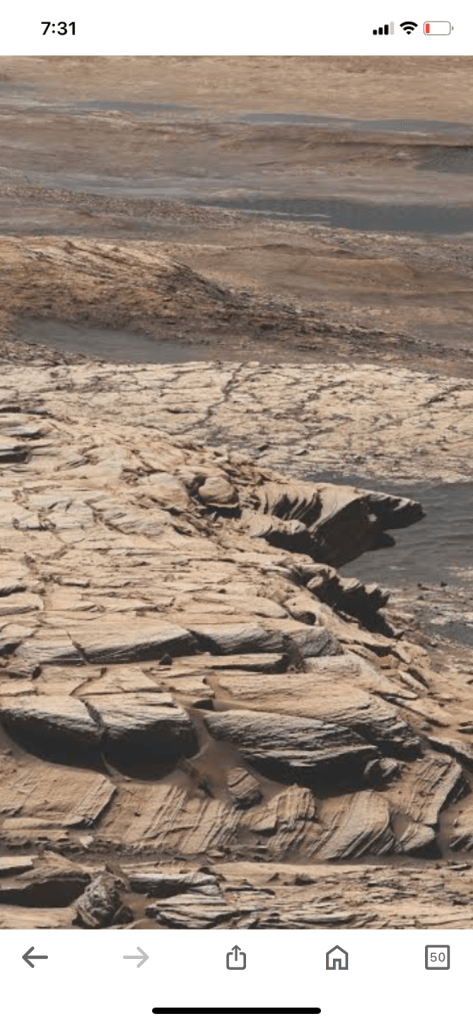
Potential signs of life on Mars might be easier to find than previously thought. Here are some reasons why:
- Water A study found molecules associated with water processes, which suggests that water may have played a role in the diversity of organic matter on Mars.
- Rivers A study by Penn State scientists suggests that Mars may have had flowing rivers in the past.
- Magnetic field A magnetic field that protected Mars from cosmic and solar radiation has been discovered.
- Microbes Many microbes on Earth could find Mars’ atmosphere hospitable.
If life existed on Mars, it might have been in the form of microbial mats. These are collections of bacteria and other microbes that created some of the oldest evidence of life on Earth.
NASA has sent the Rover Perseverance to search for signs of life on Mars.
If life existed on Mars, it’s thought that it might have been in the form of microbial mats. These are collections of bacteria and other microbes that created some of the oldest evidence of life on Earth, so it’s not unreasonable to assume that life on Mars might have taken a similar path.
The search for evidence of habitability, taphonomy (related to fossils), and organic compounds on Mars is now a primary objective for space agencies. The findings of organic compounds inside sedimentary rocks and of boron on Mars are of interest as they are precursors for prebiotic chemistry
Scientists look for signs of habitability to determine if an environment can support life. Some signs of habitability on Mars include:
- Water: Water is critical for habitability. Scientists have found evidence of liquid water on ancient Mars.
- Organic compounds: Organic compounds like amino acids and boron are precursors for prebiotic chemistry.
- Energy sources: Energy is one of the ingredients necessary for life.
Other factors that can influence habitability on Mars include: Nutrients, Radiation, pH, Brines, Porosity.
Mars also has some challenges for human habitation, including:
- Cold temperatures
- Dust storms
- High levels of radiation
- Less gravity than Earth
- Lack of large moons
The ESA’s ExoMars Rover will use multiple strategies to search for life on Mars:
- Drilling: The rover will drill down to determine if evidence of life is buried underground.
- Sampling: The rover will analyze subterranean samples.
- Characterization: The rover will investigate potential habitats.
- Visual examination: The rover will examine outcrops.
- Spectrochemical composition: The rover will perform analyses on selected samples.
The ExoMars Rover will search for two types of life-related signatures: chemical and morphological. It will also determine the geological context.
The rover’s goals include:
- Searching for signs of past life
- Investigating the Martian water and geochemical environment
- Investigating atmospheric trace gases
- Demonstrating technologies for a future Mars sample-return mission
The ExoMars 2022 mission uses a number of Russian-made components, including the rockets. The 2016 launch used a Russian-made Proton-M rocket, the same type planned for the launch in September, 2022.
NASA’s Perseverance rover has several strategies and technologies for searching for life on Mars:
- PIXL A camera mounted on the rover’s robotic arm that can see features as small as a grain of salt
- MOXIE An instrument that converts carbon dioxide in the Martian atmosphere into oxygen
- RIMFAX A ground-penetrating radar that can “see” many meters below the surface
- SuperCam A laser that can vaporize a small amount of a Martian rock into a hot gas called plasma
- Sample tubes 43 tubes, including five “witness tubes” that detect any Earthly contaminants that may seep from the rover
Perseverance’s seven primary science instruments include:
- Mastcam-Z
- Mars Environmental Dynamics Analyzer (MEDA)
- Mars Oxygen ISRU Experiment (MOXIE)
- Planetary Instrument for X-ray Lithochemistry (PIXL)
- Radar Imager for Mars’ Subsurface Experiment (RIMFAX)
Perseverance’s goals include:
- Finding signs of life
- Reconstructing the geological history of Mars
- Seeking preserved signs of biosignatures in rock samples
Sequencing technology could be adapted for extreme applications such as Mars—and beyond—providing the tools needed to study the extra-terrestrial samples. We aim to push the technology even further for when the Mars Sample Return mission returns in 2033
The confirmation that liquid water once flowed on Mars, the existence of nutrients, and the previous discovery of a past magnetic field that protected the planet from cosmic and solar radiation, together strongly suggest that Mars could have had the environmental factors to support life
Scientists expect signs of life on Mars because the planet had the ingredients for life, including:
- Water
- Organic compounds
- Essential elements and minerals
- Energy sources
- A thick atmosphere
Mars is similar to early Earth, which makes it a good place to study the origins of life. It has a cold climate and no plate tectonics or continental drift, so it has remained almost unchanged since the end of the Hesperian period.
Some scientists believe that life on Mars may have been more likely than on Earth. They found substances and minerals that only form in the presence of water. They also found carbonate minerals that may have formed when water and the atmosphere chemically reacted.
However, scientists haven’t found any definitive signs of life on Mars. They’ve only studied small parts of the planet’s surface in detail.
NASA is looking for life on Mars for several reasons:
- Learn about Earth’s past and future
- Understand climate shifts
- Prepare for human exploration
- Understand the planet’s evolution
- Learn about the building blocks of life
NASA is searching for evidence of life in areas where liquid water was once stable. They are also looking for evidence below the surface, where water might still exist today.
The Perseverance rover’s mission includes searching for biosignatures. A rock sample from Jezero Crater on Mars could hold secrets about ancient microbial life.
Life on Mars would be challenging. The planet is very cold, with temperatures reaching -225°F (-153°C). It also has dust storms, high levels of radiation, and less gravity than Earth. The thin atmosphere can’t block ultraviolet radiation from space, which would harm any living thing on the surface.
Some other challenges include:
- Food: Martian soil is not as good for growing crops as Earth’s soil.
- Water: Water would need to be processed.
- Habitats: Humans would need to live in artificial habitats with complex life-support systems.
However, some scientists believe that Mars could be a better candidate for long-term settlement than Earth’s moon.
(Full article source google)
https://130ealik57-6kr9kngv7ujukpe.hop.clickbank.net Universe discoveries