
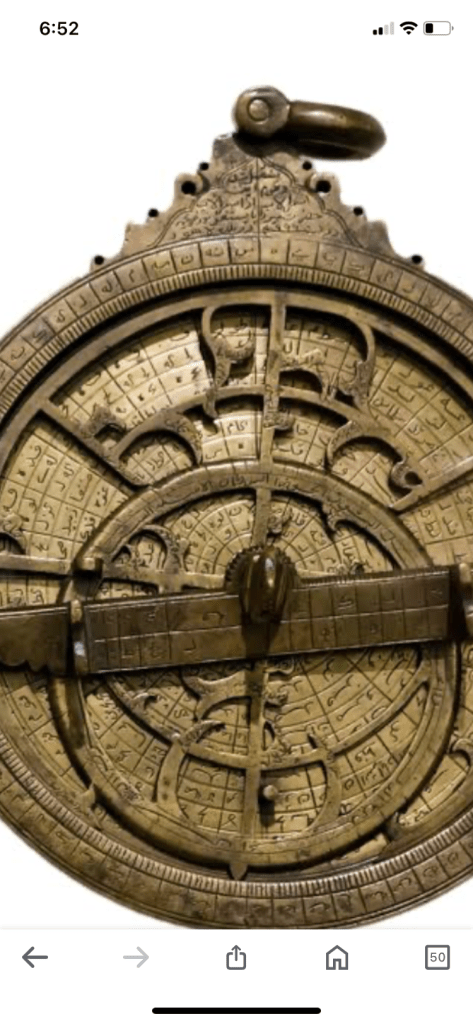
The positions of stars on an ancient navigation device can indicate when it was made.
The astrolabe is an ancient navigational instrument that can be traced back to the 6th century CE. It was used for many purposes, including:
- Determining the time
- Determining the length of day and night
- Simulating the movement of heavenly bodies
- Surveying
- Astrology
The astrolabe was also used to find a ship’s latitude.
Other ancient navigation devices include:
- Mariner’s astrolabe: Developed in the late 15th century and used in the 16th and 17th centuries
- Quadrant: A simple instrument that used a plumb bob
- Pivoted, magnetized needle and a card showing wind directions in a glass-covered box: Created in Europe
People also used tools to navigate by measuring angles between the stars and the horizon. The North Star, also known as Polaris, was a guiding star for ancient people.
The Positions of Stars on an Ancient Navigation Device Tell us When it was Made. Astrolabes serve two purposes. First, they are useful as an astronomical tool, especially for finding a ship’s latitude. But second, they are works of art in themselves
The exact inventor of the astrolabe is unknown. However, some historians credit the Greek Hipparchus of Nicea with inventing some form of the astrolabe in the 2nd century BCE. Others believe that Apollonius of Perga invented the astrolabe in the Hellenistic civilization between 220 and 150 BC.
The astrolabe was developed by Islamic astronomers and spread to Europe. The earliest surviving astrolabe was made by the astronomer Nastulus in 927/8. The first Islamic astronomer to build an astrolabe was Muhammad al-Fazari in the late 8th century
The astrolabe was used in many countries, including:
- The Arab world
- The Byzantine Empire
- India
- Europe
- Persia (Iran):
The astrolabe was used for navigation and astronomical measurements. It was also used to find the qibla, the direction of Mecca.
The astrolabe was used by many European explorers, including:
- Columbus
- Magellan
- Bartolomeu Dias
- Vasco da Gama
The astrolabe was popular until the 18th century.
Here are some other explorers who used the astrolabe:
Christopher Columbus Carried an astrolabe and quadrant on his 1492 transatlantic voyage. He also tried to use the astrolabe and quadrant to determine the altitude of Polaris on his return voyage in 1493.
Bartolomeu Dias Used an astrolabe to calculate the latitude of the Cape of Good Hope in 1488. He was the first European explorer to use the astrolabe to sail around Africa to Asia.
Vasco da Gama Used an astrolabe on his second voyage to India in 1502-1503. The oldest known astrolabe was part of his voyage.
The astrolabe was also used by Portuguese sailors on a voyage down the west coast of Africa in 1481.
The astrolabe’s accuracy is limited. It can only measure angles in a vertical plane. On land, it can only reach an accuracy of a quarter of a degree. On a ship, it’s less reliable in rough seas.
Here are some other limitations of the astrolabe:
- Scale: The scale varies with distance from the pole, expanding rapidly beyond the equator.
- Distance: Astrolabes are limited in their ability to measure vast distances in space.
- Atmospheric interference: Astrolabes can be affected by atmospheric interference.
The astrolabe was mainly used to obtain local solar time. It was also used to find the direction of Mecca and accurately determine the correct time for prayer.
Astrolabes are still used today for learning ancient astronomy. They can also be used for: Timekeeping, Surveying, Geography, Astronomy, Navigation.
Astrolabes can also be used to illustrate the celestial mechanism and the apparent movement of the stars.
Astrolabes were replaced by quadrants, which have since been replaced by sextants. Modern techniques like GPS, space science, and navigation equipment are based on astrolabe theories.
The astrolabe is a predecessor to the modern planisphere. The first mechanical astronomical clocks were based on astrolabes.
Here are some modern technologies that are based on astrolabe theories:
- GPS A satellite-based radio navigation system that uses microwave signals to track a device’s position, speed, time, and direction. GPS was originally developed for the military, but is now used by many commercial and government industries.
- Space science Used to design and build spacecraft, rockets, and probes to explore celestial bodies.
- Navigation equipment Includes gyro compasses, radar, magnetic compasses, autopilots, ARPA, automatic tracking aids, speed and distance log devices, and echo sounders.
Other modern technologies include: 5G, Advanced satellite systems, 3D printing, Big data, Quantum computing.

The astrolabe influenced the development of astronomy and new mathematical methods. It also helped traders situate themselves in their environment.
The astrolabe’s technical term is “inclinometer”. It measures the inclined position of celestial objects like the sun, moon, planets, or stars. This information can be used to determine latitude, time, and other data.
The astrolabe also influenced the development of mechanical astronomical clocks. These clocks could display the current position of the sun, stars, and planets.
Here are some more facts about astrolabes:
- Technical term: The technical term for an astrolabe is “inclinometer”.
- Components: An astrolabe is made up of a circular disc with graduations and a movable sighting device.
- Other uses: Astrolabes can also be used to:
- Identify stars and planets
- Survey
- Triangulate
- Measure the heights of buildings
- Determine the direction of Mecca
- Calculate the distance to be traveled
(Full article source google)
https://130ealik57-6kr9kngv7ujukpe.hop.clickbank.net Universe discoveries