
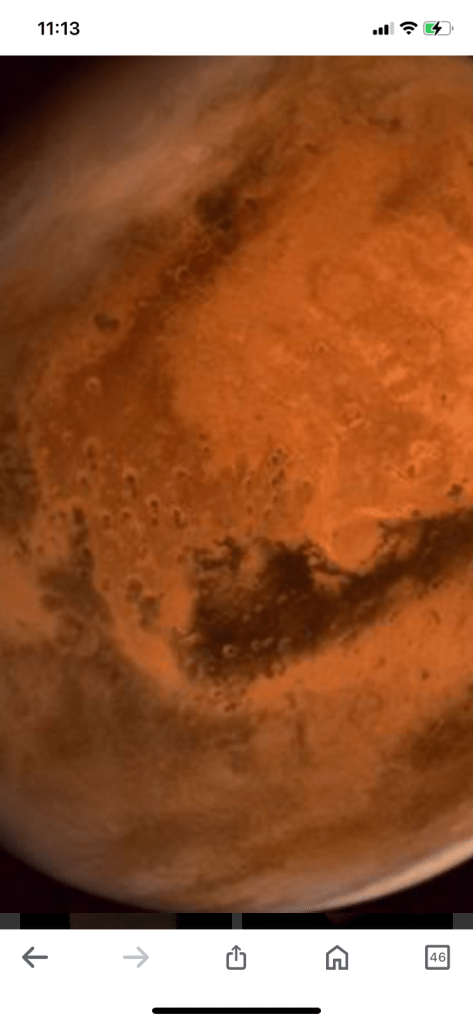
The emptied storm reached Mars on Dec. 25, 2022, giving scientists a thrilling front-row seat to watch the planet’s atmosphere balloon out, the way it might have been if it were circling a less ‘windy’ star. “This was a Christmas present for us,” said Halekas, who is leading a new study reporting this event
On December 25, 2022, scientists observed Mars’ atmosphere swell as a result of a decrease in solar wind. The MAVEN spacecraft detected a significant drop in solar wind intensity on December 26, 2022, which led to the expansion of the Martian atmosphere
The solar wind swept up Mars’ atmosphere, leaving a sparse region. The atmosphere on the sun-facing side of Mars swelled to almost four times its usual size. The Red Planet’s magnetosphere and ionosphere also swelled to three times their normal size.
The solar wind can eject atmospheric particles from a planet by imparting excess kinetic energy
Scientists believe that Mars lost its global magnetic field about 4 billion years ago, which led to the stripping of much of its atmosphere by the solar wind.
The leading theory is that Mars’ light gravity, coupled with its lack of global magnetic field, left the atmosphere vulnerable to pressure from the solar wind.
Scientists attribute this to Mars’ lower mass and density (compared to Earth) which resulted in its interior cooling more rapidly.
The solar wind stripped away most of the Martian atmosphere in only a few hundred million years after the planet lost its magnetic field. This process was quick because the Sun rotated much faster in its youth, which made the solar wind more energetic
To make Mars habitable, it needs to be warmed up and have a thick atmosphere. A thick, warm atmosphere would allow liquid water to exist, which could lead to life.
Here are some ideas for making Mars habitable:
- Release chemicals into the atmosphere: This could trap the sun’s heat and trigger a greenhouse effect. This could make Mars suitable for plants or bacteria that can turn carbon dioxide into oxygen.
- Build giant orbital mirrors: These mirrors could focus sunlight on the poles, melting dry ice and thickening the atmosphere.
- Introduce cyanobacteria: This bacteria could convert carbon dioxide into oxygen.
A habitable planet needs to have an average surface temperature of 0–30 °C, and liquid water on the surface. Mars’ average surface temperature is -60 °C.
According to Metafact, it’s possible to create a viable atmosphere on Mars that could support Earth-like life. However, the terraforming process could take thousands of years, and the entire surface of Mars might not have similar climatic features as Earth.
Mars’ atmosphere is mainly made of carbon dioxide, with only 0.13% oxygen. The atmospheric pressure at the surface is over 100 times less than Earth’s. Humans can’t breathe Martian air.
However, NASA’s Perseverance rover has produced breathable oxygen on Mars. The rover’s toaster-sized MOXIE instrument has been making oxygen from the planet’s atmosphere since April 2021. The oxygen is over 98% pure and can be used for astronauts to breathe or as fuel for future astronauts to get back to Earth.
According to NASA, Mars may have been Earth-like billions of years ago, with a thicker atmosphere and liquid water oceans. Some evidence suggests that Mars may have even had a shallow ocean in the north
However, solar radiation and other cosmic forces may have destroyed Mars’ atmosphere. Mars’ geologic activity also subsided, causing it to lose water and become drier.
According to PBS, terraforming Mars could take anywhere from 50 years to 100 million years. Some say the surface of Mars could one day look like Earth, while others say it could resemble a massive metropolis.
According to NASA, Mars and Earth formed from the same materials and looked very similar when the solar system settled into its current layout over four billion years ago. Both are terrestrial planets, with a central core, a rocky mantle, and a solid crust
Scientists claim that Mars was a wet planet with liquid water pooled in deep craters, and rivers that snaked through its jagged terrain several billions of years ago. The Red Planet is believed to have a thick atmosphere with mountaintops that pierce the sky that is unlike any mountain on Earth.
According to NASA’s Conceptual Image Lab, billions of years ago when the Red Planet was young, it appears to have had a thick atmosphere that was warm enough to support oceans of liquid water.
Planetary scientists see evidence of water all over the red planet, but a new study of meteorites suggests that Mars was once a blue planet, like Earth, covered in water as deep as 1,000 feet/300m.
(Full article source google)
 Universe discoveries