
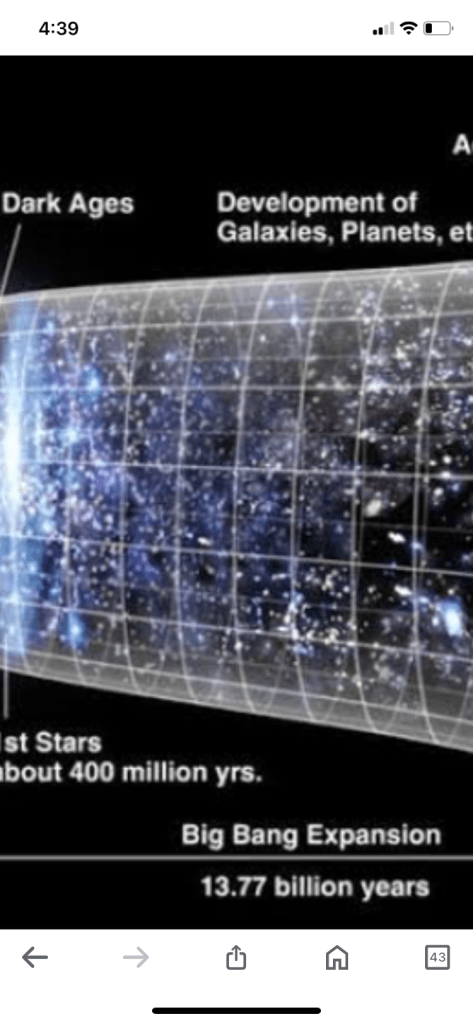
In the prevailing theory of the origins of the Universe, both familiar matter and dark matter were created at the same time, less than a second after the Universe began. Effectively, it is thought that a series of steps converted the energy that governed inflation into matter and dark matter
A new paper titled “Dark Matter and Gravity Waves from a Dark Big Bang” proposes that the universe began with two Big Bangs. The paper is available in the preprint server arXiv
The paper suggests that the first Big Bang created ordinary matter and the second created dark matter. The paper also proposes that the two Big Bangs originated from different forms of energy.
The paper challenges some of the assumptions and predictions of the standard cosmological model. It also opens up new possibilities for understanding the Dark Sector of the universe.
The paper could also explain why non-gravitational interactions between dark matter and normal matter have never been observed.
Some theories suggest that the universe has gone through multiple Big Bangs.
The standard Big Bang theory states that the universe began with a single massive explosion. However, a new theory suggests that the Big Bang is a cyclic event that consists of repeating Big Bangs
The Big Bounce is a theory that suggests that the Big Bang may have happened before, and may happen again.
Some research suggests that dark energy could cause the universe to go through multiple Big Bangs.
Sir Roger Penrose, a 2020 Nobel Prize winner in physics, believes that the universe goes through cycles of death and rebirth. He believes that there have been multiple Big Bangs and that more will happen.
The Big Bounce theory suggests that the Big Bang may have happened before, and may happen again.
Some cosmologists believe that a previous, cold dark empty universe like the one which lies in our far future could have been the source of our very own Big Bang.
Scientists have also proposed a way that the universe could stop expanding, ending in a “Big Crunch” that resets space and time as we know it.
According to arXiv, dark matter and dark radiation may have formed after the Big Bang in a second Big Bang called the “Dark Big Bang”. The Dark Big Bang would have created gravitational waves that would still be affecting the universe today
The Dark Big Bang produces gravitational radiation through the collision of true-vacuum bubbles during the phase transition. These gravitational waves are strong and have a unique signature that could be detected by pulsar timing arrays.
Dark matter is difficult to detect directly or indirectly. However, the Dark Big Bang may have left signatures in the small-scale structure of the universe
Scientists believe that dark matter could generate gravitational waves strong enough for equipment like LIGO to detect
Dark matter has ordinary gravitational properties, meaning it attracts other matter and itself. This gravitational pull can bend light from distant galaxies, making their images appear distorted when they reach our telescopes.
Gravitational waves are waves in spacetime itself, and they interact with both visible and dark matter in the same way.
The strongest gravitational waves are produced by cataclysmic events like colliding black holes, supernovae, and colliding neutron stars. Only cataclysmic events involving the heaviest objects can create gravitational waves big enough to be detected on Earth
A paper titled “Two Big Bangs, One Universe” challenges some of the assumptions and predictions of the standard cosmological model. The paper proposes that the initial singularity was a quantum fluctuation that produced both ordinary and dark matter. It also proposes that the initial conditions of the Big Bang were determined by the properties of the dark matter particles.
The standard cosmological model, also called the “Concordance Cosmological Model” or the “ΛCDM Model”, assumes that the universe was created in the “Big Bang” from pure energy. It also assumes that the universe is composed of about 5% ordinary matter, 27% dark matter, and 68% dark energy.
The cosmological principle is a fundamental principle and assumption of cosmology. It states that, on a large scale, the universe is both homogenous and isotropic. This means that all matter in the universe is uniformly distributed and all forces throughout the universe are behaving in the same manner
Here are some additional assumptions of the standard cosmological model:
- The laws of physics are universal and don’t change with time or location in space.
- The universe is homogenous, or roughly the same in every direction.
- Humans do not observe the universe from a privileged location such as its very center.
- The Universe has a component of its energy density driven by the cosmological constant, Λ.
- Dark matter is cold dark matter (CDM).
The standard cosmological model also assumes that the universe began with the Big Bang, went through a period of near-exponential inflation at early times, and has expanded ever since
The “Big Bang” is the term given to what is currently the most widely accepted scientific model for the origin and evolution of the Universe
(Full article source google)
https://32090flsz-xrgqkrk9ejk1utzg.hop.clickbank.net Universe discoveries