
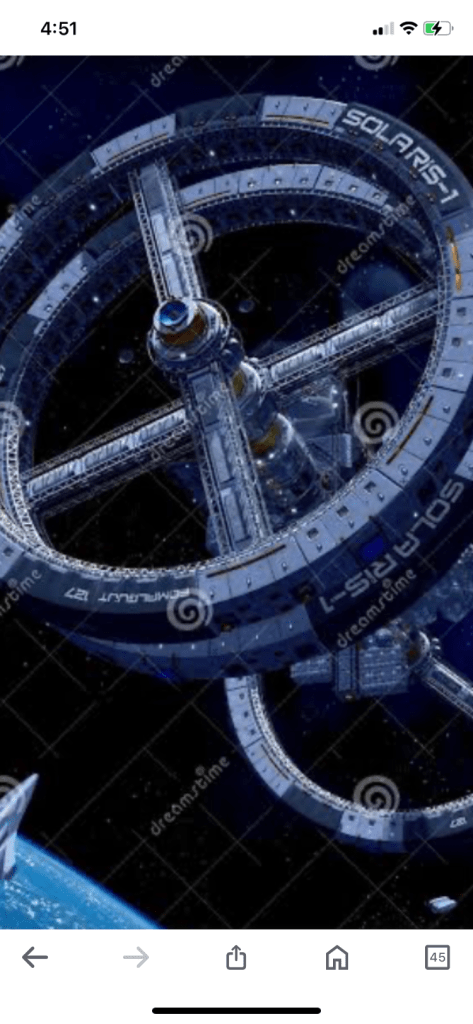
Jeff Bezos believes that humans will live in massive space stations before settling on other planets. He believes that humans will use resources from planets and the moon to support life on space colonies. These space colonies would resemble the cylindrical space stations envisioned by the late physicist Gerard Kitchen O’Neill
Bezos believes that space colonization is a way to preserve the planet. He says that humans will be able to travel back and forth between space stations and Earth. He also believes that the solar system has enough resources to support a large civilization.
Bezos is the founder and former CEO of Amazon. He stepped down as CEO two years ago to focus on his space exploration and aeronautics venture, Blue Origin
I would love to see a trillion humans living in the solar system. If we had a trillion humans, we would have, at any given time, 1,000 Mozarts and 1,000 Einsteins,” he said. “The only way to get to that vision is with giant space stations. The planetary surfaces are just way too small
During the podcast, Bezos told Fridman that humans could choose to go back and forth between space stations and Earth in the distant future. According to Bezos, space colonisation ultimately means to preserve the planet. “We’ve sent robotic probes to all the planets,” he said. “We know that this is the good one
Jeff Bezos believes that space colonization is a way to preserve the planet and ensure humanity’s survival. He views space colonization as “planetary insurance
Bezos has been talking about building space colonies since his high school graduation speech in 1982. He believes that space colonies are a better option than trying to restart life on another planet
Bezos envisions space colonies that resemble cylindrical space stations, which he says have many advantages over planetary surfaces. He says that humans will take resources from planets or the moon to support life on space colonies.
Bezos also believes that most people would still want to live in the vicinity of Earth. He speculates that people may one day go to space colonies on vacation, as people do to Yellowstone National Park today
A primary argument for space colonization is the long-term survival of human civilization and terrestrial life. By developing alternative locations off Earth, the planet’s species, including humans, could live on in the event of natural or human-made disasters on our own planet
Space colonization can also provide Earth with the equivalent of the New World that Columbus “discovered” in the 15th century. Space colonies can supply clean energy and colonists can raise enough food for themselves on only 63 ha (156 acres) with the help of abundant natural sunshine and controlled agriculture
Some other reasons for space colonization include:
- Economic development Colonizing the moon could provide raw materials for space-based construction facilities. Colonizing other planets could also provide access to new resources that could help expand human society.
- Population growth As the human population grows, it becomes more important to find new sources of resources and living space. Colonizing other planets could help reduce the pressure on Earth’s resources.
- Scientific research Colonizing other planets could provide opportunities for humans to conduct more in-depth research than uncrewed rovers.
- New perspectives Space exploration can provide new perspectives for studying Earth and the solar system.
- Inspiration Space exploration can inspire a new generation of artists, thinkers, tinkerers, engineers, and scientists.
Some other advantages of space colonization include:
- Technological advancements: Space colonization could lead to advances in 3D printing, low-gravity manufacturing, and alternative fuel production.
- New land: Space settlements could allow humans to build new land, rather than taking it from others.
- Lower fuel costs: A lunar settlement could allow for greater payloads to be placed into space for lower fuel costs. This could also allow for greater range, which is necessary for interplanetary expeditions.
- Enhanced food production: Space colonization could lead to enhanced food production techniques.
- Pollution and waste purification: Space colonization could lead to pollution and waste purification techniques.
- Disease amelioration: Space colonization could lead to disease amelioration techniques.
- Techniques to protect Earth: Space colonization could lead to techniques to help protect Earth.
(Full article source google )
https://7ff90dejbv1461ih4mkz-8gffo.hop.clickbank.net Universe discoveries