
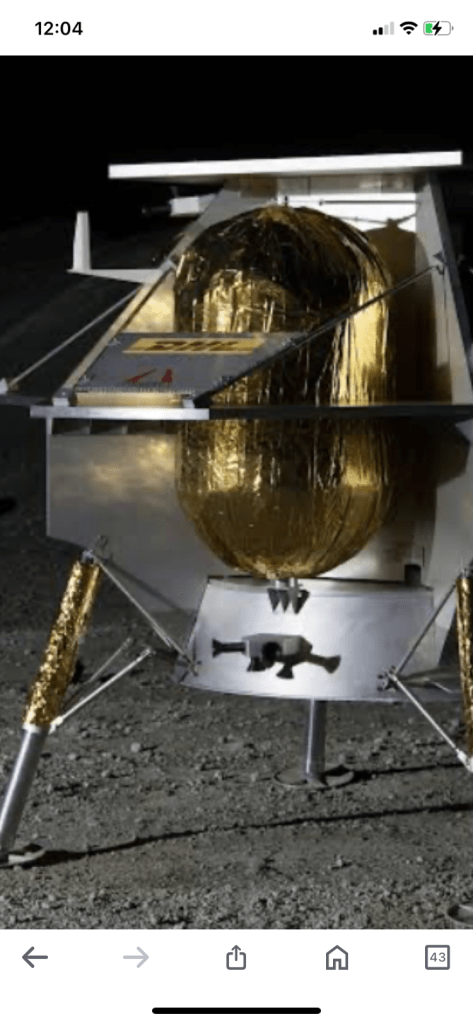
NASA’s Commercial Lunar Payload Services (CLPS) program is working with American companies to deliver science and technology to the moon. The program’s goals include scouting for resources, testing concepts, and performing lunar science.
NASA is helping to establish a commercial lunar economy for the first time. The delivery services will expand exploration capabilities and increase the amount of science that can be achieved.
NASA is working with several companies to deliver payloads for NASA. Future CLPS deliveries could include science experiments and technology demonstrations that support the Artemis program.
NASA’s Artemis 1 uncrewed moon mission launched from NASA’s Kennedy Space Center in Florida on November 16, 2022. The next moon rocket ride for astronauts is in testing for a new mission that could launch in late 2024.
A commercial lunar lander is a spacecraft that can autonomously land on the moon and carry payloads to different places. NASA’s CLPS program contracts transportation services to send robotic landers and rovers to the moon’s south polar region
As of 2023, the Apollo Lunar Module is the only lunar lander to have been used in human spaceflight. The Apollo Lunar Module was a two-stage vehicle that could transport two astronauts from lunar orbit to the lunar surface and back.
In the 21st century, there have been four successful lunar landings: China’s Chang’e-3, -4, and -5 missions, and India’s Chandrayaan-3.
NASA’s Commercial Lunar Payload Services (CLPS) program is intended to establish a commercial lunar landing services sector that provides affordable, frequent, and rapid access to the lunar surface.
The program’s goal is to enable commercial companies to build spacecraft that can autonomously land on the moon and carry NASA’s science and technology payloads to different places. The program uses fixed-price contracts to buy end-to-end payload services between Earth and the lunar surface.
The first lander of the CLPS initiative is Nova-C, which is planned to launch on a Falcon 9 rocket for its first robotic landing on the moon in the first quarter of 2022.
According to NASA, the following CLPS lunar lander launches are scheduled:
- Peregrine Mission 1: January 8, 2024
- Intuitive Machines 1: January 12, 2024
The Peregrine Mission 1 is scheduled to launch on December 24, 2023, and will be the first CLPS mission. The lander will be delivered to Sinus Viscositatis, which is located at the northeast border of the Moon’s Ocean of Storms.
The Artemis program aims to return astronauts to the moon for the first time since 1972. The Artemis 2 crewed mission is scheduled to launch in 2024, and the Artemis 3 crewed lunar landing is scheduled for 2025.
NASA has been helping to establish a commercial lunar economy through its Artemis missions. The Artemis program will enable commercial opportunities on the lunar surface, beginning with the first U.S. commercial lunar deliveries next year
NASA’s strategy stimulates the commercial space industry, which drives new ideas, brings down costs, and grows the business. NASA’s influence began with the lander’s design, which is based on the Morpheus lander, a test vehicle the company’s core team of engineers worked on during their time at Johnson.
NASA’s Artemis missions enable a growing lunar economy by fueling new industries, supporting job growth, and furthering the demand for a skilled workforce.
NASA’s Artemis I mission showed companies looking to do business on and around the Moon that they would likely have a major customer there in the coming years. NASA plans to send people to the lunar surface by 2025 and eventually create a “sustained” lunar presence
NASA’s lunar exploration objectives include:
- Scientific discovery NASA wants to learn more about the Moon, the solar system, the universe, and the deep space environment.
- Technology advancement NASA wants to learn how to live and work on another world.
- Human missions NASA wants to demonstrate technologies and operations for living and working on a planetary surface other than Earth.
- Data gathering NASA wants to gather data to characterize the effects of the Moon, Mars, deep space, and the operational environment on astronauts and biological systems.
- In-space testing NASA wants to conduct in-space testing of every possible hardware, software, and operational system required for Artemis III prior to the mission in 2024.
NASA’s Artemis missions are a key step in realizing NASA’s Moon to Mars Architecture and Objectives.
NASA’s Moon to Mars objectives include:
- Science: Conduct science on the Moon, in cislunar space, and around and on Mars using integrated human and robotic methods and advanced techniques.
- Transportation and habitation
- Lunar and Martian infrastructure
- Operations
NASA’s Moon to Mars Program Office oversees the development of the Space Launch System rocket, Orion spacecraft, supporting ground systems, human landing systems, spacesuits, and Gateway
NASA’s Moon to Mars endeavor lays the foundation for the long-term vision of creating a blueprint for sustained human presence and exploration throughout the solar system. The Moon to Mars architecture serves as a stepping stone for future missions to get humans on the surface of Mars
NASA wants to go to the Moon before Mars for several reasons:
- Proximity The Moon is much closer to Earth than Mars, so it’s faster to get to and from the Moon. A crewed mission to the Moon takes three days, while a mission to Mars takes at least seven months. Cost It’s cheaper to stage missions to Mars from the Moon than from Earth. Science NASA wants to learn more about the Moon and how to prepare for a multi-year round trip to Mars. Technology The Moon will provide a testing ground for technologies and resources that will take humans to Mars and beyond. Confidence NASA wants to build confidence in our ability to survive on Mars by first surviving on the Moon. Radiation Deep space radiation is more intense and poses a real threat to health. On the Moon, astronauts don’t have to worry about surviving a plunge through an atmosphere. Gravity The tug of gravity is weaker on the lunar surface than on Mars. Temperature The Moon is extremely cold, and a single day there lasts nearly an Earth month.
We want to stay on the lunar surface and learn on the lunar surface so that we can get the most science and know how we’re going to go to Mars,” said Jim Free, associate administrator for NASA’s Exploration Systems Development Mission Directorate. “On Apollo, we did incredible science at the equator
(Full article source google)
https://7ff90dejbv1461ih4mkz-8gffo.hop.clickbank.net Universe discoveries