
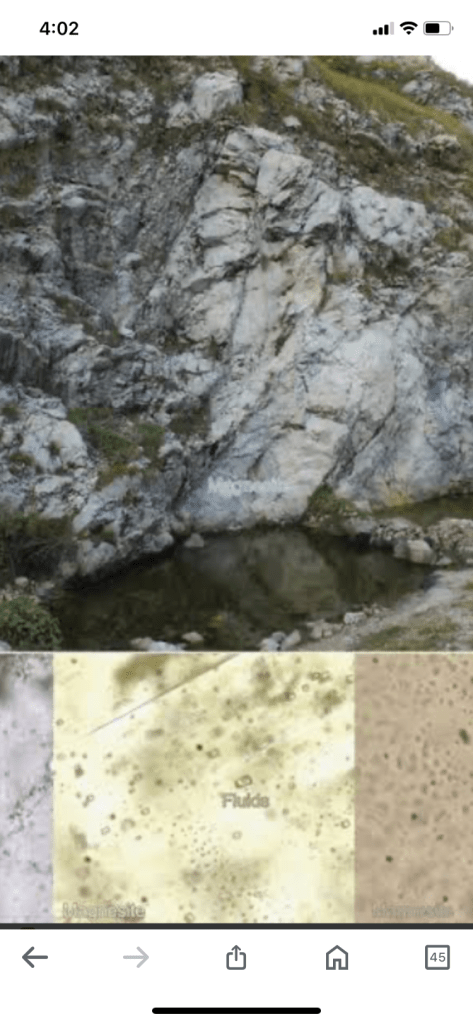
A team of researchers from India and Japan have found water droplets trapped in mineral deposits in the Kumaon mountains in the Indian state of Uttarakhand that were likely left from an ancient ocean dating back some 600 million years.
In July 2023, scientists from India and Japan discovered 600 million year old ocean water in the Himalayas. The water droplets were found in mineral deposits in the Kumaon mountains in the Indian state of Uttarakhand.

The discovery provides the first direct evidence of a gigantic ocean that existed before the Tethys Sea. The researchers believe the deposits can provide information about ancient oceanic conditions, such as pH, chemistry, and isotopic composition. This information could also provide clues about the Earth’s past climate, which can be useful for climate modeling.
The Tethys Ocean, also known as the Tethys Sea or the Neo-Tethys, was a prehistoric ocean that existed from 250–50 million years ago. It was located between the ancient continents of Gondwana and Laurasia, and was oriented east–west.
The Tethys Ocean no longer exists. As tectonic plates shifted, the ocean’s size continuously shrank. Subduction zones and volcanic activity also created more land, lowering the ocean’s area.
Ancient oceans, also known as paleo-oceans, are important for understanding the Earth’s past and the evolution of life. These bodies of water existed hundreds of millions to billions of years ago and played a key role in shaping the Earth’s climate, geological features, and biological diversity.
The Pacific Ocean is the oldest ocean on Earth, with the oldest parts of its floor dating back around 180 million years. However, the Pacific Ocean is actually much older than that, as it developed from the center of Panthalassa, an ancient ocean that began forming around 750 million years ago.
The Pacific Ocean is also the largest and deepest ocean in the world, with an average depth of 4,280 meters (14,040 ft). The Challenger Deep in the Mariana Trench, east of the Philippines, is the deepest known spot on Earth, at 11,034 meters (36,201 ft) below sea level.
The world’s oceans are constantly changing in size as tectonics makes the Earth’s crust slowly move around.
The Southern Ocean, also known as the Antarctic Ocean, is the newest ocean on Earth. It was recognized as a distinct body of water in the 2000s. On June 8, 2021, National Geographic named the Southern Ocean the world’s fifth ocean.
The Southern Ocean is the fourth-largest ocean in the world, after the Pacific, Atlantic, and Indian Oceans. It stretches over 8 million square miles and is the coldest ocean on Earth.
The U.S. Board on Geographic Names recognizes the Southern Ocean as the body of water extending from the coast of Antarctica to the line of latitude at 60 degrees South
Historically, there are four named oceans: the Atlantic, Pacific, Indian, and Arctic. However, most countries – including the United States – now recognize the Southern (Antarctic) as the fifth ocean. The Pacific, Atlantic, and Indian are the most commonly known. The Southern Ocean is the ‘newest’ named ocean
Ancient ocean deposits can provide insights into the evolution of oceans and life on Earth. For example, scientists can learn about prehistoric ocean conditions, such as pH levels, chemistry, and isotopic composition.
Scientists are also learning new things about the early days of life on Earth. For example, a submarine expedition could potentially discover evidence of ancient life that is older than anything that has been found on land.
Here are some other potential insights from ancient ocean discoveries:
- Climate change: The impact of ancient ocean water on climate change and how it may have influenced the formation of the Himalayan mountain range
- Tectonic and geologic processes: The geological processes that led to the preservation of this ancient ocean water within the Himalayan rocks
- Oxygenation event: A significant oxygenation event in Earth’s past
Scientists have discovered ancient ocean water trapped in magnesite crystals in the Himalayas. This discovery could provide insights into the evolution of oceans and life on Earth, and could also help with climate modeling.
The ancient ocean deposits could reveal details about prehistoric ocean conditions, such as pH levels, chemistry, and isotopic composition. This knowledge could help answer questions related to the evolution of oceans and, by extension, life on Earth.
The ocean water trapped in magnesite crystals can also provide insights into future climate modeling. Improved understanding of ocean carbon sequestration and other biogeochemical cycles is essential for advanced climate modeling.
(Full article source google)
 Universe discoveries
👏👏👏💯🥰🤗Wonderful
LikeLiked by 1 person
Thanks a lot dear friend 🌹
LikeLiked by 1 person
😊🥰🤗🙏🙏💯💯💯My pleasure my friend
LikeLiked by 1 person
🌹
LikeLiked by 1 person
😊🥰🤗
LikeLike