
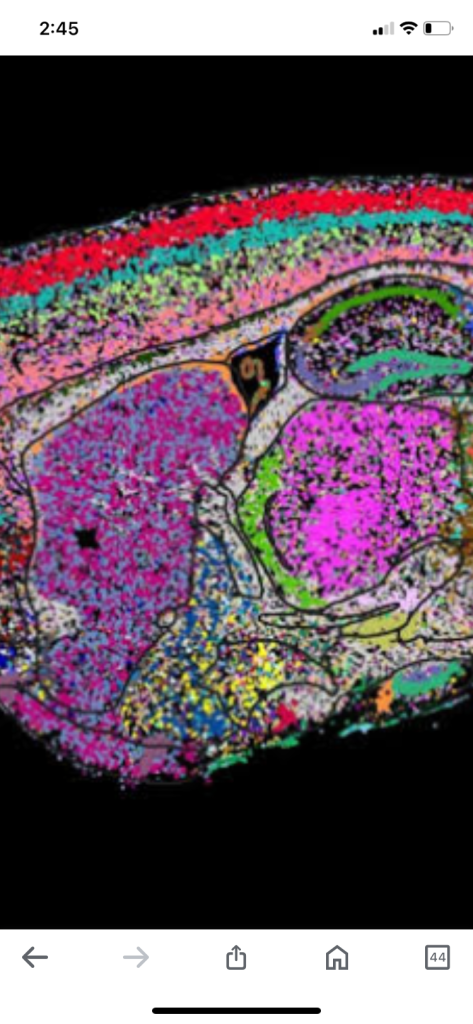
Researchers achieved a groundbreaking feat by creating the first complete cell atlas of a mammalian brain, specifically a mouse. This comprehensive map details over 32 million cells, their types, locations, molecular information, and connectivity
According to scitechdaily.com, a groundbreaking cell atlas mapping the entire mouse brain is a neuroscience milestone. The map details over 32 million cells, their types, locations, molecular information, and connectivity.
The map is expected to help researchers understand the human brain and develop precision therapies for brain disorders. According to today.ucsd.edu, the researchers found that many of the genetic programs that determine cell type were in parts of the genome that have already been implicated in human diseases.
The map gives researchers access to the location, function, and pathways between cell types and cell groups in a way that was previously unimaginable.
Researchers have created the first complete cell atlas of a mammalian brain, specifically a mouse. The Mouse Whole Brain Atlas is a high-resolution map that integrates several whole-brain single-cell RNA-sequencing (scRNA-seq) datasets. The datasets contain a total of about 4 million cells that pass rigorous quality-control (QC) criteria. The atlas details over 32 million cells, their types, locations, molecular information, and connectivity.
The mouse is the most commonly used vertebrate experimental model in neuroscience research. This cellular map paves the way for a greater understanding of the human brain.
The Mouse Whole Brain Atlas is a high-resolution transcriptomic and spatial cell-type atlas across the entire mouse brain, integrating several whole-brain single-cell RNA-sequencing (scRNA-seq) datasets. The datasets contain a total of ~4 million cells passing rigorous quality-control (QC) criteria.
The cell atlas for the mouse brain is a foundational resource for studying the development, evolution, and function of the mammalian brain. It provides neuroscientists with a unique insight into the cellular composition of the mouse brain
The cell atlas is hierarchically organized into four nested levels of classification: 34 classes, 338 subclasses, 1,201 supertypes, 5,322 clusters.
The cell atlas is registered to the Allen Mouse Brain Common Coordinate Framework (CCF v3). This allows for systematic quantifications of the cell composition and organization in individual brain regions.
The Allen Mouse Brain Atlas is a spatial framework for datasets such as in situ hybridization, cell projection maps, and in vitro cell characterization
The Blue Brain Cell Atlas (BBCAv1) is the first digital 3D cell atlas of the entire mouse brain. It was released in 2018 by the Blue Brain Project.
The BBCAv1 provides information about the major cell types, numbers, and positions in more than 700 regions of the mouse brain. It also includes the densities of neurons, the associated connective tissue cells (glia), and their subtypes for each region.
The BBCAv1 is freely available online and allows users to visualize all 737 brain regions and the cells they contain. Users can also download the region with their numbers and locations
The Blue Brain Project is a Swiss research initiative that aims to create a virtual brain that can continue to function after a person’s death. The project’s goal is to create a program that can upload a human brain to a computer. The machine would then be able to think and make decisions even when the human body is no longer present.
Blue Brain is a technology that is powered by Artificial Neural Networks (ANN). This is one of the advanced applications of Artificial Intelligence to the human brain aiming to address many of the problems that are involved in brain dysfunctions, the human mind and consciousness.
Scientists have developed the first complete cellular map of a mammalian brain. The map includes information on over 32 million cells in the mouse brain, including their types, locations, molecular profiles, and connectivity. The map is a product of the NIH BRAIN Initiative®, and is published in 10 papers in Nature.
The map is a foundational map for understanding human brain functions and developing precision therapies for brain disorders. The mouse is the most commonly used vertebrate experimental model in neuroscience research, and this cellular map paves the way for a greater understanding of the human brain.
(Full article source google)
Best telescopes on discount on Amazon Universe discoveries