
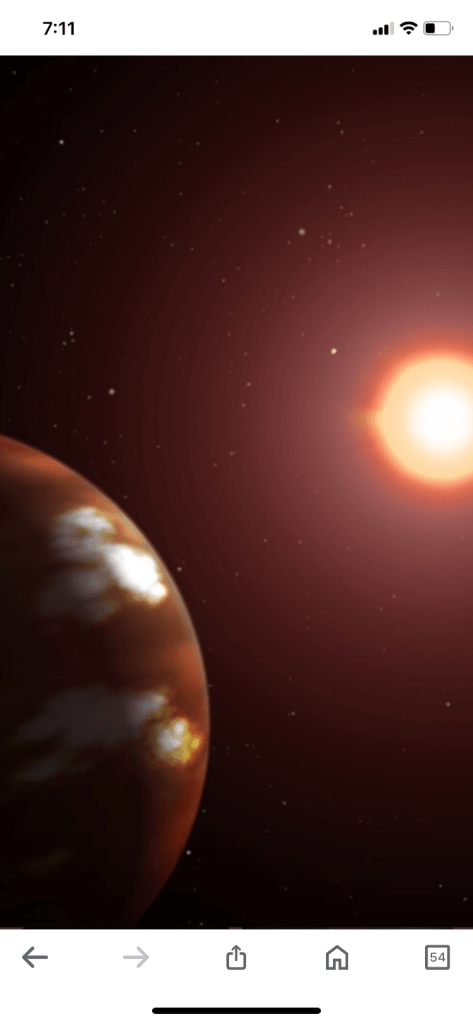
Gliese 436 b is a planet known as the “planet with burning ice”. It’s located 33 light-years from Earth and orbits a red-dwarf star in the constellation Leo. The planet’s temperature is around 526 degrees Celsius, but it’s covered in a strange substance that remains solid despite the high temperatures.
Researchers believe the planet’s immense gravity compresses the water vapor in its atmosphere, keeping it in its solid form. The planet’s density suggests it’s made of water, and researchers think it may be made mostly of an exotic form of water, an “ice” hardened by pressure rather than temperature.
Gliese 436 b was discovered in August 2004 and has an orbital period of 2.6 Earth days. It’s too compact to be made mostly of hydrogen gas, like Jupiter, but may not be compact enough to be a rocky super-Earth
The planet is too compact to be made mostly of hydrogen gas, like Jupiter, but may not be compact enough to be a rocky super-Earth. Researchers think it may be made mostly of an exotic form of water, an “ice” hardened by pressure rather than temperature
Gliese 436 b is about 2.5 million milesaway from its star, Gliese 436. This is about one-fifteenth the average distance between the sun and Mercury. For comparison, Mercury is 35 million miles from the sun.
Here are some other interesting facts about Gliese 436 b:
- First hot Neptune Gliese 436 b was the first hot Neptune to be discovered with certainty in 2007. It was also one of the smallest known transiting planets until the discovery of the Kepler exoplanets around 2010.
- Warm Neptune Gliese 436 b is categorized as a warm Neptune because it’s much closer to its star than Neptune is to the sun.
- Comet-like tail Gliese 436 b’s atmosphere leaves behind a giant trail of hydrogen that’s about 50 times the size of its parent star.
- Orbit Gliese 436 b completes one full orbit around its parent star in just over 2 days.
Gliese 436 b’s surface temperature is estimated to be 712 K (439 °C; 822 °F). However, the planet’s temperature reaches over 980° Fahrenheit
Gliese 436 b is located in the constellation Leo, which is in the Northern celestial hemisphere. The star Gliese 436 is a red dwarf that is too faint to see with the naked eye, but can be seen with a small telescope.
Gliese 436 b was discovered in August 2004 by astronomers R. Paul Butler and Geoffrey Marcy. The two scientists used the radial velocity method, which detects an extraterrestrial body by observing how its gravitational pull makes the parent star appear to shift and bend.
Yes, Gliese 436 b is covered in “burning ice”. The planet’s water turns into “burning ice” when exposed to the same conditions that turn carbon into diamonds.
The ice on Gliese 436 b is different from the ice on Earth. Earth’s ice is solid because of temperature, but Gliese 436 b’s ice is solid because of pressure. The planet’s strong gravitational pull pulls the ice back into a solid form after the heat melts it.
The planet’s atmosphere gives off large amounts of carbon monoxide, which shouldn’t happen at high temperatures without water present. The solid part of the planet is likely made of ice, the crystalline form of water.
Famously known as the planet with burning ice, Gliese 436 b is just 33 light-years away from Earth. The planet takes just two days to complete its orbit around its sun. Because it is so close to its sun, the planet’s temperature is around 526 degrees Celsius
GJ 436 b is a Neptune-sized exoplanet that orbits the red dwarf star Gliese 436. It was discovered in 2004 and is about 33 light-years away from Earth.
Here are some other details about GJ 436 b:
- Mass: 22.1 times that of Earth
- Orbital period: 2.6 Earth days
- Distance from its star: 0.0291 AU
- Mean radius: 27,567 km
- Gravity: 11.57 m/s²
- Surface gravity: 1.18 g
- Temperature: 712 K (439 °C; 822 °F)
GJ 436 b was the first hot Neptune to be discovered with certainty. It was also one of the smallest-known transiting planets in mass and radius until the Kepler exoplanet discoveries began around 2010.
In December 2013, NASA reported that clouds may have been detected in the atmosphere of GJ 436 b. Researchers from Warwick also discovered a large cloud between Earth and GJ 436 b. This cloud is likely made up of hydrogen and is thought to have escaped from the planet’s atmosphere
(Full article source google)
https://9e9f8fli49wql29k9be-nhp65z.hop.clickbank.net Universe discoveries