
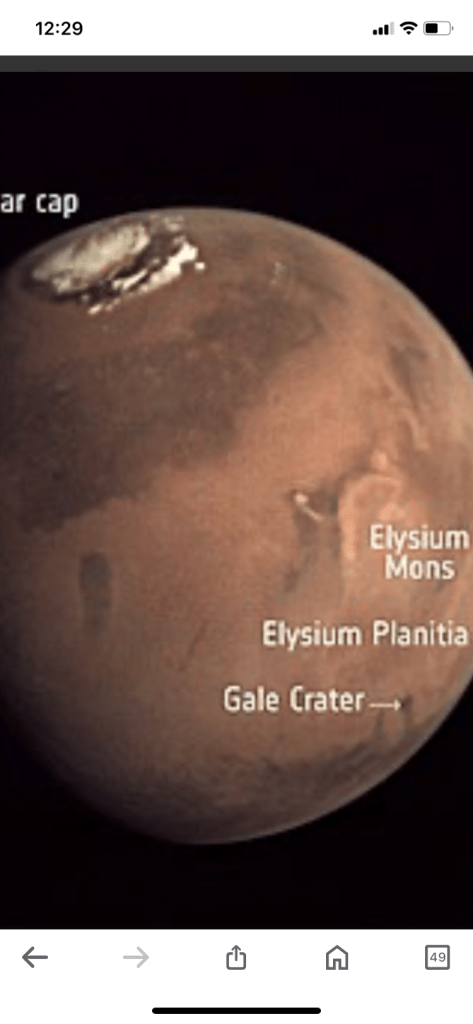
Researchers have discovered signs of extensive volcanic activity on Mars’ Elysium Planitia, including:
- Uplifted surface The surface of Elysium Planitia has been uplifted by more than a mile, which is consistent with a mantle plume.
- Fissure-fed flood lavas Elysium Planitia has many young, fissure-fed flood lavas that are between 500,000 and 2.5 million years old.
- Volcanic features Volcanic features on the surface of Elysium Planitia could be as young as 50,000 years old.
- Lava flow A lava flow the size of Oregon has been discovered in western Elysium Planitia. It is believed to have been emplaced over several weeks and is thought to be one of the youngest lava flows on Mars.
- Lava and water interaction There is evidence that lava interacted with water or ice, shaping the landscape.
Elysium Planitia is a flat plain, but something from below has uplifted its surface by more than a mile.
Elysium Planitia experienced several large floods of water, and there is evidence that the outpouring lava interacted with water or ice, shaping the landscape in dramatic ways
Mars has many signs of volcanism, including:
- Volcanic features Mars has the largest volcanoes in the solar system, as well as other volcanic features like large volcanic cones and unusual patera structures. Lava flows Mars has extensive lava flows and vast lava plains. Lava channels Mars has many lava channels, which indicate that hot lava once flowed across the surface. Cracks In the Cerberus Fossae region, there are many cracks in the surface, and one feature has dark streaks of material running alongside it for dozens of kilometers. Measurements show that the material is full of pyroxenes, minerals common in volcanic lava. Tectonic activity In the last 500 million years, northern Tharsis has seen continuous lava flows and tectonic activity. Plume of hot rock Researchers have found a massive plume of hot rock below the surface of Mars, which shows that the planet is still volcanically active. Molten magma Scans show that Mars has pockets under the surface of a potentially “warm” source that could be explained by the existence of molten rock.
In late 2022, researchers announced evidence that Mars is still volcanically active below its surface. This evidence is based on data from NASA’s InSight lander.
Some scientists believe that Mars may still have smaller volcanic eruptions, with signs of an eruption within the past 50,000 years. Geologists Vivek Krishnan and Senthil Kumar from NGRI report that Alba Mons has been erupting non-stop for at least the last 500 million years.
However, others believe that the era of active volcano construction on Mars was over three billion years ago.
According to some scientists, Alba Mons, one of the largest volcanoes on Mars, has been erupting continuously for the last 500 million years. However, other evidence suggests that significant volcanic activity at Alba Mons ended much earlier than at other volcanoes on Mars.
According to Wikipedia, geologic evidence indicates that significant volcanic activity at Alba Mons ended much earlier than at Olympus Mons and the Tharsis Montes volcanoes. Volcanic deposits from Alba Mons range in age from Hesperian to early Amazonian (approximately 3.6 to 3.2 billion years old).
However, research reveals that the Olympus Mons and Alba Mons volcanoes on Mars exhibit features similar to Earth’s active volcanic islands. This likely indicates past interaction between lava and liquid water, which supports the hypothesis that a vast ocean may have once existed in Mars’ northern lowlands
Although no volcanic activity has so far been observed on Mars, “Elysium Planitia was volcanically much more active than previously thought and might even still be volcanically alive today,” said Voigt, the first author of the study, published in the Journal of Geophysical Research: Planets
In December 2022, researchers at the University of Arizona discovered evidence that Mars is still volcanically active. The researchers analyzed orbital images of the Elysium Planitia region and found a large mantle plume of hot, molten rock pushing upward from the mantle
The Elysium Planitia is a broad plain that straddles the equator of Mars. It’s the youngest volcanic terrain on the planet, and some of the volcanic activity has been identified as recently as 1 million years ago.
The volcanic eruptions at Elysium Planitia originate from a set of fissures called Cerberus Fossae that stretch for more than 1278 kilometers (800 miles) across the planet’s surface. The Cerberus Fossae is the only Mars location with recent volcanic eruptions. Lava flows have been found that are no older than 0.2 million years from the present
According to a 2023 study published in Nature Astronomy, a mantle plume may be active beneath the surface of Mars. The plume is located under Elysium Planitia, a low-lying area within the planet’s northern lowlands.
Mantle plumes are large blobs of warm, buoyant rock that rise and push up the surface. The plume under Elysium Planitia is 2,500 miles (4,000 kilometers) wide and could be driving molten magma.
Elysium Planitia is the second largest volcanic region on Mars, measuring 1,700 by 2,400 kilometers. It contains three large volcanoes: Hecates Tholus, Albor Tholus, and Elysium Mons
According to a 2023 study, the mantle plume suggests that Mars may have a more active and dynamic interior than previously thought. The discovery reveals that Mars, like Earth and Venus, possesses an active interior, which challenges current views on the planet’s evolution
The InSight mission has proven that Mars is seismically active, with more than 900 seismic events recorded since early 2019. Some of these events have characteristics close to terrestrial tectonic earthquakes.
According to Joana Voigt, who co-led the study alongside planetary scientist Christopher Hamilton of the University of Arizona, “Elysium Planitia was volcanically much more active than previously thought and might even still be volcanically alive today
(Full article source google)
https://9e9f8fli49wql29k9be-nhp65z.hop.clickbank.net Universe discoveries