
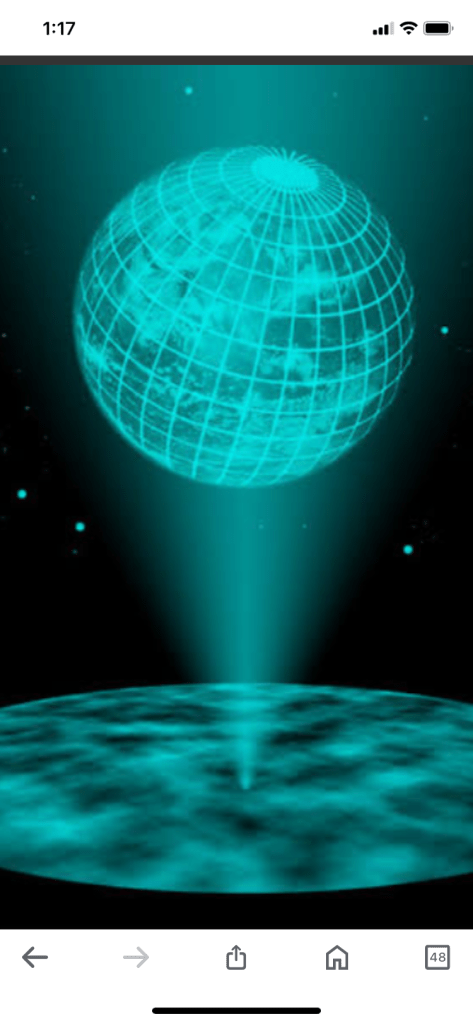
holograms might save physics.
The holographic principle is a property of string theories and quantum gravity. It states that a volume of space can be encoded on a lower-dimensional boundary.
The holographic universe principle suggests that the universe is a two-dimensional information structure painted on the cosmological horizon. The three dimensions we observe are only an effective description at macroscopic scales.
Physicists are optimistic that they’ll one day arrive at a duality that works for both. This could lead to a theory of quantum gravity, which would combine Einstein’s general relativity with quantum mechanics. It would also imply that our universe is in truth a hologram.
Dennis Gabor is known for his research in electron optics which led to the invention of holography in 1947.
Holography is “lensless photography” in which an image is captured not as an image focused on film, but as an interference pattern at the film.
Dennis Gabor is known for his research in electron optics, which led to the invention of holography in 1947
Gabor’s research focused on electron inputs and outputs. He believed that holograms needed to use both phase and amplitude waves to obtain a complete holo-spatial picture. He proposed to split an electron beam to an object and a mirror.
In 1947, Gabor conceived the idea of wavefront reconstruction for improving the performance of the electron microscope. This became the basis for the invention of optical holography for three-dimensional imaging.
Holography is “lensless photography” in which an image is captured not as an image focused on film, but as an interference pattern at the film. Typically, coherent light from a laser is reflected from an object and combined at the film with light from a reference beam.
In 1948, Dennis Gabor named his new microscopic principle “holography”. The word comes from the Greek words holos and grafe, which mean “whole” and “writing”. The name indicates that the method records the entire field of information, not just the intensity.
Gabor’s concept of holography is to see more by illuminating interference patterns in waves. This concept has become a strong thread in many areas of science, particularly photonics.
Gabor also invented electron holography, which applies holography techniques to electron waves instead of light waves. Electron holography is commonly used to study electric and magnetic fields in thin films
Here’s how a Gabor hologram works:
- 1. Light the object Use a coherent monochrome wave to light the object.
- 2. Record the diffraction pattern The diffraction pattern that results from the interference of the secondary coherent wave with the coherent background is recorded on a photographic plate.
- 3. Transfer the pattern The interference pattern is transferred onto a surface, usually a thin film, using a special printing technique.
- 4. Expose the hologram To see the three-dimensional image of the object, expose the recorded holographic plate to coherent light.
Holography is a unique method of photography that uses a laser to record 3D objects. When illuminated with a laser, holograms can create an exact 3D clone of the object.
There are two basic types of holograms: transmission and reflection. Transmission holograms create a 3D image when monochromatic light travels through them. Reflection holograms create a 3D image when laser light or white light reflects off of their surface.
In 1948, Dennis Gabor created his first hologram using a mercury arc lamp with a narrow-band green filter. This light source was one of the best coherent light sources before the laser.
In Gabor’s original system, the hologram was a record of the interference between the light diffracted by the object and a collinear background. This limited the process to objects that had significant transparent areas.
In 1962, Yuri Denisyuk in the Soviet Union and Emmett Leith and Juris Upatnieks at the University of Michigan, US, made the first practical optical holograms that recorded 3D objects. Early holograms used silver halide photographic emulsions as the recording medium
The math behind holograms is complex, but it involves using complex numbers to model the light waves used for recording and reconstructing. The complex numbers represent the light wave’s electric or magnetic field
The equations of Fresnel diffraction describe specific cases of light that’s out of phase due to obstructions. For example, the multiple plates used in creating a complex hologram.
A holographic equation is a theoretical concept in physics that relates to the idea of a holographic principle. This principle suggests that all the information about a volume of space can be represented on the boundary of that space.
The holographic principle states that the entropy of ordinary mass is also proportional to surface area and not volume. This means that volume itself is illusory and the universe is really a hologram
Holography is based on the principle of interference. A hologram captures the interference pattern between two or more beams of coherent light
Physicists are optimistic that they will one day find a duality that works for both Einstein’s general relativity and quantum mechanics. This could lead to a theory of quantum gravity, which would imply that our universe is a hologram.
Quantum gravity is a term for theories that try to unify gravity with the other fundamental forces of physics. It generally posits a theoretical entity, a graviton, which is a virtual particle that mediates the gravitational force.
One theory, known as loop quantum gravity, aims to resolve the conflict between particles and space-time by breaking up space and time into little bits.
(Full article source google)
https://3ba21jhi5zv-lsgo7gp9y6ri1m.hop.clickbank.net Universe discoveries