
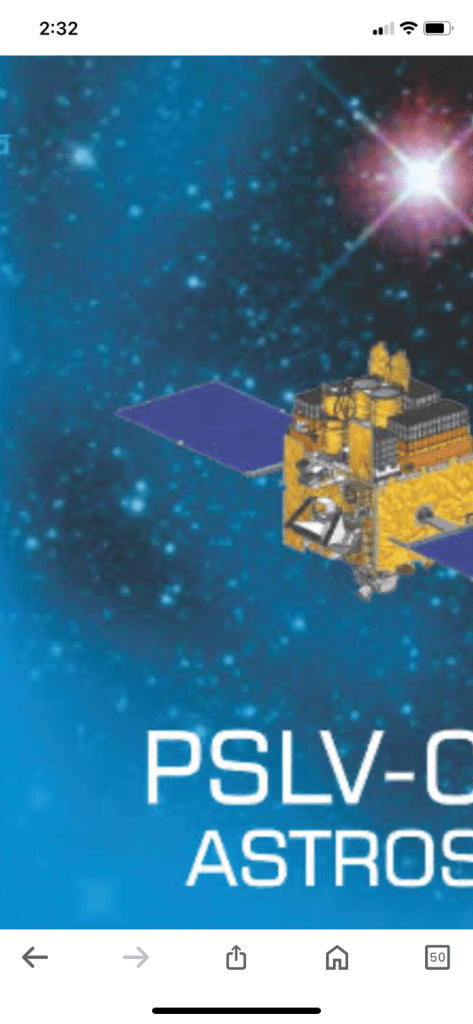
India’s AstroSat detected 67 short-lived bursts of energy from a magnetar, a type of neutron star. The bursts were each 33 milliseconds long, and one was especially bright, lasting almost a tenth of a second. The magnetar, named SGR J1830-0645, was discovered by NASA’s Swift spacecraft.
AstroSat is India’s first multi-wavelength space observatory. It has a suite of payloads that can observe celestial objects across different wavelengths, from ultraviolet to X-rays
India’s first multi-wavelength space-based observatory, AstroSat, has made a significant discovery by detecting bright pulses of energy coming from deep space. The Indian probe picked up 67 such bursts each lasting 33 milliseconds from a new and distinctive neutron star known as a magnetar
AstroSat is India’s first multi-wavelength space observatory, launched on September 28, 2015. The satellite’s mission is to study celestial sources in X-ray, optical, and UV spectral bands simultaneously.
The satellite was launched into a 650-km orbit, with a lift-off mass of 1515 kg. The mission is planned for a period of five years.
The satellite’s payloads cover the energy bands of ultraviolet (near and far), limited optical, and X-ray regime (0.3 keV to 100keV). The mission also intends to detect new briefly bright X-ray sources in the sky, and to perform a limited deep field survey of the Universe in the ultraviolet region.
The satellite measures 1.69 by 1.75 by 1.30 meters in size when in its stowed launch configuration.
AstroSat has made several discoveries, including:
- Extreme ultraviolet light In 2020, AstroSat detected extreme ultraviolet light from a galaxy called AUDFs01, which is 9.3 billion light-years away from Earth. This was a major breakthrough, and marked the discovery of one of the earliest galaxies.
- Bright pulses of energy In December 2023, AstroSat detected 67 bursts of energy lasting 33 milliseconds each from a magnetar, a new neutron star.
- New stars AstroSat observations have found that new stars are forming in gas streams outside of galaxies. This provides new insights into how stars form and how gas interacts in galaxy clusters.
- Dwarf galaxy evolution AstroSat data has provided evidence about how a dwarf galaxy evolves into a mature galaxy.
AstroSat’s main purpose is to study cosmic sources. Its scientific objectives include:
- Monitoring intensity variations: Monitoring intensity variations in a wide range of cosmic sources
- Monitoring the X-ray sky: Monitoring the X-ray sky for new transients
- Sky surveys: Performing sky surveys in the hard X-ray and UV bands
- Understanding binary star systems: Understanding binary star systems’ high energy processes
- Observing neutron stars: Observing and estimating neutron stars’ magnetic fields
- Studying star systems: Studying high energy processes in star systems and star birth regions in the outer galaxy
AstroSat also has other scientific objectives, including:
- Detecting new bright X-ray sources: Detecting and identifying new bright X-ray sources in the sky
- Periodic and aperiodic time variability studies: Performing periodic and aperiodic time variability studies for all classes of X-ray and UV bright sources
- Measuring energy spectra: Measuring energy spectra of all classes of X-ray sources over 0.3-100 keV from simultaneous observations
AstroSat also has other applications, including:
- Making star maps: Astronomy satellites can be used to make star maps
- Studying mysterious phenomena: Astronomy satellites can be used to study mysterious phenomena such as black holes and quasars
- Taking pictures of planets: Astronomy satellites can be used to take pictures of the planets in the solar system
AstroSat is a multi-institute collaborative project. The project involves:
- IUCAA
- ISRO
- Tata Institute of Fundamental Research (Mumbai)
- Indian Institute of Astrophysics (Bengaluru)
- Physical Research Laboratory (Ahmedabad)
AstroSat is a multi-wavelength space telescope with five telescopes that can see through different wavelengths simultaneously. These wavelengths include visible, near UV, far UV, soft X-ray, and hard X-ray.
(Full article source google)
https://theikariajuice.com?shield=799feghj3–ya-j9j61fo-bz8c Universe discoveries