
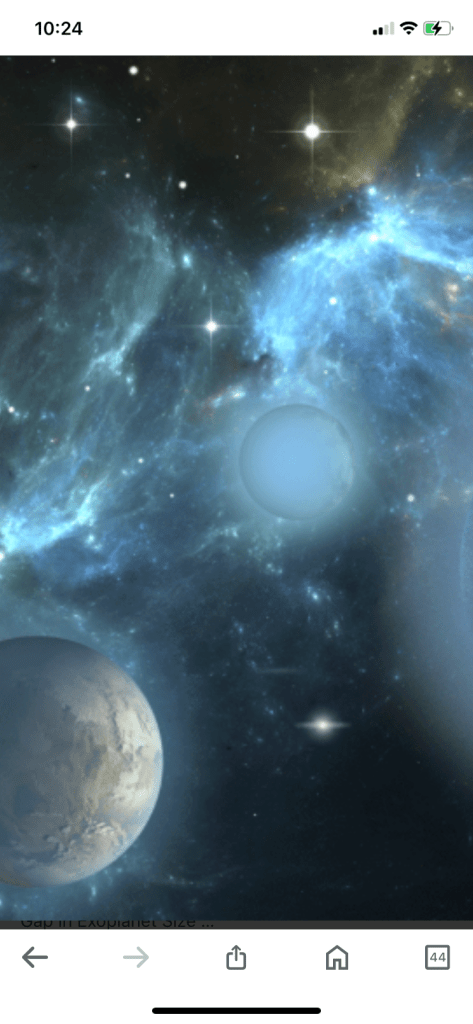
A recent study suggests that a planet’s atmosphere with low carbon abundance could be a sign of liquid water and potentially life. The study was conducted by researchers at MIT and the University of Birmingham.
The study suggests that if a terrestrial planet has less carbon dioxide in its atmosphere than other planets in the same system, it could be a sign of liquid water and possibly life on the planet’s surface. The James Webb Space Telescope (JWST) can observe low carbon abundance in a planet’s atmosphere.
The technique used to study exoplanet atmospheres is called “transit spectroscopy”. This technique involves light from a star traveling through the atmosphere of an orbiting planet and reaching telescopes.
The scientists at MIT, the University of Birmingham, proposed that if a terrestrial planet has substantially less carbon dioxide in its atmosphere compared to other planets in the same system, it could be a sign of liquid water — and possibly life — on that planet’s surface
The researchers also say that if a planet’s atmosphere shows signs of both ozone and depleted carbon dioxide, it’s likely a habitable, and inhabited world. The researchers reason that if a similar depletion of carbon dioxide, like on Earth were detected in a far-off planet, relative to its neighbors, this would be a reliable signal of liquid oceans and life on its surface.
However, habitable conditions doesn’t necessarily mean that a planet is inhabited
Earth’s atmosphere is unique in the solar system because it contains free oxygen. Oxygen is a key element for sustaining complex life forms
Earth’s atmosphere is made up of:
- 78% nitrogen
- 21% oxygen
- 0.9% argon
- 0.1% other gases, including carbon dioxide, methane, water vapor, and neon
The atmospheres of Venus and Mars are mostly carbon dioxide. The atmospheres of the other planets in the solar system are made up of mostly hydrogen and helium.
Earth is also unique because it’s located in the habitable zone, which is the perfect distance from the sun for supporting life. Earth’s atmosphere plays a crucial role in supporting life by regulating temperature and protecting the planet from harmful solar radiation.
The habitable zone is the orbital region around a star where an Earth-like planet can have liquid water on its surface and possibly support life. This definition is based on the assumption that extraterrestrial life would have the same requirement as life on Earth.
Life as we know it also requires certain chemical elements, including carbon, hydrogen, nitrogen, oxygen, phosphorus, and sulfur. These elements are common in the universe and make up 98% of living matter on Earth
Water is essential for life, and even small amounts of it on another planet could indicate that life exists or has existed there.
Water is a major component of living organisms. It plays a vital role in the metabolic processes that are necessary for growth and development. Water also helps transport dissolved substances throughout the body.
Water’s four key properties—thermal properties, ability to act as a universal solvent, cohesion, and adhesion—support the life processes and habitats of nearly all organisms.
Water is a prerequisite for life and is involved in almost all processes of life on Earth. All organisms contain 50–90% water, and some aquatic organisms even 99%. If water becomes scarce or has poor quality, plants and animals die.
Water is also important for the emergence and sustenance of life on Earth. It is necessary for prebiotic reactions and the contact of carbon molecules with rocks and minerals.
These six elements are common in the universe and make up 98% of living matter on Earth:
Carbon, Hydrogen, Nitrogen, Oxygen, Phosphorus, Sulfur.
These elements are the building blocks of life. They are essential components of proteins, nucleic acids, lipids, and carbohydrates, which make up the basic structure of living organisms
According to a study, a carbon-lite atmosphere could be a sign of water and life on other terrestrial planets. Scientists at MIT, the University of Birmingham, and elsewhere say that a low carbon abundance in planetary atmospheres could be a signature of habitability.
Photosynthesis is a biochemical process that uses up carbon dioxide. Plants and some microbes use photosynthesis to create food. Plants and photosynthetic algae and bacteria use energy from sunlight to combine carbon dioxide from the atmosphere with water to form carbohydrates. Oxygen is a byproduct that is released into the atmosphere.
Earth has a lower amount of carbon in the atmosphere than other planets because of the presence of water and life. Earth’s oceans dissolve CO2 in the atmosphere, and Earth’s volcanoes release less carbon dioxide than other planets’ volcanoes. Earth is also not hot enough to burn carbon.
Earth’s atmosphere contains a small amount of carbon compared to the amount stored in the oceans, soils, and geologic formations. The concentration of carbon dioxide in Earth’s atmosphere is currently at nearly 412 parts per million (ppm) and rising
Carbon dioxide (CO2) is a greenhouse gas that helps trap heat in the atmosphere. Without it, the planet would be too cold. However, increasing CO2 concentrations are causing global temperatures to rise. This is known as climate change
High levels of carbon dioxide can have harmful effects on human health and the environment. These include:
Inflammation, Reduced cognitive abilities, Bone demineralization, Kidney calcification, Oxidative stress, Endothelial dysfunction.
High levels of carbon dioxide can also contribute to:
- Ocean acidification
- Rising sea levels
- More frequent and intense storms
- Mass species extinctions
- Food scarcity
- Greater economic inequality
According to a study, a carbon-lite atmosphere on an exoplanet could be a sign of water and life.
Here are some exoplanets with carbon in their atmospheres:
- K2-18b This exoplanet is 8.6 times the mass of Earth and is located in the habitable zone. The James Webb Space Telescope found carbon dioxide and methane in its atmosphere, which suggests it may have a surface covered by oceans.
- HD 209458b This gas giant planet is 150 light-years from Earth and orbits a star that is similar to the Sun. It has oxygen and carbon in its atmosphere.
- WASP-39b The James Webb Space Telescope detected carbon dioxide in the atmosphere of this exoplanet.
The James Webb Space Telescope can also detect exoplanets with low levels of carbon dioxide and ozone in nearby systems, such as TRAPPIST-1.
The team said that James Webb Space Telescope (JWST) can easily detect exoplanets with relatively depleted carbon dioxide and possibly ozone, in nearby, multiplanet systems such as TRAPPIST-1 — a seven-planet system that orbits a bright star, just 40 light years from Earth
According to a study, the James Webb Space Telescope (JWST) can easily detect exoplanets with relatively depleted carbon dioxide and possibly ozone. This includes exoplanets in nearby, multiplanet systems such as TRAPPIST-1.
TRAPPIST-1 is a cool red dwarf star with seven known exoplanets. It’s located in the constellation Aquarius, about 40.66 light-years away from Earth. The star is estimated to be 7.6 billion years old, making it older than the Solar System.
The JWST has already found definitive evidence for carbon dioxide in the atmosphere of a gas giant planet orbiting a Sun-like star 700 light-years away
Mercury and TRAPPIST-1 b are planets that have no carbon dioxide.
Mercury has a very thin atmosphere with no trace of carbon dioxide. It’s the only planet without any kind of atmosphere, but it does have an exosphere.
TRAPPIST-1 b is a rocky exoplanet that’s most likely a bare rock without any carbon dioxide in its atmosphere
(Full article source google)
https://75dfepgs18yveuf760jgccpeuk.hop.clickbank.net Universe discoveries