
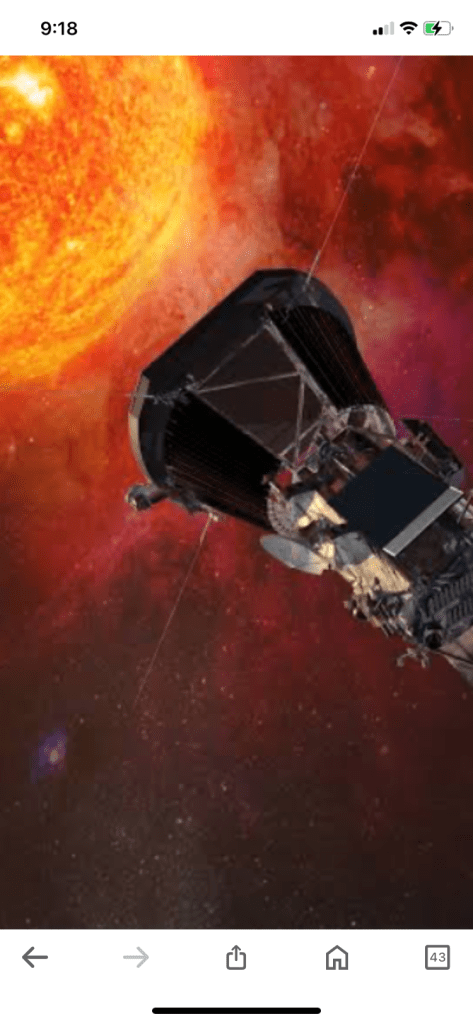
On December 24, 2024, NASA’s Parker Solar Probe will pass the sun at a speed of 195 km/s, or 435,000 mph. The probe will be 6.1 million kilometers, or 3.8 million miles, away from the sun’s surface
The Parker Solar Probe is a mission that was launched in 2018. On its last three orbits, scheduled for late 2024 and 2025, the probe will fly within 6.16 million kilometers (3.83 million miles) of the sun’s surface. It will also set another solar system speed record when the probe hits its maximum speed of 692,000 kilometers per hour (430,000 miles per hour).
The primary obstacle preventing a landing on the sun is the extreme temperature
NASA’s Parker Solar Probe on December 24, 2024, is set to race past the sun at a godly speed of 195 km/s, or 435,000 mph. Till now, no human-made object has got so close to the surface of the Sun. The probe will be just 6.1 million km, or 3.8 million miles away from the star’s boiling surface
The Parker Solar Probe’s objectives include:
- Tracing the flow of energy that heats and accelerates the solar corona and solar wind
- Determining the structure and dynamics of the plasma and magnetic fields at the sources of the solar wind
- Exploring mechanisms that accelerate and transport energetic particles
The Parker Solar Probe’s mission is to revolutionize our understanding of the Sun. It will provide new data on solar activity and make critical contributions to our ability to forecast major space-weather events that impact life on Earth.
The Parker Solar Probe has also studied comets, detected radio emissions from Venus’ atmosphere, and even captured the first-ever images of Venus’ surface in visible wavelengths
The Parker Solar Probe has made several discoveries, including:
- Dust-depletion zone A region around the sun where dust particles are predicted to get hot enough to disappear.
- Comet PSP-001 Discovered in images from the Parker Solar Probe on September 25, 2022.
- Solar wind origins Scientists believe they have discovered the processes that give birth to streams of charged particles released from the sun’s corona.
- Switchbacks Strange flips in the magnetic field as the spacecraft approaches the sun. These flips align with magnetic “funnels” in the solar surface.
- Dust thinning The first direct evidence of dust starting to thin out around 11 million kilometers from the sun.
The Parker Solar Probe has also observed:
- Magnetic and particle conditions at 18.8 solar radii above the solar surface
- The source of the fast solar wind
The Parker Solar Probe concluded that magnetic reconnection within funnel structures is the source of the fast solar wind’s energy
The probe also found that the switchbacks in the magnetic field align with magnetic funnels in the solar surface.
The probe’s data has exceeded expectations in quality, quantity, and significance
The Parker Solar Probe’s primary science goals are to:
- Understand how the sun’s corona is heated to temperatures 300 times higher than the visible surface below
- Explore what accelerates the solar wind
- Provide a statistical survey of the outer corona
Scientists also hope to learn more about the solar wind, which is a mixture of magnetic forces, plasma, and particles. The solar wind is a constant and intense stream of charged particles that pushes out comet tails and creates the long streamers seen in solar eclipses.
The Parker Solar Probe’s data will help scientists understand and forecast space weather events that can impact Earth’s environment and sometimes human technology. Space weather can change the orbits of satellites, shorten their lifetimes, or interfere with onboard electronics.
The Parker Solar Probe faces some of the most challenging conditions ever faced by a spacecraft. These include:
- Temperatures The probe encounters temperatures of up to 1,500°F (800°C). The spacecraft and its instruments are protected by a 4.5-inch-thick carbon-composite shield that can withstand temperatures of nearly 2,500°F (1,377°C).
- Space dust Space dust can degrade materials and instruments. The probe’s visible imaging camera, WISPR, picks up material expelled from the spacecraft after impact with dust grains.
- Speed The probe’s elliptical orbit takes it past the sun at about 200 km/s (400,000 mph). This speed poses a danger, as the probe could run into interplanetary dust particles.
- Solar flares and CMEs The spacecraft experiences these challenges while capturing crucial images and data.
The Parker Solar Probe also experiences intense light and high-speed particles
The Parker Solar Probe has a planned lifespan of seven years, ending in 2025. During its mission, the probe will complete 24 orbits around the sun, coming as close as 6.1 million kilometers to its surface. This is about seven times closer than any other spacecraft has come to the sun
The Parker Solar Probe is expected to continue orbiting the sun after its mission ends in 2025. The probe will gather data about the sun and its environment
The probe will complete 24 orbits of the sun over its seven-year lifespan. It will fly seven times closer to the sun than any other spacecraft.
The probe’s mission involves a highly elliptical orbit around the sun. It will reach its aphelion at Earth and eventually close to the orbit of Venus. The probe will swing past Venus seven times, slowing down with each pass. Eventually, it will end its rendezvous with Venus and move into a closer orbit around the sun.
The probe is designed to swoop within about 4 million miles (6.5 million kilometers) of the Sun’s surface. Its objectives include tracing the flow of energy, studying the heating of the solar corona, and exploring what accelerates the solar wind
The Parker Solar Probe uses a high-gain antenna to send data back to Earth. The probe also has two fan-beam and two low-gain antennas for uplink and telemetry
The probe’s antennae pick up electromagnetic signals as it flies near the sun. These signals are converted into changes in voltage and recorded into solid-state memory. The probe also has special instruments that record the speed, direction, and makeup of charged particles in the solar wind.
The probe needs a clear line of sight to send information back to Earth. During the Science Phase of each orbit, the probe is actively making observations and communication is largely cut off.
The probe’s communications are provided by three networks: the Near Earth Network, the Space Network, and the Deep Space Network. These networks ensure that the probe has communications support from launch through the mission.
The Parker Solar Probe has a number of technologies, including:
- Heat shield Made of two panels of superheated carbon-carbon composite, the heat shield is designed to minimize heat conduction.
- Solar panels The primary power source for the mission is a dual system of solar panels (photovoltaic arrays).
- Solar Probe Cup (SPC) A Faraday cup instrument that makes rapid measurements of thermal coronal and solar wind plasma.
- FIELDS detector Uses five antennas to measure the electric and magnetic fields in the solar corona.
- Wide-Field Imager for Parker Solar Probe (WISPR) Takes images of the corona to reconstruct its three-dimensional structure.
- Solar Wind Electrons, Alphas, and Protons (SWEAP) investigation Consists of four sensors that measure the speed, density, and temperature of the particles that the spacecraft is flying through.
The Parker Solar Probe also has an autonomous system that helps protect the mission from the Sun’s intense light emission.
The Parker Solar Probe is designed to withstand extreme temperatures and radiation. The spacecraft has a 4.5-inch-thick carbon-composite shield that can withstand temperatures of up to 2,500°F (1,377°C). The shield is also designed to remain cool on the backside
The Parker Solar Probe also has an autonomous system that protects the spacecraft from the sun’s intense light emission. This system allows coronal material to “touch” the spacecraft
(Full article source google)
https://75dfepgs18yveuf760jgccpeuk.hop.clickbank.net Universe discoveries