
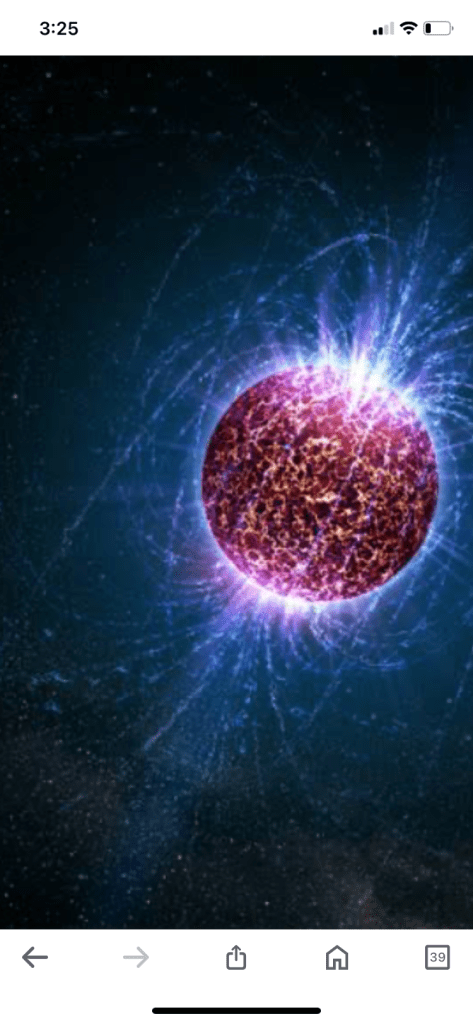
According to a new theoretical analysis, there’s an 80–90% chance that massive neutron stars have cores of deconfined quark matter. This result was reached through supercomputer runs using Bayesian statistical inference.
Neutron stars are the smallest and densest stellar objects known, aside from black holes. They are the collapsed cores of massive supergiant stars that have a mass of 10–25 solar masses. Neutron stars are about 10 kilometers in radius and have a mass of about 1.4 M☉.
Neutron stars are named for their cores, which have such strong gravity that most of the positively charged protons and negatively charged electrons in the interior combine into uncharged neutrons. Neutron stars are incredibly hot when they form, but they cool slowly and produce no new heat.
Neutron star cores contain matter at the highest densities in the universe. This highly compressed matter may undergo a phase transition where nuclear matter melts into deconfined quark matter, liberating its constituent quarks and gluons.
However, none of these states have been observed in nature before.
New theoretical analysis places the likelihood of massive neutron stars hiding cores of deconfined quark matter between 80 and 90 percent. The result was reached through massive supercomputer runs utilizing Bayesian statistical inference
According to a new study published in Nature Communications, there’s a 80–90% chance that massive neutron stars have cores of deconfined quark matter. The study’s findings were based on supercomputer runs that used Bayesian statistical inference.
Bayesian inference is a statistical method that compares model parameters with observational data to determine their likelihood.
Neutron stars are formed when a massive star runs out of fuel and collapses. The core of the star collapses, crushing protons and electrons into neutrons
Strange matter is a hypothetical form of quark matter that’s more stable than ordinary matter under certain conditions. It’s made up of quarks, which are subatomic particles. Strange matter is hypothesized to exist in the cores of neutron stars, or as isolated droplets called strangelets.
The hyper-pressurized core of a neutron star can cause a trio of up, down, and strange quarks to join forces and form strange matter. Strange matter is an exotic material that’s immune to erosion or damage.
Neutron stars are made up of neutronium, a dense form of matter. The pressure inside neutron stars is a billion billion times higher than the sun’s core. Some physicists have speculated that this pressure could cause a soup of quarks to emerge. According to new research, the pressure inside neutron stars could cause their cores to be made up entirely of quarks.
Some scientists believe that neutron stars can capture dark matter through scattering. This scattering transfers the dark matter’s kinetic energy to the star
According to a team led by Ho-Sang Chan, neutron stars may form with a small amount of dark matter. Some say that neutron stars may be ideal laboratories for discovering dark matter.
Dark matter doesn’t interact with anything, except gravity, so it can’t form objects like stars or planets
It’s unlikely that dark matter is made of neutrons.
Neutrons are unstable unless they’re bound to protons in an atomic nucleus or in a neutron star. Free neutrons decay into a proton, an electron, and an electron antineutrino with a half-life of just over 10 minutes. Three neutrons bound together would also be unstable, with two of the neutrons decaying into protons to form Helium 3.
Dark matter is a substance that interacts with visible matter mainly through gravity. It could be made up of standard baryonic matter, such as protons or neutrons. However, most astronomers believe that the majority of dark matter is not made up of protons and neutrons.
Neutron stars are dense enough to capture dark matter. However, the calculations used to detect dark matter in neutron stars need to fully account for the star’s unique environment
Dark matter is thought to be made up of different types of particles, including massive quark objects that have survived since the Big Bang. However, dark matter is not made up of the particles in the Standard Model of particle physics, such as quarks and electrons.
The leading explanation for dark matter is that it’s an undiscovered subatomic particle, such as axions or weakly interacting massive particles (WIMPs). Another possibility is that dark matter is made up of primordial black holes.
Some theories suggest that strange quarks may have bound to other particles in the early days of the universe and formed dark matter. However, these theories remain untested because strange quarks have only been observed inside particle accelerators
According to the “strange matter hypothesis,” strange matter is a hypothetical form of quark matter that could be more stable than ordinary atomic nuclei. It could also be the most stable and dense form of matter in the universe
Strange matter is made up of different flavors of quarks, including strange quarks. It would allow the three types of quarks to exist at a very low energy state, making it possibly the most stable matter in the universe.
Strange matter is contagious and could potentially overwhelm normal matter. If a small piece of strange matter, called a strangelet, were to come into contact with ordinary matter, it could potentially convert the ordinary matter into strange matter.
Strange matter is so stable that all matter in the universe might want to be strange
A new theoretical analysis published in Nature offers a first-ever quantitative estimate for the likelihood of quark-matter cores inside massive neutron stars. The result was reached through massive supercomputer runs utilizing Bayesian statistical inference.
Neutron-star cores contain matter at the highest densities reached in our present-day Universe, with as much as two solar masses of matter compressed inside a sphere of 25 km in diameter. These astrophysical objects can indeed be thought of as giant atomic nuclei, with gravity compressing their cores to densities exceeding those of individual protons and neutrons manyfold.
This highly compressed matter may undergo a phase transition where nuclear matter melts into deconfined quark matter, liberating its constituent quarks and gluons.
The researchers found that, based on current astrophysical observations, quark matter is almost inevitable in the most massive neutron stars
(Full article source google)
https://75dfepgs18yveuf760jgccpeuk.hop.clickbank.net Universe discoveries