
Iron snow is a theory that could explain the magnetic fields of planets and moons, including Ganymede
Here’s some information about iron snow and Ganymede:
- Iron snow This is a theory that crystallized iron particles precipitate through the outer core of some planets and moons. The iron crystals are denser than the surrounding liquid, so they fall towards the planet’s inner core.
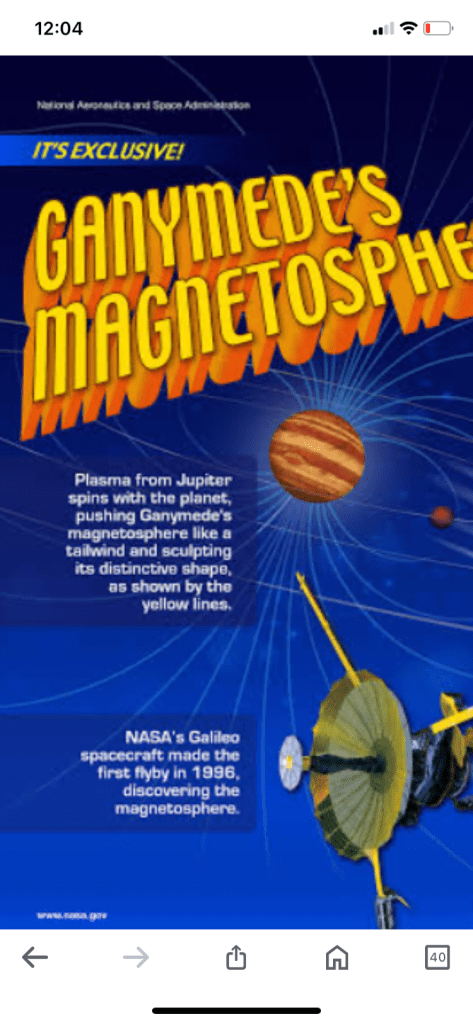
- Ganymede Ganymede is Jupiter’s largest moon and the only moon known to have its own magnetic field. The magnetic field is surprisingly strong for its size, and it causes auroras around the moon’s north and south poles.
- Tidal effects Jupiter’s tidal effects continually stretch and squeeze Ganymede, keeping its core warm and driving the magnetic field.
- Iron snow’s impact Iron snow would occur intermittently and be localized at different places throughout the core. The result would be a shifting and dancing magnetic field that strengthens, weakens, and changes shape over time.
This sporadic and cyclical process has significant ramifications for a planet’s magnetic fields. Iron snow at Ganymede would occur intermittently, and be localized at different places throughout the core. The result would be a shifting and dancing magnetic field that strengthens, weakens, and changes shape over time.
Iron snow at Ganymede would occur intermittently, and be localized at different places throughout the core. The result would be a shifting and dancing magnetic field that strengthens, weakens, and changes shape over time
The magnetic field of Ganymede is shifting and dancing because of iron snow. Iron snow is a sporadic and cyclical process that occurs intermittently, and is localized at different places throughout the core. This results in a shifting and dancing magnetic field that strengthens, weakens, and changes shape over time.
Ganymede is the largest moon in the solar system, and it is also the only moon with a magnetic field. The magnetic field of Ganymede is thought to be generated by a process called the dynamo. The dynamo is a process that occurs in the liquid metallic core of a planet or moon, and it creates a magnetic field by the movement of electrically conducting fluids.
The iron snow on Ganymede is thought to be caused by the freezing of liquid iron in the core. When the liquid iron freezes, it forms crystals that are made of iron and oxygen. These crystals are then carried around by the movement of the liquid metal in the core, and they cause the magnetic field to change.
The magnetic field of Ganymede is important because it protects the moon from the harmful radiation of the sun and cosmic rays. The magnetic field also helps to keep the atmosphere of Ganymede in place.
Not all planets have magnetic fields. Of the planets studied by spacecraft, all have strong magnetic fields except for Mercury, Mars, and Venus.
The four gas giants have very strong magnetic fields, while Earth has a moderately strong magnetic field. Mercury has a very weak field, and Venus and Mars have almost no measurable fields.
Jupiter has the largest magnetic field in the solar system, stretching about 12 million miles from east to west. Jupiter’s magnetic field is around 20,000 times stronger than Earth’s magnetic field.
Planets like Earth and Jupiter have active iron cores that generate magnetic fields. Other planets like Mars and Venus have either cooled cores or lack the necessary convection to produce a magnetic field.
Earth is the only planet known to have a global magnetic field generated by its core. Other planets in our solar system have magnetospheres, but Earth has the strongest one of all the rocky planets
Earth’s magnetic field is generated by convective motion in the planet’s liquid iron outer core, commonly referred to as the geodynamo. The liquid metal in Earth’s outer core flows, and its motion and high iron content cause the planet to act like a huge dipolar magnet.
For a planet to have a magnetic field that extends outside of the planet’s circumference, there has to be a metal liquid core capable of generating an electric current. As the Earth turns, small whirlpools of liquid and solid iron are constantly moving around
A planet’s magnetic field is caused by the interaction between the planet’s rotation and the convection of its interior conducting material
To generate a magnetic field, a planet must meet three requirements:
- A molten, electrically conducting interior
- Convection in the interior
- A moderately rapid rotation
The magnetic fields act like giant bar magnets and can be offset from the rotation axis of a planet. When the liquid metals in the core cool, the magnetic field disappears
Iron snow is a sporadic and cyclical process that occurs intermittently and at different locations throughout the core of a planet or moon.
Iron snow is made up of crystallized iron particles that precipitate through the outer core of some planets and moons as the core cools. The iron crystals are denser than the surrounding liquid and fall towards the planet’s inner core.
The iron snow process can have significant implications for a planet’s magnetic field. The shifting and dancing magnetic field strengthens, weakens, and changes shape over time.
The movement of iron may account for the magnetic fields present on the planet Mercury and the moon Ganymede.
The iron snow theory is a geological model that describes how iron crystallizes and falls through a planet’s core. The theory suggests that iron snow could explain the magnetic fields of planets and moons, including Ganymede
The iron snow theory describes how iron cools and crystallizes at the top of the core, then falls and melts at a greater depth. The iron crystals are denser than the surrounding liquid and fall towards the planet’s inner core. There, they remelt under pressure and combine with other elements.
The iron snow theory assumes that this process generates a dynamo process within the core and creates the magnetic field
Ganymede’s magnetic field is believed to be created by convection within its liquid iron core. This convection is caused by Jupiter’s tidal forces.
Ganymede’s magnetic field is also believed to result from tidal flexing that leads to action between its liquid outer core and solid inner core.
Ganymede’s magnetic field is embedded in Jupiter’s magnetic field. When Jupiter’s magnetic field changes, the auroras on Ganymede also change.
Ganymede is the only known moon with a magnetic field. It’s the largest moon in the solar system and the only Galilean moon with its own magnetic field.
(Full article source google)
https://d9b41mep4411838f06ndpar598.hop.clickbank.net Universe discoveries