
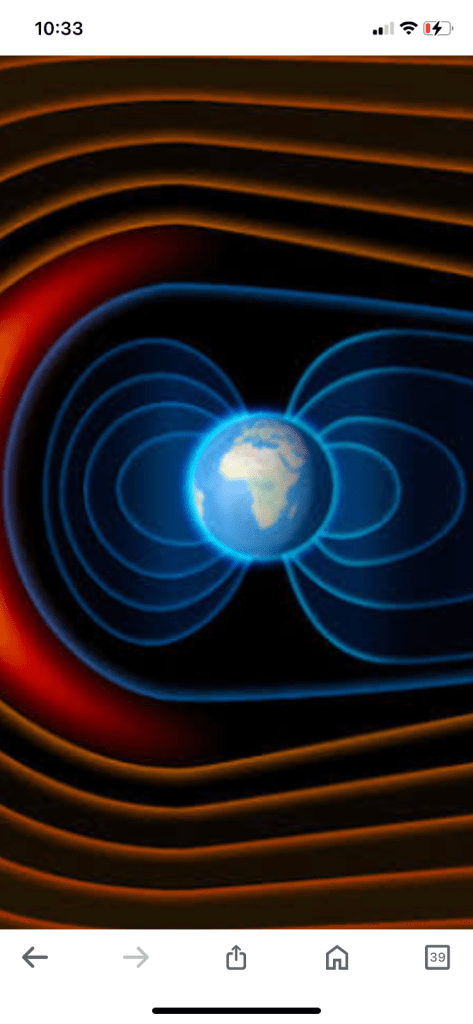
According to a theoretical study published in Physical Review Letters, dark matter could help us discover the origin of magnetic fields in the cosmos. The study suggests that magnetic fields may have originated within a second of the Big Bang.
Here are some details from the study:
- Mini-halos Dark matter mini-halos scattered throughout the cosmos could act as sensitive probes of primordial magnetic fields.
- Primordial magnetic fields The study suggests that if magnetic fields are primordial, it could cause an increase in dark matter density perturbations on small scales.
Dark matter makes up about 63% of all matter in the universe. Understanding dark matter could help us learn more about the universe, including details of its origin and formation
Magnetic fields in the cosmos: Dark matter could help us discover their origin. The mini-halos of dark matter scattered throughout the cosmos could function as highly sensitive probes of primordial magnetic fields. This is what emerges from a theoretical study conducted by SISSA and published in Physical Review Letters
According to a theoretical study published in Physical Review Letters, mini-halos of dark matter could be highly sensitive probes of primordial magnetic fields.
Dark matter halos are thought to exist before galaxies, with galaxies forming where the gravity of dark matter halos has gathered gas. Minihalos are small halos, and it is thought that they were common in the early universe before gravity caused halos to combine into larger halos.
Dark matter halos are a basic unit of cosmological structure. They are hypothetical regions that have decoupled from cosmic expansion and contain gravitationally bound matter.
Magnetic fields are found on all cosmic scales, from planets and stars to large scale fields found in galaxies and galaxy clusters. However, the origin of these fields remains unknown.
Physical Review Letters is a scientific journal published 52 times per year by the American Physical Society. It is considered one of the most prestigious journals in the field of physics
Dark matter affects the universe in several ways:
- Slows the expansion of the universe Dark matter’s gravitational effect slows the expansion of the universe.
- Affects the development of galaxies Dark matter affects the development of structures in the early universe, including the development of galaxies. Dark matter halos are thought to be the places where galaxies were born.
- Affects the distribution of galaxies Dark matter affects the gravitational effect on galaxies and their distribution throughout the universe.
- Provides extra gravity Dark matter provides extra gravity that keeps stars from flying out into space.
- Acts as an invisible skeleton Dark matter acts as the invisible skeletal structure that holds up the visible universe.
- Allows galaxies to hold onto raw ingredients Dark matter’s gravity allows our galaxy to hold onto the raw ingredients that made life and planets possible.
Dark matter is one of two mysterious invisible substances that make up the majority of the matter in the universe. The other substance is dark energy, which has a strange “antigravity” effect, pushing space and galaxies apart.
Dark matter is thought to have played a critical role in the formation and evolution of galaxies and planetary systems
According to the “cold dark matter” model, dark matter particles were the first to form in the early universe. Gravity caused these particles to clump together into dense regions called “halos”. These halos became the sites for the formation of the first galaxies and stars
Dark matter’s gravity pulls normal matter (gas and dust) together to form stars and galaxies. Scientists call dark matter the “glue” that holds galaxies and clusters of galaxies together.
Dark matter makes up most of the mass of galaxies and galaxy clusters. It’s responsible for how galaxies are organized on grand scales
Dark matter plays a crucial role in structure formation because it only feels the force of gravity. This allows the gravitational Jeans instability to form compact structures without being opposed by any other force.
Dark matter also provides the gravitational force necessary to hold these structures together. Without dark matter, the gravitational force alone would not have been sufficient to explain the observed distribution of matter and the formation of structures.
Dark matter also:
- Seeded the development of galaxies
- Seeded the development of quasars
- Cooled pockets of gas to form nebulae
- Became part of black holes
Dark matter also affects the movement of stars within galaxies.
Dark matter is difficult to identify for two reasons:
- Dark matter doesn’t interact with electromagnetic force Dark matter doesn’t absorb, reflect, or emit light, making it invisible to telescopes and other instruments that rely on electromagnetic radiation.
- Dark matter doesn’t interact with normal matter Dark matter is not known to interact with ordinary baryonic matter and radiation except through gravity.
Scientists are confident that dark matter exists because of the gravitational effects it appears to have on galaxies and galaxy clusters. Astronomers can detect dark matter’s influence by observing how its gravity bends and distorts light from more-distant objects, a phenomenon called gravitational lensing.
(Full article source google)
Best woman clothes on heavy discount on Amazon Universe discoveries
Nice write up.
LikeLiked by 1 person
Thanks a lot sir🙏
LikeLike