
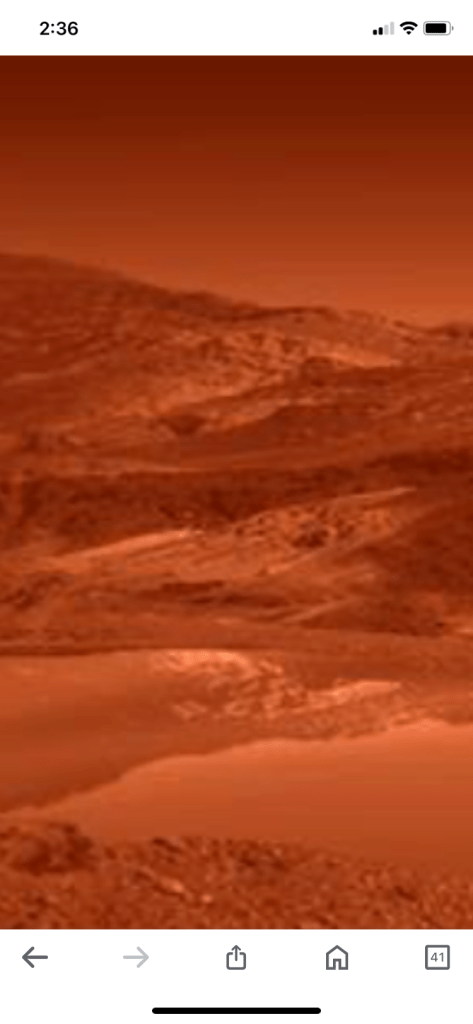
According to a January 5, 2024 study by UTSA professor Xinting Yu, Titan’s “magic islands” are likely floating chunks of porous, icy organic solids. The study suggests that these islands are chunks of frozen organic solids that break off from the shore and drift on the methane lakes.
The study pivots from previous work suggesting the islands were gas bubbles. Instead, the scientists think the islands may be blobs of organic molecules that form in the atmosphere, collect in the lakes, and float around.
The fundamental query revolves around the behavior of organic compounds formed within Titan’s dense atmosphere upon descent onto its various terrains.
Titan’s atmosphere is made up of nitrogen and methane, with some argon and hydrocarbons. The methane is destroyed by sunlight, which creates organic compounds. These compounds form a thick orange haze, similar to smog on Earth
The atmosphere also creates organic molecules, including benzene, which precipitate as solids. However, the low surface tension of Titan’s methane and ethane makes it difficult for solids to remain afloat for long periods of time.
Scientists believe that the heaviest organic molecules fall to the surface. The chemical evolution of the main atmospheric constituents produces ethane that accumulates on the surface or near subsurface. Eventually, it dissolves in methane-ethane lakes and seas.
The larger organic compounds drift downwards to form the moon’s characteristic “haze” and the extensive dunes. Eventually, they reach the surface.
Titan’s atmosphere is similar to Earth’s in that it’s mostly made of nitrogen and has a surface pressure of about 1.5 bars. However, Titan’s atmosphere is denser than Earth’s, with a surface pressure that’s about 1.48 times that of Earth’s. Titan’s atmosphere is also about 1.19 times as massive as Earth’s overall, or about 7.3 times more massive on a per surface area basis.
Titan’s atmosphere contains no free oxygen. It’s made up of about 95% nitrogen and 5% methane, with small amounts of other carbon-rich compounds.
Titan’s surface temperature is about −179°C (94 K). However, humans walking outside on Titan would only need warm clothing and respirators due to its thick atmosphere.
Titan contains ice water below its surface that can be used as a source of oxygen
According to NASA, Titan could potentially support life. Titan has many Earth-like qualities, including a thick atmosphere that could protect humans from radiation. Titan also has lakes, rivers, and seas of liquid methane or ethane, which some models suggest could support non-water-based life.
However, Titan’s surface is -180°C, and it lacks a global ocean like the ones on Europa and Enceladus. Some say that Titan would not be a comfortable place for Earthlike microbes. Any microbes on Titan may have to live underground or forego membranes
According to some, Titan is the most hospitable extraterrestrial world in our solar system for human colonization. However, others say that Titan will never become habitable because it’s too far from the Sun.
Here are some reasons why Titan might be habitable:
- Subsurface water: Titan’s subsurface water could support life as we know it.
- Surface lakes and seas: Titan’s surface lakes and seas of liquid hydrocarbons could support life that uses different chemistry than we’re used to.
- Global ocean: The discovery of a global ocean of liquid water adds Titan to the handful of worlds in our solar system that could potentially contain habitable environments.
- Thick atmosphere: Titan’s thick atmosphere is stronger than Earth’s and would protect humans from radiation.
- Elements for life: Titan has an abundance of all the elements necessary to support life.
However, life as we know it cannot exist on Titan’s frigid surface. However, deep underground, conditions are potentially suitable for life.
scientists believe that the “Magic Islands” of Titan may be blobs of organic molecules that form in the atmosphere and float around in the giant lakes of liquid methane.
Organic molecules are made of carbon and contain functional groups, which are groups of atoms that give the molecules specific chemical properties. The building blocks of organic molecules are similar to bricks, which attach together to create a larger structure.
Lake islands can form in a number of ways, including:
- Sedimentation: Sedimentation can accumulate over time to form islands.
- Erosion: Erosion can separate a landmass from the mainland surrounding the lake.
- Earthquakes: Earthquakes can contribute to the formation of islands.
- Volcanic activity: Volcanic activity can create crater or caldera islands.
- Glacial lakes: Moraines can form islands when a glacial lake is created.
- Magma: When two plates move apart, magma can rise up and solidify to form an island.
(full article source google)
https://0783fqbq-0rrkxlfx7pepbls6l.hop.clickbank.net Universe discoveries
Nice post😊👌👌👌👏
LikeLiked by 1 person
Thanks 🌹
LikeLike