
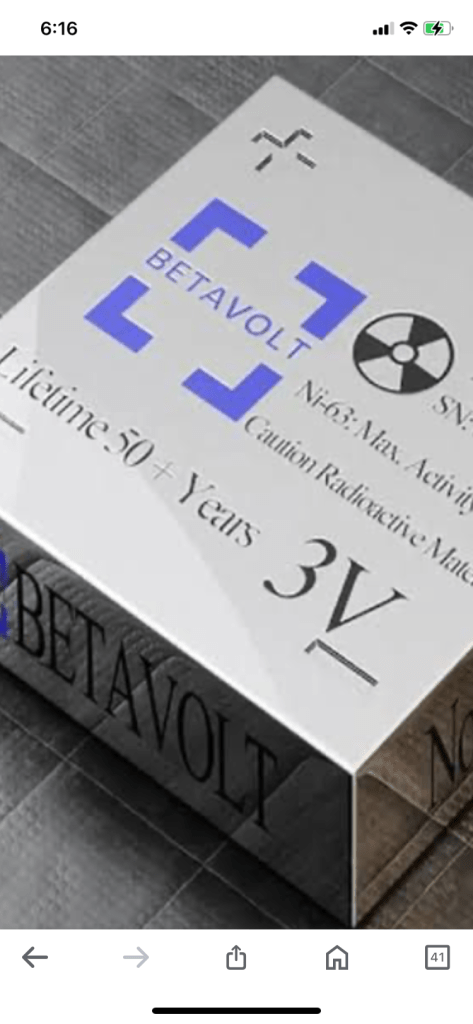
According to a Chinese startup, Betavolt, their nuclear battery can produce electricity for 50 years without needing to be charged or maintained. The battery is smaller than a coin, measuring 15 x 15 x 5 mm, and uses 63 nuclear isotopes. The battery uses a decaying nickel isotope to generate energy and a layer of artificial diamond that acts as a semiconductor.
The battery’s small size means it could be used in series to produce more power. The company envisions mobile phones that never need to be charged and drones that can fly forever.
A Reddit user says that a single Betavolt battery starts at $5,200.
The Chinese company Betavolt has created the world’s first “nuclear battery” for mobile device, according to Fire News. The coin-sized battery can generate energy for 50 years without needing to be recharged, reports Android Central
Nuclear batteries are technically not electrochemical and cannot be charged or recharged. However, it is possible to create a rechargeable nuclear battery.
Nuclear batteries use the energy released from the decay of radioactive isotopes to generate electricity. They are capable of producing electricity for decades without needing to be recharged or replaced.
Nuclear batteries are suitable for applications where recharging and/or refueling is not viable. They have been used in various applications, such as in spacecraft and remote pacemakers
Nuclear batteries, also known as radioisotope batteries, generate electricity by capturing and converting the decay energy of radioactive substances into electricity
The radioactive substances emit energetic alpha or beta particles through radioactive decay. Semiconductors within the device capture and convert the decay energy into electricity.
Some batteries use the decay to generate heat and then harvest with thermocouples. Others harness diode junctions to facilitate non-thermal conversion.
Nuclear batteries have an advantage over other types of batteries due to their high energy density. Energy density is the total energy content per unit mass. The energy density of a nuclear battery is about 104 times higher than a chemical battery.
However, nuclear batteries contain radioactive isotopes, which can pose environmental and health risks if not handled and disposed of properly. There is also a potential for accidents or misuse to release radioactive material, leading to safety concerns.
Nuclear batteries can produce specific powers of 1–50 mW/g. According to Betavolt, their first nuclear battery can produce 100 microwatts of power and a voltage of 3V. They plan to produce a battery with 1 watt of power by 2025.
Nuclear batteries are mainly used for low power output applications that chemical batteries can’t fulfill. They are reliable and can output power for decades to a hundred years
It has an advantage over other types of batteries due to its high energy density. Energy density is the total energy content per unit mass. The energy density of a nuclear battery is about 104 times higher than a chemical battery
Betavolt Technology is a Chinese company that is developing nuclear batteries. According to Betavolt, their batteries could power mobile phones that never need to be charged and drones that can fly forever.
A betavoltaic device is a type of nuclear battery that generates electric current from beta particles (electrons) emitted from a radioactive source. Betavoltaic batteries have an energy density that is 102 to 104 times higher than that of chemical or fossil fuels. They have a long lifetime potential of several tens of years to several hundreds of years.
Betavolt Technology claims to have successfully miniaturized atomic energy batteries, which measure less than a coin at 15 x 15 x 5mm. The company envisions its Betavolt atomic energy batteries as a solution to long-lasting power supply needs.
The lifespan of a betavoltaic battery depends on the half-life of the radioisotopes that power it. These half-lives can range from a few years to 100 years. For example, tritium has a half-life of 12.32 years, meaning half of it decays every 12 years.
Betavoltaic batteries can run for longer than traditional batteries because they rely on radioactive decay, which is independent of temperature and other environmental factors.
In the 1970s, researchers from Donald W. Douglas Laboratories developed a betavoltaic power source that was implanted in pacemakers in over 100 test patients. The Pm147-Si battery achieved a conversion efficiency of ~ 4% and had an expected lifetime of ~ 10 years.
Yes, Betavolt Technology is a Chinese company that is developing nuclear batteries. The company claims to have miniaturized atomic energy batteries that are smaller than a coin and could keep a smartphone charged for 50 years.
Betavolt’s first model, the BB100, is 15 x 15 x 5 mm and provides 100 microwatts of electricity. The company plans to produce a battery with 1 watt of power by 2025.
The radionuclide battery uses a decaying nickel isotope to generate energy and a layer of artificial diamond that acts as a semiconductor.
Nuclear batteries convert radioisotope energy into electrical energy. They have an advantage over other types of batteries due to their high energy density. The energy density of a nuclear battery is about 104 times higher than a chemical battery.
Please like subscribe comment your precious thoughts on my blogs on universe discoveries (best destination for latest universe discoveries and science discoveries)
(Full article source google)
https://66567ljfz81wbshny7cnm-kodp.hop.clickbank.net
Best electronics toys on discount on Amazon Universe discoveries
Wonderful comment 😊🙏🙏🙏
LikeLiked by 1 person
Thanks 🙏
LikeLiked by 1 person
😊🙏🙏🙏
LikeLike