
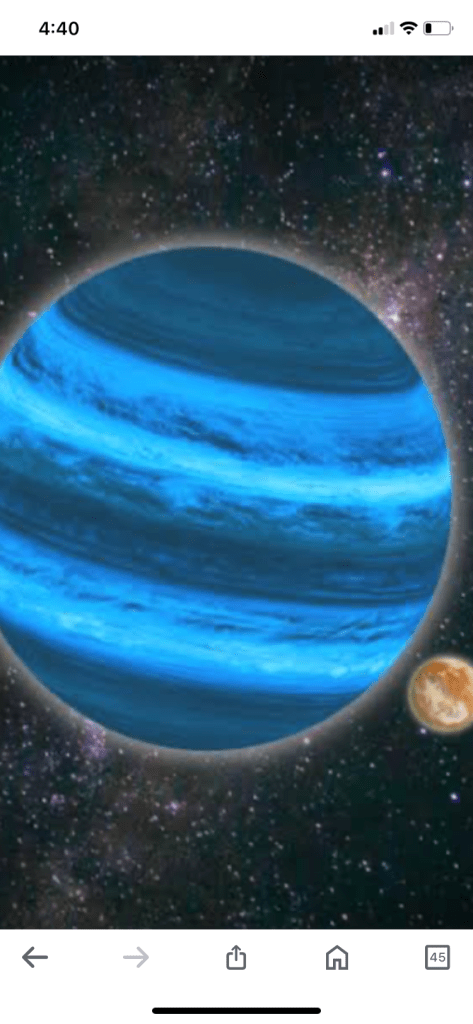
big planets don’t necessarily mean big moons.
While moons can vary in size, they are generally much smaller than their planets. However, a moon can be bigger than a planet. A moon is defined as a celestial body that orbits around a planet or another celestial body that is not a star.
Objects orbit based on their mass and velocity. The less massive object orbits the larger massive object, or they orbit together around a common point. For a moon to be bigger than the planet it orbits, it would have to be less massive.
Some planets are too massive to form a sizable moon. For example, computer simulations show that rocky planets more than six times the mass of Earth end up with vapor-only discs, meaning that a large moon could not grow
In my opinion, a planet does not have to have a large moon to host life on its surface,” Dr. Nakajima tells Universe Today. “However, at least for Earth, the Moon plays a crucial role on the life on Earth. So, if we want to find a second Earth, a planet with a large moon would be a great candidate.
In general, larger planets have more moons than smaller planets. This is because larger planets have a stronger gravitational pull, which allows them to capture and hold onto more moons.
However, other factors can also determine the number of moons a planet has. For example, Mars has a lower mass than Earth, but it has two moons, while Earth only has one.
The number of moons a planet has depends on two factors: the size of the planet and its proximity to the sun. The gas giants Jupiter and Saturn, and the ice giants Uranus and Neptune, have dozens of moons. Saturn has the most moons of any planet in our solar system, with 146 confirmed moons.
Inner planets have fewer moons than outer planets for a few reasons:
- Size Inner planets are smaller and have weaker gravitational forces. This means there’s less space for a planet’s gravitational pull to capture or create a moon.
- Distance from the sun The sun’s gravitational pull makes it difficult for moons to remain in orbit around inner planets.
- Formation Inner planets formed closer to the sun with less material around them. They grew slowly by collecting many small rocky planetesimals and never became massive enough to capture a disk of gas and dust.
The terrestrial planets Mercury and Venus have no moons, Earth has one, and Mars has two small moons
The outer planets, also known as gas giants, are larger than the inner planets because they formed farther from the sun. The solar nebula was cooler farther from the sun, which allowed lighter gases to condense and form massive gas giants with thick atmospheres
The outer planets are primarily made of gases and ices, while the inner planets are mainly made of dense, solid rock. The outer planets are larger in size and much more massive, but their overall density is lower. For example, Saturn is massive and second in size to Jupiter, but its density is so low that it would float in water.
The outer planets are also known as Jovian planets. They are located relatively far from the Sun and have diameters that are about 4 to 11 times the size of Earth’s
Some planets are too massive to form a large moon. For example, computer simulations show that rocky planets more than six times the mass of Earth, known as super-Earths, end up with vapor-only discs, meaning that a large moon could not grow
Moons are always smaller than the planet they orbit. However, a moon is not defined by its size. In other planetary systems, there may be moons as big or even bigger than Earth. For example, Saturn’s moon Titan is bigger than planet Mercury.
Some planets, like Mercury and Venus, don’t have moons. Mercury is so close to the Sun and its gravity that it wouldn’t be able to hold on to its own moon
Yes, a moon can be larger than the planet it orbits. This can happen when the moon and planet are both relatively small. For example, Pluto’s moon Charon is about half the size of Pluto.
Mathematically, a moon can be larger than its planet if the moon has a significantly lower density than the planet.
In our solar system, seven moons are larger than Pluto, including Earth’s moon. Jupiter’s moon Ganymede is the largest moon in the solar system, and is larger than both Mercury and Pluto
Planets appear smaller than the moon because they are much farther away. The moon is about 384,400 kilometers away from Earth, while the next closest planet, Venus, is about 40 million kilometers away
The moon also appears larger than other planets because it is closer to Earth than any other planet. The moon is also more visible because it’s in orbit around Earth, so we see its reflected light much better.
The moon always looks the same size from any location on Earth. However, the things your mind compares the moon with, like a house or mountain, look bigger or smaller depending on how far away you are from them
The Sun and Moon appear to be the same size in the sky because the Sun is about 400 times wider than the Moon, but it’s also about 400 times farther away. This is a unique situation among the planets and moons in our solar system
The apparent size of an object in the sky depends on its distance from the observer. The Sun is much larger than the Moon, but its greater distance from Earth makes it appear smaller in the sky.
The Sun is the largest object in our solar system, with a diameter of about 865,000 miles (1.4 million kilometers). The Moon’s mean diameter is 2,159.2 miles (3,475 km), which is less than a third the width of Earth.
The Sun appears small because it’s 93 million miles away. The distance between the Sun and Earth is almost impossible to comprehend
The Sun is 109 times wider than Earth and weighs 333,000 times more. However, when compared to other stars, the Sun is considered small
According to Universe Today, a planet doesn’t need a large moon to support life on its surface. However, Earth’s moon plays a vital role in shaping life as we know it.
Factors that contribute to a planet’s ability to support life include: Liquid water, Suitable atmosphere, Stable climate.
Earth’s moon controls the length of the day and ocean tides, which affect the planet’s biological cycles. It also plays a role in creating tides and stabilizing the planet’s axial tilt.
According to LinkedIn, if the moon disappeared, the length of a day on Earth would become much shorter. It could also mix up our seasons and make ice ages common
Please like subscribe comment your precious thoughts on my blogs on universe discoveries ( a destination for latest universe discoveries and science discoveries)
Full article source google
https://e85edngocysyixmax9uf47-byt.hop.clickbank.net Universe discoveries