
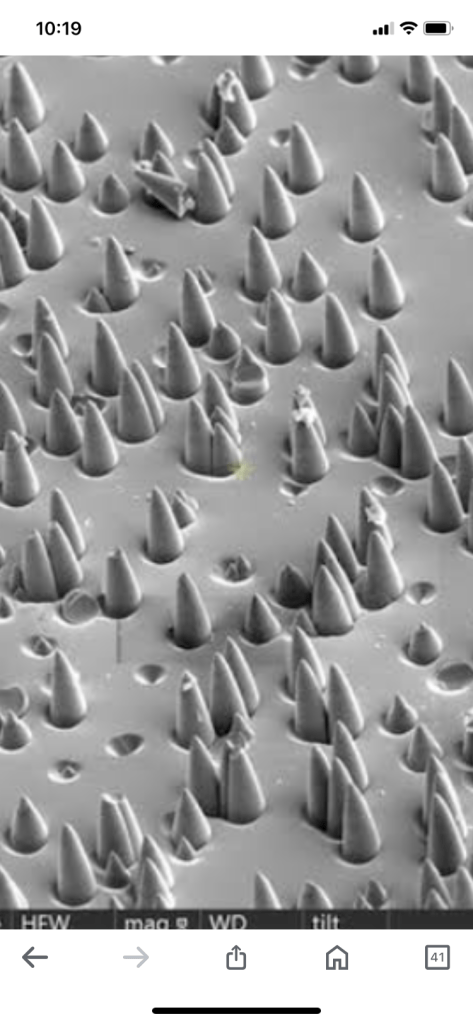
The image of an alien landscape is actually a scanning electron microscope view of a test glass surface. The image is part of a project to improve the lifetime of spaceborne atomic clocks, which are found at the heart of navigation satellites
The image shows the wear and tear of atomic clocks over time. The strange forms are similar to penitentes, which are unusual landscape features found in cold environments like the Atacama desert. They’re also found on Pluto, though they’re the size of skyscrapers there.
Atomic clocks are the most accurate timekeepers because they tell time with electrons. Atomic clocks deviate only 1 second in up to 100 million years.
The leading image has nothing to do with alien landscapes. It’s from a scanning electron microscope. It shows the surface of test glass from a project aimed at improving the lifetime of atomic clocks in the Galileo Navigation Satellite System (GNSS.)
The image of an alien landscape is actually a scanning electron microscope view of a test glass surface. The glass surface has sharp features etched by plasma.
A scanning electron microscope (SEM) uses a focused beam of electrons to scan the surface of a specimen and generate images at a much greater resolution than a light microscope. The electrons interact with atoms in the sample, producing various signals that contain information about the surface topography and composition of the sample. The electron beam is scanned in a raster scan pattern, and the position of the beam is combined with the intensity of the detected signal to produce an image.
SEMs are used in a wide range of fields, including materials science, biology, and semiconductor manufacturing. They can be used to study the structure and composition of materials, to image biological samples, and to inspect semiconductor devices.
Here’s some additional information about SEMs:
- SEMs have a much higher resolution than light microscopes, about 0.1 nm compared to about 200 nm.
- SEMs use electromagnets rather than lenses, which gives the researcher more control over the degree of magnification.
- SEMs can be used to generate three-dimensional images.
The cesium atomic clock is the most precise atomic clock ever created. It uses the spinning states of the cesium nucleus to create a consistent frequency that is used to create the time standard
Here are some other types of atomic clocks:
- Optical atomic clocks These clocks are so accurate that they wouldn’t have lost a second over the universe’s entire existence. They use a laser that is tuned to precisely match a frequency.
- Caesium fountain clocks These clocks are based on the vibrations of caesium atoms and are accurate to about one second in 30 million years.
Atomic clocks are the most accurate timekeepers, losing or gaining one second in 109 days. This means that once synchronized, they don’t need to be reset for generations.
Yes, atomic clocks are more accurate than digital clocks. Digital clocks are accurate to a few seconds a day or better, but this depends on manufacturing tolerances. Atomic clocks are more precise because of their oscillation frequency, which is generally more than 1 gigahertz (billion oscillations per second).
Atomic clocks are the most accurate timekeeping devices in history, with an error of only 1 second in up to 100 million years. In comparison, the average quartz clock will lose one second every couple of years.
Atomic clocks use lasers to measure the vibrations of atoms, which oscillate at a constant frequency.
Please like subscribe comment your precious thoughts on my blogs on universe discoveries ( a destination for latest universe discoveries and science discoveries)
Full article source google
 Universe discoveries