
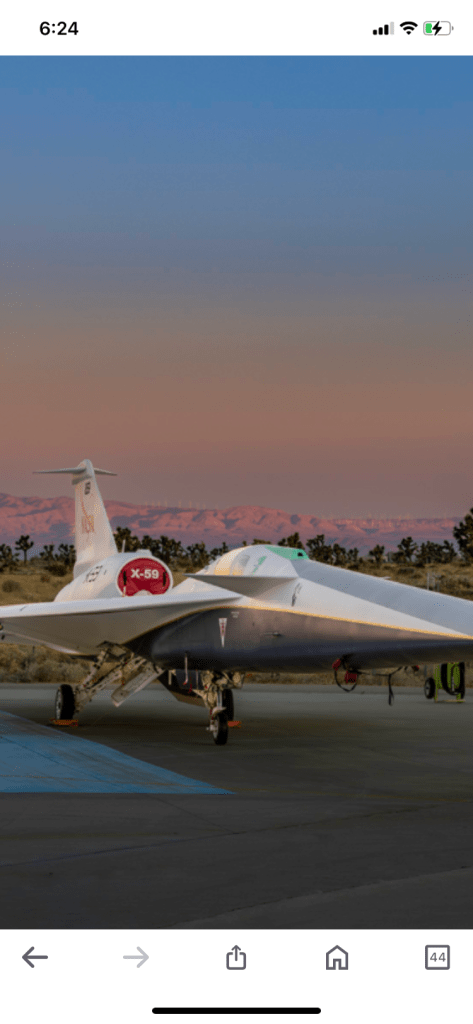
On January 12, 2024, NASA unveiled the X-59, a “quiet” supersonic aircraft, as part of its Quesst mission to make commercial supersonic flight possible. The X-59 is a one-of-a-kind experimental aircraft that NASA and Lockheed Martin hope will gather data to revolutionize air travel.
Supersonic speed is the speed of an object that exceeds the speed of sound (Mach 1). Some drawbacks and design challenges of supersonic transport include:
- Excessive noise generation
- High development costs
- Expensive construction materials
- High fuel consumption
- Extremely high emissions
- An increased cost per seat over subsonic airliners
On January 12, 2024, NASA and Lockheed Martin unveiled the X-59, an experimental supersonic aircraft. The X-59 is designed to be “quiet” by eliminating the windshield and using a thin, tapered nose to break up shock waves. The aircraft is 99.7 feet long and 29.5 feet wide, and is powered by a single engine. It is designed to reach speeds of Mach 1.4, or 925 mph, at an altitude of 55,000 feet
The X-59 is not a prototype, but rather an experimental aircraft that will inform the development of future quiet supersonic aircraft. NASA plans to test the X-59 over US cities to determine if it is quiet enough
An interesting example of a supersonic aeroplane is NASA’s X-59 quiet supersonic aircraft. On January 12, 2024, NASA and Maryland-based aerospace firm Lockheed Martin formally unveiled X-59, an experimental quiet supersonic aircraft, outside Lockheed Martin’s Skunk Works Facility in California
NASA and Lockheed Martin unveiled the X-59, a quiet supersonic aircraft, on January 12, 2024. The unveiling took place at Lockheed Martin’s Skunk Works facility in Palmdale, California
The X-59 is the centerpiece of NASA’s Quesst mission, which aims to make sonic booms quieter to address one of the main challenges of supersonic flight over land
Lockheed Martin is a global aerospace, defense, arms, security, and advanced technologies company. They research, design, develop, manufacture, integrate, and sustain advanced technology systems, products, and services
Lockheed Martin provides support and upgrade services for military aircraft, ground vehicles, missile defense systems, satellites, and space transportation systems. They also produce various military and civilian aircraft, such as the F-35 Lightning II, the C-130J Super Hercules, and the S-92 helicopter.
Lockheed Martin’s four business segments are Aeronautics, Missiles and Fire Control, Rotary and Mission Systems, and Space. About half of the company’s annual sales are to the U.S. Department of Defense
As the world’s leading systems integrator, Lockheed Martin delivers comprehensive training and logistics solutions to prepare military personnel for the most complex missions. Discover Lockheed Martin’s innovative weapon systems, showcasing cutting-edge defense technology for modern warfare and security.
The X-59 is a unique experimental supersonic aircraft that is being developed for NASA’s Low-Boom Flight Demonstrator project. The X-59 is designed to fly faster than sound, but without the loud sonic boom that usually accompanies supersonic flight. The X-59 is 99.7 feet long and 29.5 feet wide, and is designed to reach a speed of Mach 1.4, or 925 mph, at an altitude of 55,000 feet
The X-59 is the centerpiece of NASA’s Quesst mission, which aims to gather public feedback on quieter supersonic flight. The data collected from the X-59 will be used to help regulators consider lifting the ban on commercial supersonic flight over land.
The X-59’s design includes a powerful engine for quiet sonic booms. The plane’s shape and technological advancements are intended to make quiet supersonic flight possible. The X-59’s design minimizes the sonic boom after the plane crosses the sound barrier, so that only smaller waves reach the ground. According to the X-59’s makers, the noise is similar to a car door thudding shut.
The X-59 is scheduled to begin flight testing in 2021. Developers are planning trips over population centers to see how people perceive its sonic footprint. If the plane passes the tests, it could one day make high-speed flight quiet enough to be a feasible possibility for passenger planes.
As of December 2023, the X-59’s first flight is planned for 2024. The aircraft will undergo ground testing before high-speed taxi tests and eventually a first flight.
The X-59 is a one-of-a-kind experimental aircraft that has required complex engineering from NASA researchers working with prime contractor Lockheed Martin Skunk Works. The overall project, including testing, will cost about $632 million over eight years
Please like subscribe comment your precious thoughts on my blogs on universe discoveries ( a destination for latest universe discoveries and science discoveries)
Full article source google
Best pet supplies on heavy discount on Amazon Universe discoveries