
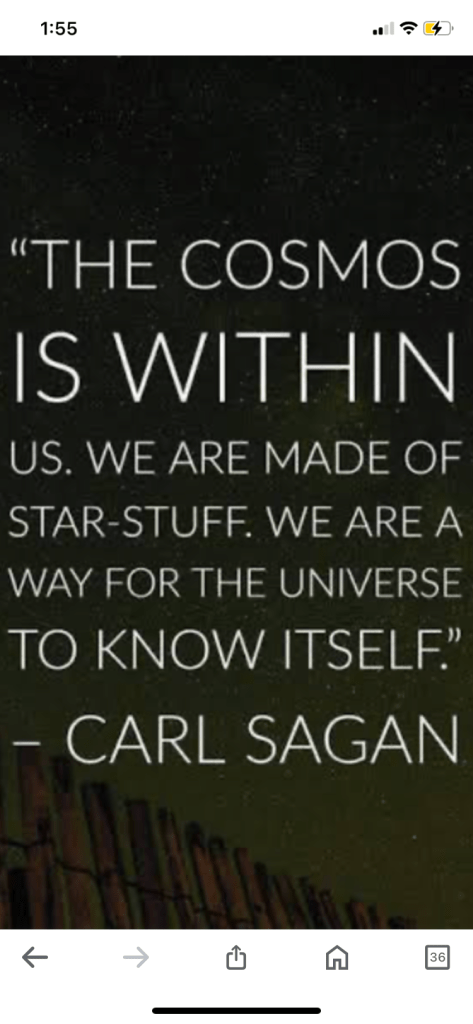
There’s no scientific evidence that humans become stars or sources of light when they die. However, when we die, our bodies are broken down and recycled into the ecosystem. Our atoms continue to exist long after we’re gone.
The phrase “we are all made of stardust” has both a scientific and philosophical meaning. It refers to the fact that the elements in our bodies, like carbon, oxygen, and iron, were created in the nuclear furnaces of stars. It also refers to the idea that all organisms share a common heritage, no matter where they come from.
The elements that make up our bodies were once flung into space as dust and gas (stardust). Eventually, they came together to become part of our planet Earth. About 86% of our mass is stardust.
In billions of years, when the Sun’s life ends, the stardust that was once inside us will become part of a new nebula. From that nebula, a new star may form.
The idea that humans are made of stardust refers to the fact that the elements in our bodies, such as carbon, oxygen, and iron, were forged in the nuclear furnaces of stars. However, there is currently no scientific evidence to support the idea that humans become literal stars or sources of light when we die
The phrase “we are all made of stardust” can also mean that you shine in what you do. It can also mean that you have been helpful and done a great job
Scientists say we are made of stardust because the elements that make up our bodies were created in the nuclear furnaces of stars
Carl Sagan famously said, “We are made of star stuff”. He was referring to the origin of many elements, like the calcium in our bones and the iron in our blood, that are forged in the last breaths of dying stars.
The DNA in our bodies is made up of carbon, hydrogen, oxygen, nitrogen, and phosphorus. All of these elements, except hydrogen, are made by stars and released into the cosmos when the stars die.
The phrase “we are all made of stardust” also suggests a deep connection between humans and other living things on Earth, as well as with the Earth itself.
Most of the elements of our bodies were formed in stars over the course of billions of years and multiple star lifetimes. However, it’s also possible that some of our hydrogen (which makes up roughly 9.5% of our bodies) and lithium, which our body contains in very tiny trace amounts, originated from the Big Bang
Yes, stardust is a scientific term. It refers to small fragments of dust-like material found in space. These fragments are made from cooling gases ejected from presolar stars. The dust grains are then incorporated into the cloud from which the Solar System condenses
Stardust can also refer to:
- A mass of distant stars appearing as tiny particles of dust
- A naively romantic quality
- A feeling or impression of romance, magic, or ethereality
Stardust is a scientific term referring to refractory dust grains that condensed from cooling ejected gases from individual presolar stars and incorporated into the cloud from which the Solar System condensed
The phrase “we are stardust” is a metaphor that highlights our connection to the universe. The phrase is not meant to be taken literally
The elements that make up our bodies were formed in stars over billions of years and multiple star lifetimes. However, some of our hydrogen and lithium may have originated from the Big Bang.
The Earth is partly made from stardust from red giant stars. This explains why the Earth contains more stardust than the asteroids or the planet Mars.
A survey of 150,000 stars shows that humans and their galaxy have about 97 percent of the same kind of atoms. The elements of life appear to be more prevalent toward the galaxy’s center
Carl Sagan, a NASA astrophysicist and popular science figure, famously said in the 1980s, “We are made of star stuff”. Sagan’s statement is not a metaphor, but rather a precise and poetic way of saying that the elements that make up our bodies were created in the cores of stars
Astrophysicist Hubert Reeves has also said, “We’re all made of stardust
astronomer Carl Sagan
Most of us are familiar with the saying, made popular by astronomer Carl Sagan, folk singer Joni Mitchell, and countless inspirational posters and billboards—We are stardust. Yet, how do we know that we’re stardust? Put another way, what’s the observational evidence that we’re made of elements forged in dying stars?
Albert Einstein said, “Human beings, vegetables, or cosmic dust, we all dance to a mysterious tune, intoned in the distance by an invisible piper
Here are some other quotes about cosmic dust:
- David Jones: “We are nothing but space dust, trying to find its way back to the stars”.
- Joanie Mitchell: “We are stardust”.
- Lawrence Krauss: “Every atom in your body came from a star that exploded. And, the atoms in your left hand probably came from a different star than your right hand. It really is the most poetic thing I know about physics: You are all stardust”.
We are made of the sea and the stars.They were created in the nuclear fusion fires of past generations of stars. We are all made of star dust.“
The short film Stardust illustrates a quote by Carl Sagan, “We are made of stardust”.
Stardust is also a 2007 film starring Ian McKellen as the narrator and Peter O’Toole as the king. Some say the movie is entertaining and appealing to kids, but it’s darker than other movies and has violence and sex
The 2007 movie Stardust has several messages, including:
- The importance of love, bravery, loyalty, and dedication
- The importance of being careful what you wish for
- The importance of not underestimating the value of things you don’t understand
- The importance of not focusing too much on what you think will make you happy, and neglecting the happiness that’s right in front of you
- The importance of proof, and what is real and true
The movie is about a young man named Tristan Thorne who goes on a quest to test his ability to love and face those who are enslaved to power. The movie’s main character’s purpose is to prove his love, and some say the romance makes the fantasy storyline stronger.
- “There are more stars in our universe than grains of sand on all of earth’s beaches.”
- “We live in a galaxy that is one of hundreds of billions of galaxies in the universe
Astronomers understand very well how extraordinary and stunning our existence is. How connected all of us are to each other and this incredible universe. Did you know that the iron in your blood, the blood that courses through your veins, came from a supernova explosion that occurred before our sun was formed? Did you know that the oxygen in your lungs came from nuclear reactions in stars that lived and died before our solar system was formed?…..Everyone on this pale blue dot (as Carl Sagan called it) is part of a unique community. We have much more in common than what sets us apart.”
Please like subscribe comment your precious thoughts on my blogs on universe discoveries ( a destination for latest universe discoveries and science discoveries)
Full article source google
Best pet supplies on heavy discount on Amazon Universe discoveries
I never knew this and I love the becoming a star theory!
LikeLike
Superb
LikeLike