
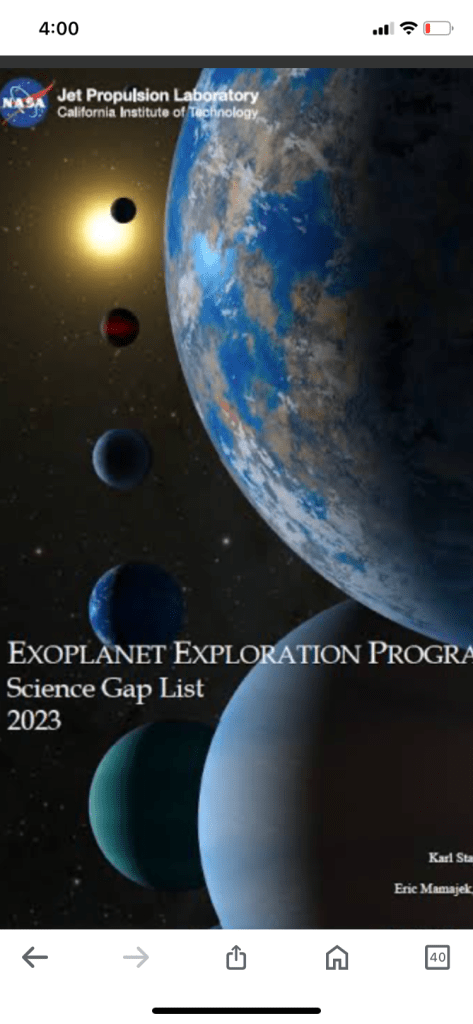
The first in a series of lectures leading up to the advent of the HWO. To tackle that part of the project, a NASA project known as the Exoplanet Exploration Program developed a list of 164 candidate exoplanets “whose [hypothetical] exo-Earths would be the most accessible” for the HWO.
On January 5, 2024, NASA’s Exoplanet Exploration Program (ExEP) released a list of 164 nearby exoplanets that are considered the most accessible for the Habitable Worlds Observatory (HWO) to survey for potentially habitable exoplanets.
The ExEP created a Mission Star List for HWO after the Astro2020 Decadal Survey was released. The list includes 164 stars whose hypothetical exo-Earths would be the most accessible for a systematic imaging survey of habitable zones.
Planning large astronomical missions can be a lengthy process, sometimes taking decades. For example, the James Webb Space Telescope took decades to become functional.
The Habitable Worlds Observatory (HWO) is a space telescope that will search for Earth-like planets around stars similar to our Sun. It will be the first NASA mission to look for signs of life on potentially habitable exoplanets.
HWO will be a large, stable telescope equipped with a coronograph, which allows scientists to study faint objects near bright objects. It will search the atmospheres of planets outside the solar system for biosignatures, or spectral signatures of key chemicals.
HWO is expected to directly image 20–30 Earth-like planets. If there’s even a small chance of life on an Earth-like world, HWO could discover our first inhabited planet beyond the Solar System
As of June 2021, 59 potentially habitable exoplanets have been found. Of the 1,780 confirmed planets beyond our solar system, 16 are located in their star’s habitable zone.
The Kepler mission, which ended in 2018, has identified over 2,800 confirmed exoplanets, with several thousand more candidates waiting to be confirmed. Researchers have identified several hundred planets in the habitable zone of their star in Kepler data.
One 2020 study that analyzed Kepler data calculated that the Milky Way could harbor as many as six billion Earth-like planets. Another estimated the number of potentially habitable planets in our galaxy at about 300 million.
The closest extrasolar planets overall to Earth are Proxima Centauri b, c, and d, each located 4.22 light years away. Proxima b is the closest potentially habitable planet to Earth.
Scientists have discovered several Earth-like planets, including:
- Kepler-186f The first Earth-sized planet found in the habitable zone of another star in 2014
- Kepler-452b A planet that’s 60% larger than Earth, but has a star that’s 10% larger than the sun. NASA considers this planet and its star to be the closest analog to Earth and the sun.
- TOI 700 e A planet that’s the same size as Earth and is in the habitable zone of its star
- Kepler-62f, Kepler-62e, and Kepler-62c Super Earth-sized planets that are less than twice the size of Earth
Japanese scientists also announced in September 2023 that they may have found an Earth-like planet in the Kuiper Belt, a disk of objects in the outer solar system. The planet is estimated to be 1.5–3 times the mass of Earth.
On January 5, 2024, NASA’s Exoplanet Exploration Program (ExEP) released a list of 164 nearby stars that are considered the most accessible for the Habitable Worlds Observatory (HWO) to survey for potentially habitable exoplanets.
The HWO is a proposed space telescope that would observe and detect biosignatures in the habitable zones of stars. It would use spectroscopy to search for chemical “biosignatures” in these planets’ atmospheres, including gasses such as oxygen and methane which could serve as critical evidence for life.
The HWO’s main objective would be to identify and directly image at least 25 potentially habitable worlds. It would gather data in optical, infrared, and ultraviolet light, representing an advancement over current observational technologies
The Habitable Worlds Observatory (HWO) is a NASA mission that would search for and characterize potentially habitable planets beyond our solar system. It would be the first NASA mission designed specifically to look for signs of life on potentially habitable exoplanets.
The HWO would be a large ultraviolet, optical, infrared space telescope. It would be the first specifically engineered to identify habitable, Earth-like planets next to relatively bright stars like our Sun with a coronagraph, and examine them for evidence of life.
The HWO’s primary mission is to observe 25 different exoplanets in their parent star’s habitable zones and look for biosignatures on them.
The HWO would help astronomers study exoplanets in the habitable zone, the region around a star where temperatures are suitable for liquid water.
Here are some promising exoplanets:
- TRAPPIST-1e This is one of seven Earth-sized planets orbiting TRAPPIST-1, which is 40 light-years away. Three of those planets are in the habitable zone, and TRAPPIST-1e is thought to be the most likely to support life.
- Kepler-186f This is the first Earth-sized planet discovered in the potentially habitable zone around another star.
- TOI 700 e This is an Earth-sized planet within the habitable zone of its star.
- Wolf 1069 b This is the sixth closest Earth-mass habitable zone exoplanet, at a distance of 31 light-years.
- Proxima b This is the closest potentially habitable planet to Earth, at a distance of 4.22 light years.
Mars is considered the most likely planet in our solar system to support life, based on its environment. Mars has a source of energy, water, and chemical building blocks. Recent discoveries have also shown evidence of liquid water beneath its surface, and the possibility of a subsurface ocean.
Other planets in our solar system that are considered likely to support life include: Europa, Enceladus, Titan.
Some conditions necessary for life to exist include:
- A stable source of energy
- A suitable atmosphere
- The presence of liquid water
Based on these criteria, Kepler 186f is also considered one of the most likely candidates for life.
Please like subscribe comment your precious thoughts on my blogs on universe discoveries ( a destination for latest universe discoveries and science discoveries)
Full article source google
Best pet supplies on heavy discount on Amazon Universe discoveries
Thanks for sharing this idea Anita
LikeLiked by 1 person
Welcome 🙏freinds
LikeLiked by 1 person
Thank you and greetings from Italy
LikeLiked by 1 person