
NASA has several plans to search for water ice on the moon’s south pole, including:
- Volatiles Investigating Polar Exploration Rover (VIPER) This rover will explore the south pole in late 2023 to search for water ice and other resources. In late 2024, VIPER will land on Mons Mouton to conduct the first resource mapping mission beyond Earth.
- Lunar Flashlight This SmallSat mission will orbit within 9 miles (15 kilometers) above the lunar south pole to search for water ice in the moon’s darkest craters.
- Lunar Trailblazer This orbiter will launch in 2023 to aid efforts to map water ice at greater depths.
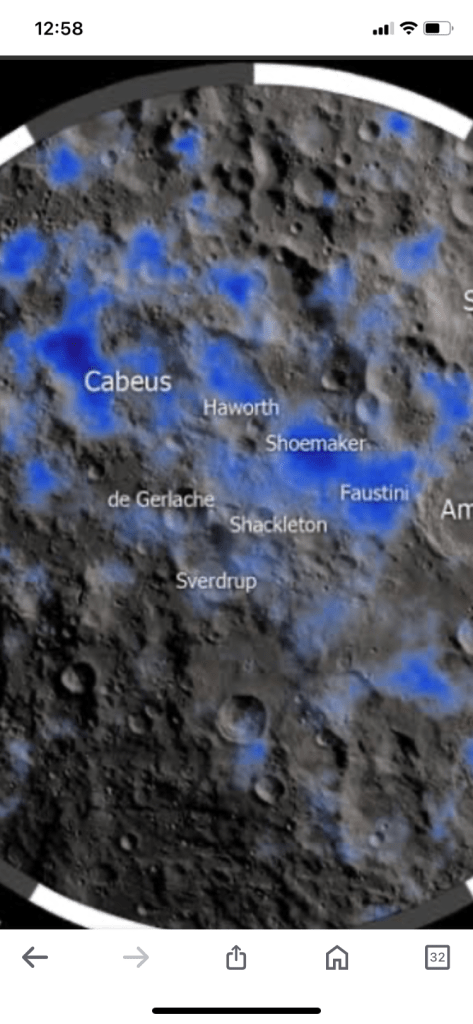
- ShadowCam This instrument is onboard South Korea’s first lunar orbiter, which launched in 2022. NASA’s Artemis missions also include the study of the moon’s south pole, which was the subject of a 2023 map of water distribution. Water on the moon could be extracted to provide liquid water for drinking and growing plants. It could also be separated into its components by electrolysis using solar energy, providing hydrogen and oxygen for breathing and rocket fuel.
In 2023, a new map of water distribution on the Moon provided hints about how water may be moving across the Moon’s surface. The map, made using SOFIA data, extends to the Moon’s South Pole – the intended region of study for NASA’s Artemis missions, including the water-hunting rover, VIPER
The moon’s south pole is a compelling location for future exploration missions and a potential site for a lunar outpost. The region is of particular interest to scientists because of the presence of water ice in permanently shadowed areas.
The south pole is believed to have the greatest potential for finding water ice, which could be used to support astronauts and make rocket fuel. Scientists also believe that the permanently shadowed places on the moon could contain ice and other minerals that would be vital resources for future explorers.
Some of the craters in the south pole region may have frozen water in them due to the angle of the sunlight. If so, it might be a good location for a testing base or colony
Interest in the lunar south pole as a landing site is mainly driven by the fact that scientists know the region hosts water in the form of ice. Water is, of course, essential for life as we know it — but it also has other uses. For instance, it can act as a coolant for equipment and even provide rocket fuel
NASA’s Artemis III mission is scheduled for 2026 and will be the first human mission to the moon’s south pole in over 50 years. The mission will involve four astronauts traveling to the moon’s orbit, where they will meet up with a SpaceX Starship rocket. Two astronauts will then descend to the moon’s south polar region.
The Artemis program is a NASA-led initiative that aims to re-establish a human presence on the moon for the first time since 1972. In 2024, NASA’s Artemis 2 mission will send four astronauts on a lunar flyby.
On August 23, 2023, India became the first country to land a spacecraft on the moon’s south pole. The Vikram lander touched down at 6:04 PM. India is also the fourth country to soft land on the moon, after the Soviet Union, the United States, and China.
The south pole is a relatively uncharted territory, full of craters and deep trenches that can make it difficult for spacecraft to land safely. However, some believe the region contains frozen water that could support future human exploration
The moon’s south pole is also known as the lunar south pole. It has unique craters on its surface that sunlight can’t reach. The region also has abundant resources like solar power, oxygen, and metals.
Here are some other reasons why the moon’s south pole is special:
- Rare Earth elements Some believe the moon’s surface contains rare Earth elements. If this is true, analyzing the lunar soil could help determine if these elements are present in a similar way to what is found on Earth.
- Astronomical radio signals The south pole has mountains and basins that face away from Earth. This makes it an ideal place to receive astronomical radio signals from a ground radio observatory.
- Extreme temperatures The moon’s south pole experiences extreme temperatures due to its location. Temperatures can drop to as low as -230 degrees Celsius (-382 degrees Fahrenheit) in shadowed regions. The moon’s south pole is also one of the harder places on the lunar surface to land. It is heavily boulder strewn, without the wide, flat expanses that the Apollo astronauts and early uncrewed landers targeted.
The lunar south pole is the southernmost point on the Moon. It is of interest to scientists because of the occurrence of water ice in permanently shadowed areas around it. The lunar south pole region features craters that are unique in that the near-constant sunlight does not reach their interior
Please like subscribe comment your precious thoughts on universe discoveries (a perfect destination for universe new discoveries and science discoveries)
Full article source google
Best pet supplies on discount on Amazon
https://4562erlm06s3gxe9wifapei7fk.hop.clickbank.net Universe discoveries