
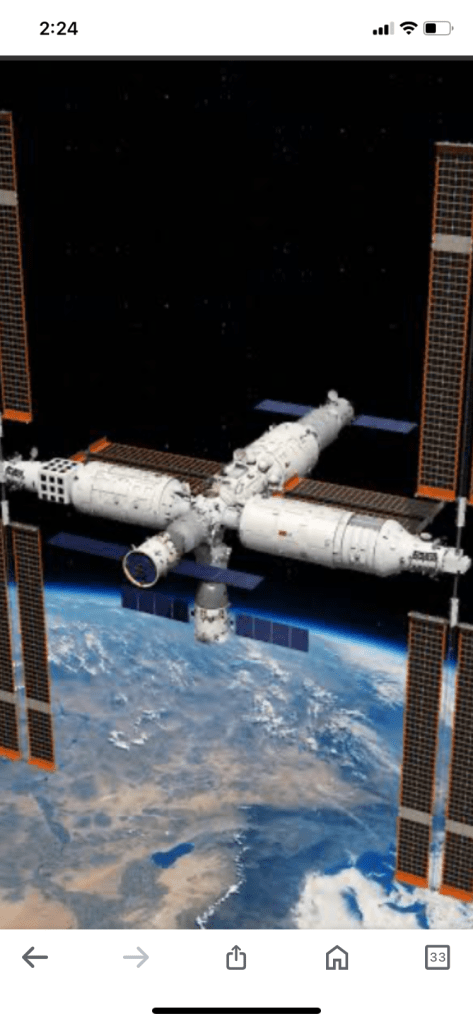
Scientists will study some of Earth’s earliest organisms on China’s space station, Tiangong. The experiment will test whether early life forms can create methane in a cosmic environment
The experiment involves sending archaea samples to the space station to assess the viability of early life forms in a simulated cosmic environment.
Tiangong is a three-module space station in low-Earth orbit. The core module, Tianhe, launched in April 2021, followed by the Wentian and Mengtian experiment modules in 2022. The station can support six astronauts at a time, but typically hosts three astronauts for six-month stays
Archaea samples have been sent to China’s space station to test whether early Earth life forms can create methane in a cosmic environment. China’s space station is set to host a scientific experiment aimed at assessing the viability of Earth’s early life forms in a simulated cosmic environment
Some scientists choose China’s space station for research because of its high-speed communications system. This system can send tens of gigabytes of data to the ground each day, allowing scientists to analyze data that might otherwise be discarded
The space station’s main purpose is for scientific research. It’s expected to host more than 1,000 scientific experiments over its lifetime of at least 10 years. These include studying the effects of microgravity on living tissues and the behavior of fires.
The space station also aims to provide opportunities for space-based experiments and a platform for building capacity for scientific and technological innovation
China is also conducting other space experiments, including:
- Microgravity tower A facility to conduct microgravity experiments on Earth to support space research.
- Xihe-2 solar exploration mission A mission to study the Sun, including the origin and evolution of magnetic fields and the structure and mechanism of solar bursts. The mission is expected to launch in 2026.
- Reusable robotic spacecraft A series of orbital test flights to develop reusable technologies to reduce space mission costs.
- Protein-crystallization experiments Experiments to study the effects of microgravity on plant cells, bone and muscle, and molten materials.
- Earth observation Experiments to study the effects of radiation and microgravity on diseases, and the development of solar cells. China’s space program also includes:
- Establishing a complete R&D and testing system for manned space projects
- Establishing a coordinated and complete national satellite remote-sensing application system
- Developing space science and exploring outer space
- Sending a robotic rover to Mars
- Launching a space telescope named Xuntian
Yes, China has sent people to space. In 2003, Yang Liwei became the first Chinese astronaut to travel to space on the Shenzhou 5 mission. In 2012, Liu Yang became the first Chinese woman to travel to space on the Shenzhou 9 mission. In 2021, Wang Yaping became the first Chinese woman to walk in space on the Shenzhou 13 mission
In May 2023, China sent three astronauts to the Tiangong Space Station, including the first civilian astronaut. The Shenzhou-16 mission included university professor Gui Haichao, who became the first civilian to travel to space.
Yes, three Chinese astronauts returned to Earth on October 31, 2023 after a six-month stay on the Tiangong space station. The astronauts, Jing Haipeng, Zhu Yangzhu, and Gui Haichao, emerged from the return capsule near the Jiuquan Satellite Launch Center on the edge of the Gobi Desert
The astronauts left for space on June 5, 2022 to oversee the final construction stage of the Tiangong space station, which was completed in November 2022
Some scientists choose China’s Tiangong space station for research because of its high-speed communications system. The station’s transmission rates can reach up to 1.2 Gbps, which is double the International Space Station’s (ISS) rates. This allows scientists to send tens of gigabytes of data to the ground each day.
The station’s high-speed communications system also allows scientists to analyze data that may contain discoveries, such as weak gamma-ray bursts or other astrophysical events.
The Tiangong space station can also test over 100 high-performance computer chips at once. Some Chinese space experts believe that in the coming years there will be a high demand for low-cost space-grade chips.
The Tiangong space station is preparing to host 1,000 scientific experiments. Researchers say the station is a welcome addition for astronomical and Earth observation, and for studying how microgravity and cosmic radiation affect phenomena such as bacterial growth and fluid.
Archaea samples were sent to China’s space station on January 18, 2024 to test if early life forms can create methane in a cosmic environment. The samples will undergo scientific testing to assess their ability to survive in the simulated atmospheric environment of Mars and other extreme conditions.
Archaea are a major contributor to Earth’s atmospheric methane. They can thrive with just hydrogen and carbon dioxide, and then transform into methane.
The CHEESE project aims to test whether methane-producing microorganisms, or methanogens, can survive in the environments inside and outside the space station.
Please like subscribe comment your precious thoughts on universe discoveries (a perfect destination for universe new discoveries and science discoveries)
Full article source google
https://4562erlm06s3gxe9wifapei7fk.hop.clickbank.net Universe discoveries
China always makes things at a cheap cost! But India is also doing great about space.👌 technology well shared
LikeLiked by 2 people
Yes in space race China and USA are still leaders 😊but soon india 🇮🇳 will have its space station then things will change 🙏
LikeLiked by 2 people
☺️🙏
LikeLike
Absolutely true let’s celebrate India’s win ..all the country doing their bit
LikeLiked by 1 person
A beautiful science article with good sharing 💥
LikeLiked by 1 person
Thanks dear friend 🌹
LikeLiked by 1 person
That’s so fascinating. Thank you.
LikeLike