
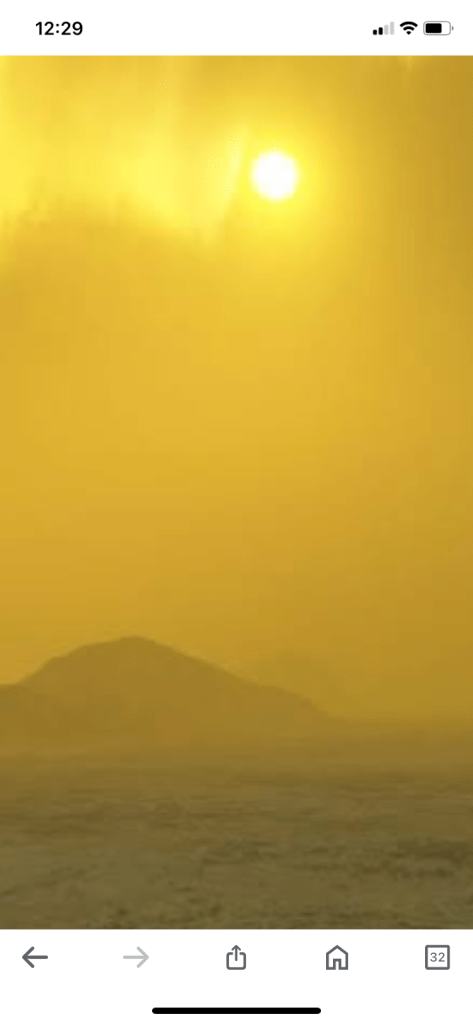
Venus is no longer able to sustain life due to a runaway greenhouse effect. The greenhouse effect is caused by the planet’s thick atmosphere, which traps heat from the sun and raises the temperature to extreme levels. The greenhouse effect turned all surface water into vapor, which then leaked slowly into space
Venus is also wrapped in suffocating layers of a poisonous atmosphere made of carbon dioxide and sulfuric acid.
Some say that geological occurrences caused the “hot death” of Venus. A NASA study suggests that volcanoes may have played a role in destroying Venus and leaving it as an uninhabitable world. Researchers found that it was due to the volcanic activity lasting hundreds to thousands of centuries and erupting massive amounts of material
Solar radiation pummeled it, disassociating its chemical bonds and sending the oxygen and hydrogen flying away, joining a grim procession beyond our solar system. If Venus had plate tectonics like the Earth, then this is where that process came to end
According to a 2020 study, Venus has retained most of its water over the past 4 billion years. However, other studies suggest that Venus may have had surface water and habitable conditions for up to 3 billion years, until around 700 to 750 million years ago.
According to the European Space Agency, the solar wind has been carrying off particles from Venus’ upper atmosphere into space for 4.5 billion years.
Some say that Venus’ climate conditions never allowed water vapor to condense in the atmosphere. This is because the temperatures were never low enough for raindrops to form and fall.
However, other models suggest that Venus may have had a moderate surface temperature and bodies of liquid water on its surface as recently as 700 million years ago.
Some say that Venus may have had oceans billions of years ago. However, others say that Venus never had oceans because the climate conditions didn’t allow water vapor to condense in the atmosphere.
According to one theory, Venus’ oceans boiled off due to a runaway greenhouse effect. The rising temperatures caused the ocean to boil, which triggered the greenhouse effect. Then, sunlight split the water molecules, allowing hydrogen to escape into space.
Another theory suggests that Venus’ oceans evaporated into space due to its close proximity to the sun. The sun’s ultraviolet rays quickly evaporated water, keeping the planet in a prolonged molten state.
Imagine our sister planet Venus billions of years ago being an ocean-filled world like Earth is today. The thinking is that at some point Venus underwent a “runaway greenhouse” where the surface became so hot the oceans boiled off, leaving a barren surface too hot for life of any kind
Venus’s water has evaporated into space. The water molecules were broken apart by solar radiation, and the hydrogen escaped into space. The oxygen became trapped in the planet’s surface rocks and turned into carbon dioxide.
The solar wind, a stream of charged particles emitted by the sun, also carried the lighter hydrogen gas away into space.
Venus has no protection against the solar wind, which can strip away molecules from the atmosphere. Earth has a shielding magnetosphere that protects it from the solar wind.
Venus is uninhabitable because of its dense, toxic atmosphere and surface temperature. The planet’s atmosphere is made up of 95-97% carbon dioxide, which is too rich for life to exist. The surface temperature averages 465°C (870°F), which is too hot for humans or known life forms to survive
Venus’ surface is also blasted by high temperatures and pressures. The air pressure on the surface is over 90 times that of Earth.
Some say that Venus was once more Earth-like, but climate change made it uninhabitable. A study from the University of Chicago argues that there is little chance the planet was ever habitable
Venus and Earth could have been twin-like planets, but Venus became uninhabitable. The reason is a runaway greenhouse effect, which was triggered by volcanic activity and the loss of water from Venus’ atmosphere. This process condemned Venus to become the hellish landscape it is today.
Some scientists believe that Venus may have once been habitable for microbial life. Venus is roughly the same mass as Earth and is often called Earth’s twin. Scientists think that Venus may have had oceans and an atmosphere that could have supported life as we know it
In 2020, scientists announced the discovery of phosphine on Venus. This compound of phosphorus and hydrogen could be associated with life. If there is life in Venus’ clouds, researchers believe it to be an aerial form, existing only in Venus’ temperate cloud deck
Some scientists believe that Venus may have been habitable for microbial life for up to 2 billion years
Here are some reasons why scientists believe Venus may have been habitable:
- Liquid water Liquid water is key to life as we know it. Some models suggest that Venus may have had a shallow liquid-water ocean and habitable surface temperatures for up to 2 billion years.
- Phosphine Phosphine is a compound typically associated with microbial activity on Earth. Scientists have found phosphine in the acidic clouds floating above Venus. However, the initial detection of phosphine has come under scrutiny, and further observations are needed to resolve the debate.
- Early formation Some modeling suggests that water could have existed for 1 billion to 3 billion years.
- Weathering processes Weathering processes can keep the atmospheric CO2 low enough to maintain liquid surface water for almost one billion years. However, Venus’ surface is a boiling hot landscape, with temperatures reaching 900 degrees Fahrenheit and a stifling air that is drier than the driest places on Earth.
In 2020, scientists detected phosphine gas in the clouds of Venus. Phosphine is a poisonous gas that is typically released by living organisms. The gas was detected at a depth deeper than previously observed
Astronomers detected a spectral fingerprint, or light-based signature, of the gas phosphine in Venus’ atmosphere. Scientists had previously shown that if this poisonous gas were detected on a rocky, terrestrial planet, it could be produced only by a living organism.
However, to date, no definitive evidence has been found of past or present life on Venus
Phosphine is considered a “biosignature”, which is a molecule that is strongly associated with life’s chemistry. It has few non-life methods of production, especially on a rocky planet like Venus.
On Earth, microbes that live in oxygen-free environments create phosphine. This means that there is a chance that living organisms have been found in the clouds of Venus.
However, most astronomers believe that it would be impossible for life to exist on Venus. Venus is a very dry planet with no evidence of water, its surface temperature is hot enough to melt lead, and its atmosphere is so thick that the air pressure on its surface is over 90 times that on Earth
A runaway greenhouse effect turned all surface water into vapor, which then leaked slowly into space. The present-day surface of volcanic rock is blasted by high temperatures and pressures. Asked if the surface of Venus is likely to be life-bearing today, we can give a quick answer: a hard “no.”
According to Universe Today, solar radiation can break down chemical bonds and send oxygen and hydrogen flying away. This can happen when an object absorbs solar radiation, which is energy emitted by the sun through electromagnetic waves.
Ionizing radiation can also damage molecules by extracting electrons from them. These electrons can then create ions that can cause bond dissociation.
Solar radiation also heats the atmosphere directly and indirectly. This can lead to the warming of the surface and the movement of the atmosphere.
Solar radiation is also important for life on Earth. It helps determine atmospheric and climatological trends and dynamics, and it also makes photosynthesis possible
Solar radiation pummeled it, disassociating its chemical bonds and sending the oxygen and hydrogen flying away, joining a grim procession beyond our solar system. If Venus had plate tectonics like the Earth, then this is where that process came to end
Please like subscribe comment your precious thoughts on universe discoveries (a perfect destination for universe new discoveries and science discoveries)
Full article source google
https://4562erlm06s3gxe9wifapei7fk.hop.clickbank.net Universe discoveries
Nice. Your good
LikeLiked by 1 person
Thanks a lot dear friend 😊
LikeLiked by 1 person