

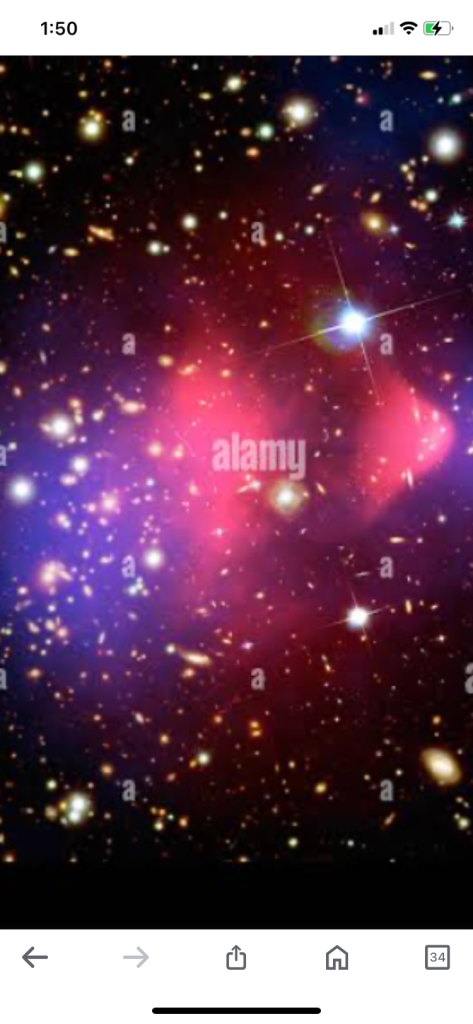
Hubble Space Telescope’s view of a galactic collision gets turned into beautiful song. An image of two merging galaxies has been turned into music using a technique called data sonification. NASA has composed a beautiful melody to represent the cosmic collision of two galaxies
The Hubble Space Telescope captured an image of two galaxies colliding. Scientists used data sonification to transform the image into a musical composition. The piece represents the cosmic collision with a melody.
Hubble’s two mirrors collect and focus light. The telescope’s observations of galaxies have helped scientists understand that the universe is expanding
Data sonification is the process of translating data into sound. This can be done for a variety of purposes, such as to make data easier to understand, to communicate it to a wider audience, or to create new forms of art and music.
In the case of the image of two merging galaxies, the data was first converted into a series of pitches and durations. The pitches were assigned based on the color of the pixels in the image, and the durations were assigned based on the brightness of the pixels. The resulting piece of music is a unique and beautiful interpretation of the data, and it provides a new way to experience the image.
Data sonification has the potential to be a powerful tool for understanding and communicating data. It can be used to make complex data more accessible to a wider audience, and it can also be used to create new forms of art and music. As the technology continues to develop, we can expect to see even more innovative and creative uses of data sonification in the future.
The Hubble Space Telescope captured a spectacular head-on collision between two galaxies that created a triangular-shaped star-birthing frenzy. The interacting galaxy duo is collectively called Arp 143.
The Hubble Space Telescope has also helped pin down the age for the universe now known to be 13.8 billion years, roughly three times the age of Earth. It discovered two moons of Pluto, Nix and Hydra. It helped determine the rate at which the universe is expanding. It also discovered that nearly every major galaxy is anchored by a black hole at the centre.
Large galaxies merged with each other on average once over the past 9 billion years. Small galaxies coalesced with large galaxies more frequently. The Milky Way and the Andromeda Galaxy are predicted to collide in about 4.5 billion years.
Here are some examples of galaxy collisions:
- Andromeda–Milky Way collision This collision is expected to occur in about 4.5 billion years between the Milky Way and the Andromeda Galaxy.
- Butterfly Galaxies These two spiral galaxies, NGC 4567 and NGC 4568, are slowly colliding and merging to look like butterfly wings.
- Medusa Merger This merger is located in Ursa Major, and the ejected dust is said to look like the snakes of the Gorgon Medusa.
- VV 340 Also known as Arp 302, this deep space object is an example of two colliding galaxies. Galaxy collisions are a natural part of galaxy formation. Scientists believe that elliptical galaxies are formed from the collision of two galaxies, usually spiral galaxies.
When two galaxies collide, they can create new forms and shapes. The collision can cause the following:
- Tidal waves These can cause objects to change their orbital periods, which can distort or rip apart galaxies.
- Black holes The supermassive black holes at the center of the galaxies will merge into a single, larger black hole. This collision creates gravitational waves that move outward.
- Star formation The gas that pours toward the center of the galaxies can ignite a star formation explosion. This can produce stars more than 100 times faster than either galaxy can today.
- Globular clusters When disk galaxies collide, they can form new globular clusters.
- New galaxies The collision can create a new, larger galaxy. For example, the collision between the Milky Way and Andromeda will create a giant elliptical galaxy. Galaxy mergers are the most violent type of galaxy interaction. The gravitational interactions between galaxies and the friction between the gas and dust have major effects on the galaxies involved.
As the stellar stuff of colliding galaxies migrates in, so will the gigantic black holes that scientists believe sit at the centers of most large galaxies. The dense, invisible objects will plow through like invisible meteors, dragging stars along with them (and perhaps swallowing some) as they go
When the Milky Way and Andromeda collide, they will merge to create a new galaxy called Milkomeda or Milkdromeda. This new galaxy will be elliptical, which is less structured and ordered than the spiral galaxy we live in today
The collision will cause the following:
- Tidal forces The two galaxies will undergo tidal forces, which will cause their shape to distort and new stars to form.
- Black holes The supermassive black holes at the center of the two galaxies will merge, which could release a huge amount of energy.
- Orbits and structure The gravitational interactions will likely change the orbits of many stars, which will rearrange the galaxy’s structure.
- Appearance The new galaxy will look like an insect’s antennae. The collision will also cause a massive amount of chaos, with huge amounts of rocks, dust, asteroids, planets, and stars being thrown in all directions.
Please like subscribe comment your precious thoughts on universe discoveries (a perfect destination for universe new discoveries and science discoveries)
Please donate a coffee if you like the article
Full article source google

Best books on discount on Amazon
https://4562erlm06s3gxe9wifapei7fk.hop.clickbank.net Universe discoveries