
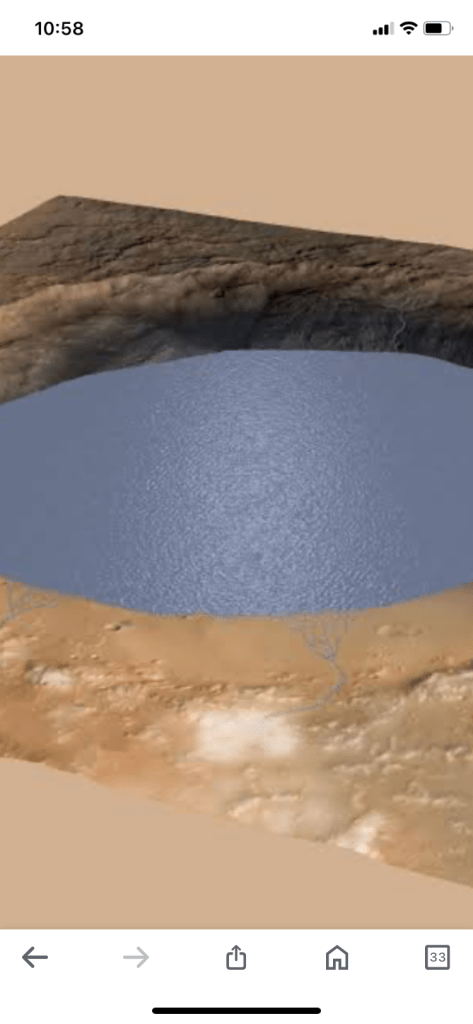
NASA’s Perseverance rover has found evidence of an ancient lakebed in Jezero Crater on Mars. This discovery suggests that the planet may have supported microbial life in the past
The rover’s radar observations also revealed sedimentary-like features similar to river deltas on Earth. The crater floor has layers of sediments that appear regular and horizontal, similar to Earth’s strata layers.
The rover has also found a diverse set of organic molecules in a Martian crater. Organic compounds are molecules made of carbon, and often include other elements like hydrogen, oxygen, nitrogen, phosphorus, and sulfur.
Data from NASA’s Perseverance rover confirms that the Jezero Crater on Mars, where the robot landed in 2021, was once filled with water. If life ever existed on Mars, the verification of an ancient lake at the site provides the best hope of finding signs of organisms having once inhabited the Red Planet
Perseverance will search for signs of microbial life by collecting rock core samples and examining them for preserved biosignatures. The rover will also use a camera mounted to its robotic arm called PIXL to look for signs of microscopic life. PIXL can see features as small as a grain of salt.
Perseverance will also use Raman spectrometers to identify organic compounds and biological molecules on Mars’ surface. A Raman spectrometer uses a laser to excite molecules, and then the way these excited molecules scatter light tells scientists what kind of molecules they are.
Perseverance will collect some of the rocks it examines and place them at the base of the delta to be retrieved by later missions. Future missions would return these samples to Earth for deeper study.
The Perseverance rover has found a number of things on Mars, including:
- Evidence of flowing water
- Igneous rocks
- Rich sedimentary rock layers
- Sandstone and mudstone
- Evidence of boulders that originated elsewhere
- Nutrients and energy sources that microbes could have used The rover has also collected a variety of samples, including: Sedimentary rocks, Igneous rocks, Regolith. The rover’s findings suggest that Mars may have had regions that could have supported life in the past.
In 2013, scientists announced that Mars may have supported microbial life in the distant past. The announcement came after NASA’s Curiosity rover analyzed the first sample collected from the interior of a Martian rock.
The rover’s observations suggest that microbial life could have survived on Mars when the planet was warmer and wetter. Researchers believe Mars likely had a global subsurface habitable zone that was several kilometers thick. In this zone, hydrogen production would have generated enough chemical energy to support microbial life.
The rover’s analysis also suggests that an ancient network of rivers on Mars once made parts of the planet habitable for microbial life.
According to nationalgeographic.com, everything we’ve learned about Mars suggests that the planet was once capable of hosting ecosystems and that it might still be an incubator for microbial life today.
According to NASA, there’s no evidence of life beyond Earth. Some say it’s unlikely that any planet in our solar system has life. Microbes that travel to other planets on spacecraft are likely destroyed by the sun’s ultraviolet radiation.
However, in 1996, scientists discovered evidence of microscopic fossil life in a meteorite from Mars. In 2019, microorganisms were found on the International Space Station, including bacteria and fungi
As of 2022, there’s no conclusive evidence of past or present life on Mars.
In 1996, scientists announced that they found evidence of ancient life on Mars. This evidence included bacteria-shaped objects and organic chemical molecules in the Martian meteorite ALH 84001. However, the claim was later rejected.
NASA’s Curiosity and Perseverance rovers have found organic matter on Mars. However, this isn’t a conclusive sign of life because it could have been created by non-biological chemistry.
A new study using data from NASA’s Mars Perseverance rover has found potential evidence of organic molecules on Mars. This indicates a complex organic geochemical cycle and the possibility of prolonged habitability.
According to Cosmosmagazine.com, the discovery of an ancient lake on Mars provides the best hope of finding signs of organisms that may have once lived on the planet.
In 2021, NASA’s Perseverance rover landed in the Jezero Crater on Mars. The rover’s scans confirmed what scientists had previously suspected: that the crater was once filled with water. The findings offer hope that traces of life may be found in the crater, possibly in rock samples.
According to Space.com, there is evidence that Mars was once a habitable planet with a thicker atmosphere and liquid water on its surface. However, the surface of Mars is currently bathed in ionizing radiation, and its soil is rich in perchlorates that are toxic to microorganisms.
Here are some things we’ve learned about Mars:
- Water Mars has a thin atmosphere, and most of the water on the planet is now in icy dirt and clouds. However, there is evidence that Mars was once wet, with signs of ancient floods.
- Magma NASA’s Perseverance rover has recorded the sound of Mars, and discovered molten magma beneath the surface.
- Auroras Mars has local magnetic fields, and auroras can be found all around the planet.
- Magnetic field Mars has a mosaic of local magnetic fields, and auroras aren’t confined to the poles like they are on Earth.
- Size Mars is smaller than Earth, but its land area is roughly the same as Earth’s continents.
- Surface Mars has a rocky surface, and its red color comes from iron in the soil that rusts.
- Moons Mars has two moons, Phobos and Deimos.
- Meteorite collection Earth has about 50 Martian meteorites, which are believed to have been ejected from Mars by large impacts.
Modern Mars is a vast desert of sand dunes, ripples, dust devils, and streaks of materials deposited by wind. Dust even covers icy deposits at the poles. But the surface of the Red Planet has been wet at times. Both Mars rovers as well as orbiters have found plenty of evidence for water in the past
Please like subscribe comment your precious thoughts on universe discoveries (a perfect destination for universe new discoveries and science discoveries)
Full article source google
Best books on discount on Amazon
https://4562erlm06s3gxe9wifapei7fk.hop.clickbank.net Universe discoveries
👏👏👏
LikeLiked by 1 person
Say hi😊🪶
LikeLiked by 1 person
Could not see your responds!!
LikeLike