
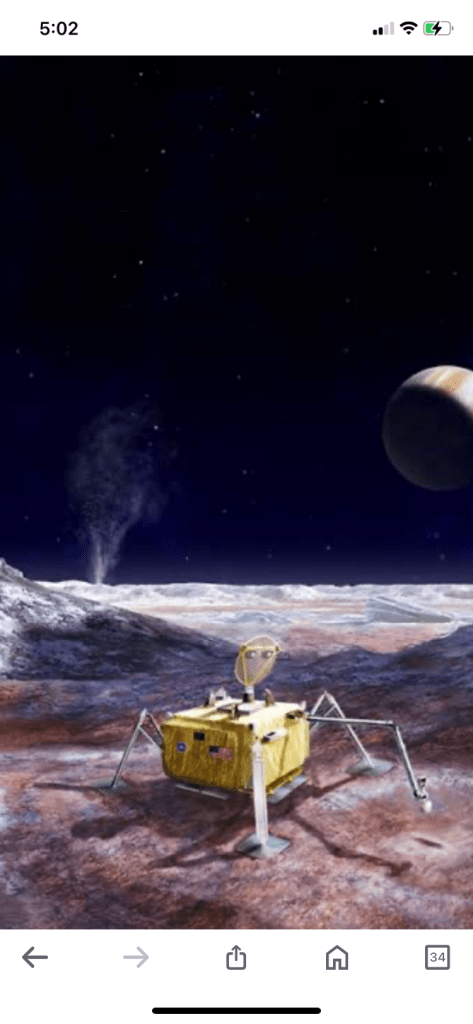
According to NASA, a spacecraft will land on Europa and collect samples from about 10 centimeters beneath the surface to look for signs of life. The spacecraft’s landing gear has legs that can absorb the landing of a heavy spacecraft.
NASA’s Europa Clipper spacecraft will perform close flybys of Europa, Jupiter’s moon. Europa has strong evidence of an ocean of liquid water beneath its icy crust. Scientists believe there’s a rocky seafloor at the bottom of Europa’s ocean, and hydrothermal activity could provide chemical nutrients that could support life.
The Europa Clipper’s infrared spectrometer will map the composition and distribution of ices, salts, organics, and the warmest hotspots on Europa. The maps will help scientists understand the moon’s geologic history and determine if Europa’s suspected ocean is suitable for life.
The agency recently released images of the mission’s unique landing gear, whose legs can absorb a heavy spacecraft’s landing. Taken together, the lander’s metal appendages make the craft look spider-like. Engineers are preparing to test these legs on a platform that will mimic a landing on Europa
NASA’s Europa Lander is a proposed mission to send a spacecraft to Europa, one of Jupiter’s moons, to collect samples from about 10 centimeters beneath the surface. The samples would be studied for signs of life
The Europa Lander is a large strategic science mission that would be launched in 2027. The mission would complement the Europa Clipper orbiter mission, which is scheduled to launch in October 2024 and arrive at Jupiter in 2030. The Europa Clipper will study Europa through a series of flybys to determine if it could support life.
Europa is one of Jupiter’s largest moons and the sixth-closest to the planet. It’s considered one of the most promising places in our solar system to find habitable environments. Europa’s surface temperature averages about -160°C at the equator and -220°C at the poles, keeping its icy crust as hard as granite.
If life exists in that ocean, signs of its existence called biosignatures could potentially find their way to the surface. In this mission concept, a spacecraft would land on Europa and collect and study samples from about 4 inches (10 centimeters) beneath the surface, looking for signs of life
The Europa Clipper Magnetometer (ECM) will measure Europa’s magnetic field during flybys to confirm the existence of a subsurface ocean. The ECM will also measure the ocean’s depth, salinity, and the thickness of Europa’s ice shell
The ECM will study the magnetic field that Jupiter’s magnetosphere induces in Europa’s ocean to learn about the ocean’s depth, salinity, and ice shell thickness. The thickness of the ice shell is important for the ocean’s potential habitability.
The Europa Clipper will also carry an ice-penetrating radar instrument to characterize the ice shell and reveal potential water pockets
The Europa Clipper mission will investigate whether Europa’s subsurface ocean could be a suitable habitat for extraterrestrial life. The mission will study the ocean’s chemistry, how the ocean and surface exchange material, and how radiation alters compounds on the surface.
Europa Clipper will also examine the moon’s icy shell, surface geology, and current activity. The mission will determine whether Europa and similar worlds with global oceans could support life.
Europa may have the necessary ingredients for life as we know it: water, energy, and complex molecules known as organics. Europa’s smooth and icy surface with very few impact craters suggests a young and active surface. This could be due to the presence of a subsurface ocean that allows the ice to move and reform, erasing older features.
Europa’s subsurface ocean may have formed due to tidal heating. Tidal flexing, or the squeezing in and out of Europa as it orbits Jupiter, creates heat that may be enough to maintain a liquid ocean. This heat may have also melted ice to produce the ocean
Europa’s ocean may have also formed when water-rich minerals ejected their water due to heating from the decay of radioactive elements. The heating and increased pressure would have caused a breakdown of water-containing minerals, releasing trapped water and creating the ocean.
Scientists believe that Europa’s hidden ocean is salty and tidal, causing its ice surface to move and create large fractures. The fresh icy surface of Europa, which is covered with cracks and ridges, is the external signature of a vast internal salty ocean
Europa is considered a more compelling target for the search for life than Ganymede for a few reasons:
- Ocean proximity Europa’s ocean is closer to the surface than Ganymede’s. This means that chemicals generated on the surface can easily be transported into the ocean.
- Ocean composition Europa is thought to have one giant ocean, while Ganymede is thought to have multiple ocean layers separated by ice.
- Seafloor Europa’s ocean is thought to sit on a rocky seafloor, which could provide nutrients and thermal vents to sustain life.
- Water–rock interaction Models suggest that high-pressure ice layers cover Ganymede’s seafloor, preventing significant water–rock interaction. Europa is one of the most likely places in the solar system to support life. Scientists believe that Europa has a salty ocean with about twice as much water as Earth’s oceans combined. Many scientists believe that this ocean could support living microorganisms similar to bacteria found on Earth
Scientists think Europa has a salty ocean beneath its icy crust with about twice as much water than all of Earth’s oceans combined. Water dissolves nutrients for organisms to eat, transports important chemicals within living cells, supports metabolism, and allows those cells to get rid of waste
Please like subscribe comment your precious thoughts on universe discoveries
Full article source google
Best products for health and beauty on discount on Amazon Universe discoveries
Interesting article. I have always been fascinated with oceans and the life forms that inhabit them. Thanks for sharing.
LikeLike