
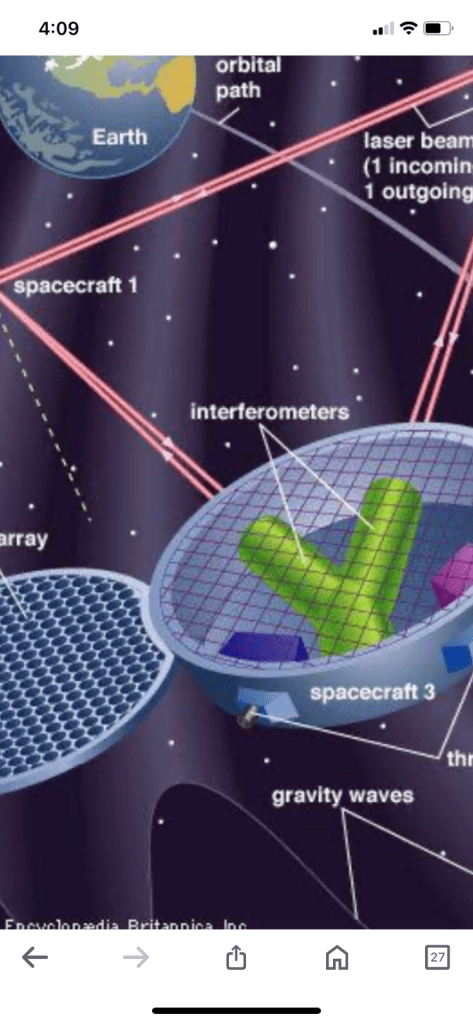
The Laser Interferometer Space Antenna (LISA) is a space-based gravitational wave observatory. The mission is a collaboration between NASA, ESA, and an international group of scientists
LISA’s primary goal is to detect and measure gravitational waves created by mergers of supermassive black holes and compact binary systems. LISA will observe gravitational waves by measuring changes in the length of its arms, which are 2.5 million kilometers long.
LISA will be sensitive to gravitational waves with wavelengths between 300,000 kilometers and 3 billion kilometers. This is longer than the wavelengths detected on Earth by LIGO, but shorter than those seen by pulsar timing arrays.
LISA will be the first telescope to find and study gravitational waves in space. These waves are tiny ripples in space-time.
The science of studying gravitational waves just got a big boost thanks to the European Space Agency. Its science program committee just approved the Laser Interferometer Space Antenna—affectionately known as LISA—for official planning and building. That means gravitational wave astronomers will take their next steps to capture information about gravity waves from space
The Next Steps
The decision to forge ahead with LISA is a formal step called “adoption”. It basically says that the technology for the mission and the concept and timeline are good to go. That allows the agency to go ahead with building the spacecraft and its instrumentation. From this point, the agency is now free to solicit and select contractors for fabrication. The design and assembly process could begin as early as January 2025.
LISA’s Gravitational Wave Targets
This intricate mission should be able to capture the ripples in spacetime produced when massive objects collide. That includes the mergers of supermassive black holes at the hearts of galaxies. In our own galaxy, LISA should be able to detect the mergers of white dwarfs or neutron stars. Its data should give astronomers precise information about the distances to these events and even their locations
One very exciting possibility that LISA could enable is the detection of the very first seconds after the Big Bang occurred. That’s because gravitational waves from that seminal event will carry distance and intensity information
Today, ESA’s Science Programme Committee approved the Laser Interferometer Space Antenna (LISA) mission, the first scientific endeavour to detect and study gravitational waves from space.
LISA is not just one spacecraft but a constellation of three. They will trail Earth in its orbit around the Sun, forming an exquisitely accurate equilateral triangle in space. Each side of the triangle will be 2.5 million km long (more than six times the Earth-Moon distance), and the spacecraft will exchange laser beams over this distance. The launch of the three spacecraft is planned for 2035, on an Ariane 6 rocket.
Bringing ‘sound’ to the cosmic movie
Just over a century ago, Einstein made the revolutionary prediction that when massive objects accelerate, they shake the fabric of spacetime, producing miniscule ripples known as gravitational waves. Thanks to modern technological developments, we are now able to detect these most elusive of signals.
“LISA is an endeavour that has never been tried before. Using laser beams over distances of several kilometres, ground-based instrumentation can detect gravitational waves coming from events involving star-sized objects – such as supernova explosions or merging of hyper-dense stars and stellar-mass black holes. To expand the frontier of gravitational studies we must go to space,” explains LISA lead project scientist Nora Lützgendorf.
LISA will detect, across the entire Universe, the ripples in spacetime caused when huge black holes at the centres of galaxies collide. This will enable scientists to trace the origin of these monstrous objects, to chart how they grow to be millions of times more massive than the Sun and to establish the role they play in the evolution of galaxies.
For centuries we have been studying our cosmos through capturing light. Coupling this with the detection of gravitational waves is bringing a totally new dimension to our perception of the Universe,” remarks LISA project scientist Oliver Jennrich
Golden cubes and laser beams
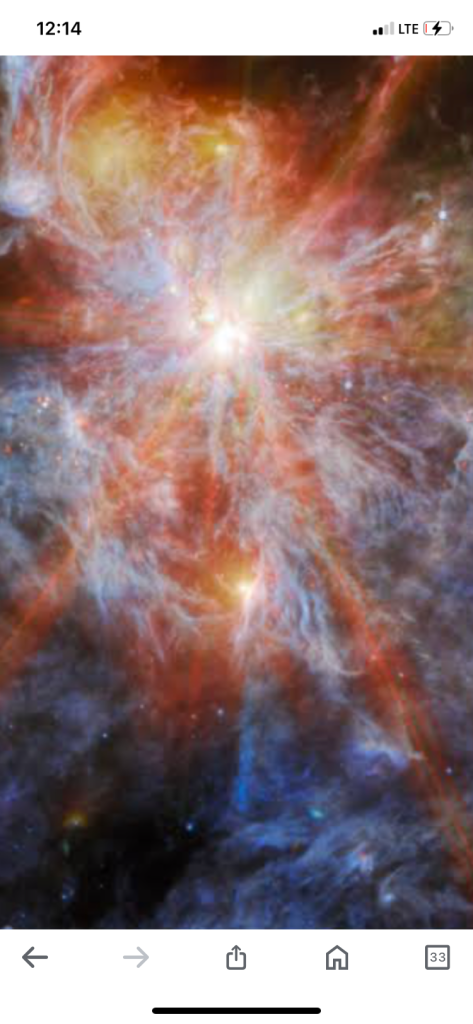
To detect gravitational waves, LISA will use pairs of solid gold-platinum cubes – so called test masses (slightly smaller than Rubik’s cubes), free-floating in special housing at the heart of each spacecraft. Gravitational waves will cause tiny changes in the distances between the masses in the different spacecraft, and the mission will track these variations using laser interferometry.
What will be one of the most ambitious and most expensive space missions ever mounted by Europe has just been given the formal green light.
The Laser Interferometer Space Antenna (Lisa) will try to detect ripples in the fabric of space-time generated when gargantuan black holes collide.
These gravitational waves will be sensed by three spacecraft firing lasers at each other over a distance of 2.5 million km (1.5 million miles).
The cost will run into the billions.
Scientists believe that studying gravitational waves will help answer important questions about the workings and history of the Universe.
LISA detects gravitational waves by measuring the changes in distance between free-falling test masses inside the spacecraft. The spacecraft are connected by laser beams that form the arms of a laser interferometer.
LISA will detect gravitational waves by measuring differential changes in the length of its arms. The satellites will fly in an equilateral triangle around the Sun, 2.5 million kilometers apart. Laser beams sent through optical telescopes on each satellite will measure the displacements between pairs of satellites.
LISA will observe gravitational waves produced by compact binary systems and mergers of supermassive black holes
Mission descriptionLISA- will observe gravitational waves by measuring differential changes in the length of its arms, as sensed by laser interferometry
The Laser Interferometer Space Antenna (LISA) is a gravitational-wave observatory that uses three spacecraft to detect gravitational waves. The spacecraft are arranged in an equilateral triangle with sides 2.5 million kilometers long. The distance between the satellites is precisely monitored to detect a passing gravitational wave.
LISA uses laser interferometry to measure the separation of free-floating reference surfaces in each satellite. The separation is measured over the 2.5 million km long “arms” to detect and measure minuscule variations caused by a passing gravitational wave.
LISA is designed to observe gravitational waves from violent events in the Universe. By measuring distance changes in these arms caused by passing gravitational waves, LISA will be able to measure their amplitude, direction, and polarization.
Please like subscribe comment your precious thoughts on universe discoveries
Full article source google
Best kitchen and housewares items on discount on Amazon Universe discoveries