
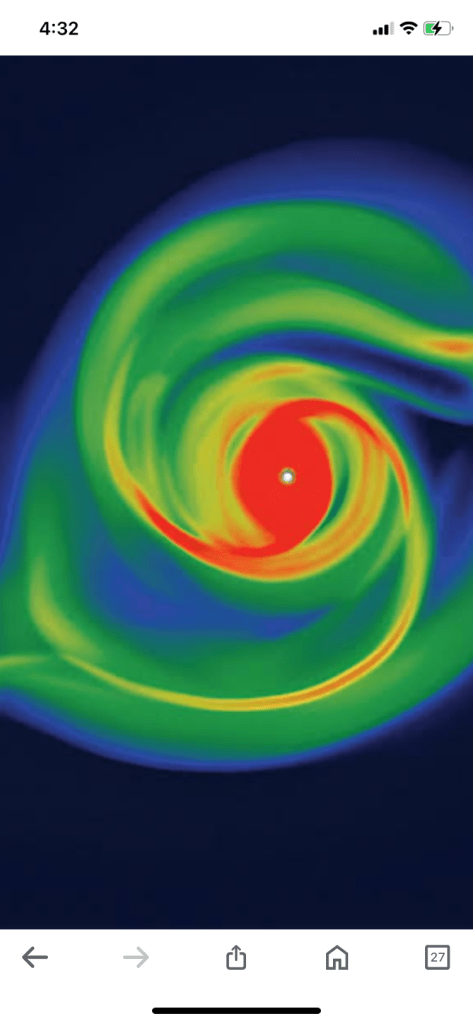
According to a study published in the journal Astronomy and Astrophysics, young planets that form from disk instability are shaped like flattened Smarties. The study found that these planets are oblate spheroids, which are spheres that are squashed from the top and bottom but bulge in the middle
The study used computer simulations to model the formation of planets. The researchers focused on the shapes young planets take and how they can grow into massive Jupiter-sized planets
New research finds that young planets are flattened structures rather than spherical. Astrophysicists from the University of Central Lancashire (UCLan) have found that planets have flattened shapes like smarties just after they form rather than being spherical as previously thought
An oblate spheroid is a sphere that is squashed from the top and bottom but bulges in the middle. The Earth, Saturn, Jupiter, and the star Altair are examples of oblate spheroids
The Earth’s shape is an oblate spheroid because of its rotation. The Earth’s spin flattens the poles and bulges the equator. This is due to centrifugal force, which pushes the mass outwards and flattens it along the rotation axis.
The circumference around the Earth’s poles is smaller than the circumference around the equator. This type of shape is called an ellipsoid
Computer simulations of planet formation developed by the University of Central Lancashire (UCLan) show that newborn planetsform as oblate spheroids – orbs squashed from the top and the bottom but bulging in the middle.
Isaac Newton first proposed that the Earth was not perfectly round, but instead an oblate spheroid. In 1687, Newton published his analyses in Principia, where he theoretically deduced the Earth’s shape. He found that the equatorial semiaxis would be 1/230 longer than the polar semiaxis.
Maupertuis also worked out the theory predicting the Earth was an oblate spheroid
Other planets that are oblate spheroids include:
- Saturn: The most oblate planet in the solar system, with a flattening of 0.09796.
- Jupiter: Has a slight but noticeable bulge around the equator due to its rapid rotation rate of 1 rotation per 10 hours.
- Neptune: The rotation of Neptune causes it to bulge slightly around the equator. The Earth and Mars are also oblate spheroids, but to a lesser extent than Saturn. Earth’s circumference around the equator is about 0.3% larger than its circumference around the poles. Mars’ circumference around the equator is about 0.6% larger than its circumference around the poles
The oblate spheroid is the approximate shape of rotating planets and other celestial bodies, including Earth, Saturn, Jupiter, and the quickly spinning star Altair. Saturn is the most oblate planet in the Solar System, with a flattening of 0.09796
According to a new research letter published in Astronomy and Astrophysics, young planets that form from disk instability are not spherical. Instead, they are oblate spheroids, which are shaped like flattened Smarties.
The research was conducted by astrophysicists at the University of Central Lancashire (UCLan). The researchers used computer simulations to model the formation of planets.
The researchers were surprised by the findings, as they had always assumed that planets were spherical.
Technically, no planet is fully spherical. For example, Jupiter’s flattening is around 6%, while Saturn is 10%, and Earth is almost spherical at just 0.3%.
The process of planet formation can take millions to billions of years.
For a planet to form, a star needs to have an accretion disk surrounding it. This disk allows excess material to clump together to start the formation of planets.
Rocky planets like Earth develop over millions of years, followed by gas giants like Jupiter, which build upon rocky cores. However, new evidence from NASA’s Spitzer Space Telescope suggests that some gas giants may sprout in less than one million years.
If a disk around a star is heavy enough, gravity can cause the disk to fragment and collapse into planets. This process can be relatively fast (thousands to tens of thousands of years). Heavy gaseous planets like Jupiter and Saturn could be formed this way.
In the warmer parts of the disk, closer to the star, rocky planets begin to form. After the icy giants form there’s not a lot of gas left for the terrestrial planets to accrete. Planets that are rocky like Mercury, Venus, Earth and Mars may take tens of millions of years to form after the birth of the star.
The nebular hypothesis is the leading theory of planet formation. It suggests that planets form when a dense cloud of dust and gas, called a nebula, spins around a new star. Gravity causes the dust and gas to clump together, and these clumps slowly grow into planets
The Sun and the planets formed together 4.6 billion years ago from a cloud of gas and dust called the solar nebula. A shock wave from a nearby supernova explosion may have caused the solar nebula to collapse. The Sun formed in the center, and the planets formed in a thin disk orbiting around it.
Planets closest to the star tend to be rockier because the star’s wind blows away their gases. They are also made of heavier materials attracted by the star’s gravity.
The standard scenario of planet formation has three stages:
- Dust to planetesimals
- Planetesimals to protoplanets
- Protoplanets to planets The process of planet formation begins with the collapse of a dense region of the solar nebula. This region becomes hot and starts to spin. The spinning cloud of gas and dust flattens into a disk, with most of the material concentrated in the central region
One of the first stages of planet formation is the growth of small planetesimals and their accumulation into large planetesimals and planetary embryos. This early stage occurs long before the dispersal of most of the gas from the protoplanetary disk.
Planets undergo four stages of development before becoming different planets: Differentiation, Cratering, Flooding, Surface Evolution
According to a study by the University of Central Lancashire (UCLan), young planets that form from disk instability are oblate spheroids, not spheres. Oblate spheroids are spheres that are squashed at the top and bottom, but bulge in the middle. They are similar in shape to flattened candies
The researchers used a supercomputer to simulate planet formation. They found that planets formed through disk instability gather more material at their poles than their equators. This stretches them out into an oblate spheroid.
A spheroid is a quadric surface that is obtained by rotating an ellipse about one of its principal axes. It is also known as an ellipsoid of revolution or rotational ellipsoid
The disk instability theory of planet formation states that a massive disk can fragment into planet-sized clumps due to self-gravity. These clumps can then contract and coalesce into a baby planet
The disk instability theory explains the formation of outer planets and their quick growth. It proposes that outer giants could grow quickly due to the location of their orbit and that their formation began with a gassy core
Disk instability happens when a massive disk fragments into planet-sized self-gravitating clumps. Scattered light from these disks will illuminate high altitude density variations that result from stirring of the disk by the forming planet
The gravitational instability model of planet formation states that gravity is the only force that can create structures by accumulating material in space. The model proposes that the gathering of gas that forms a planet begins with instabilities in the gas cloud that makes up a protoplanetary disk
According to the model, as the rotating disk of gas and dust particles cools down, the gravitational force causes the particles to come together, forming clumps. These clumps then collapse under their own gravity, leading to the formation of planets.
The gravitational instability mechanism is one hypothesis that explains how giant planets form. The hypothesis states that the solar nebula breaks up through its own self-gravity into clumps of gas and dust. These clumps are called giant gaseous protoplanets (GGPPs), and they then contract and collapse to form giant planets
Please like subscribe comment your precious thoughts on universe discoveries
Full article source google
Best men and women wear on heavy discount on Amazon Universe discoveries