
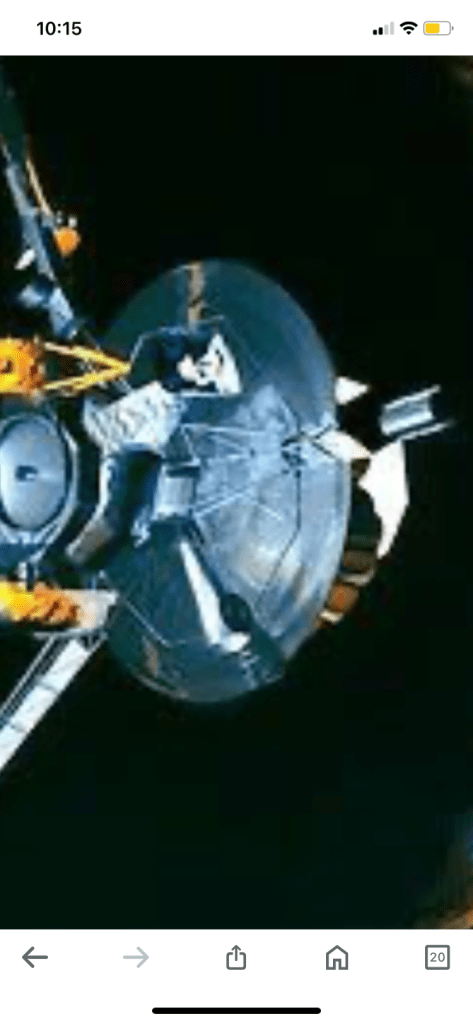
In December 1990, the Galileo spacecraft found evidence of life on Earth during a flyby:
- Methane and oxygen The spacecraft detected high levels of methane and oxygen, which suggested photosynthesis was occurring on Earth’s surface.
- Methane ratios The spacecraft measured methane in Earth’s atmosphere, with ratios that suggested a disequilibrium caused by living organisms.
- Surface pigment The spacecraft found a widely distributed surface pigment with a sharp absorption edge in the red part of the visible spectrum. The Galileo spacecraft also took several images of Earth during its flybys. Astronomers have used these images to learn more about life on Earth, which is useful for astronomers searching for life on other worlds
During the flybys of Earth Galileo took several images of our planet, which astronomers have used to discover life on Earth. The idea of “discovering” life on Earth in the 21st century might seem a bit ridiculous, but the study is quite useful to astronomers seeking life on other worlds
The Galileo spacecraft took images of Earth in 1990 during its first of two flybys on its way to Jupiter. The images were used to create the Galileo Earth Spin Movie, which shows the Earth’s rotation and weather system.
The Galileo spacecraft took 500 frames over a 25-hour period to create the movie. The first frame was taken in December 1990, when the spacecraft was 2.1 million kilometers away. The color composite image was made using images taken through red, green, and violet filters
The Galileo spacecraft made many discoveries, including:
- Subsurface liquid layers Galileo found evidence of subsurface liquid layers of saltwater on Europa, Ganymede, and Callisto.
- Volcanic activity Galileo examined a variety of volcanic activity on Io.
- Asteroid moon Galileo was the first spacecraft to discover a moon of an asteroid, Dactyl, which orbits the asteroid Ida.
- Magnetic data Galileo discovered magnetic data that suggests the moons of Ganymede and Callisto likely have liquid water.
- Jupiter’s atmosphere In 1995, Galileo captured data about Jupiter’s atmosphere that challenged prevailing theories about Jupiter’s structure.
- Comet collision In 1994, Galileo observed Comet Shoemaker–Levy 9’s collision with Jupiter.
- Venus’ clouds Galileo’s flight past Venus in 1990 yielded infrared images of the planet’s clouds.
- Jupiter’s rings Galileo found a 700,000-mile-wide dusty band around Jupiter and showed the planet’s tenuous rings arose from material kicked up by micrometeorites. Galileo was also the first spacecraft to fly by an asteroid and orbit an outer planet.
NASA named the Galileo spacecraft after the Italian astronomer Galileo Galilei, who discovered Jupiter’s four large moons in 1610. The moons are known as the Galilean moons, and include Ganymede, Callisto, Io, and Europa.
The Galileo spacecraft was designed to study Jupiter, its moons, and its magnetosphere. It was the first spacecraft to orbit Jupiter, arriving in December 1995. The spacecraft also studied
His 1610 discovery of what is now known as the Galilean moons orbiting Jupiter was important evidence of the Copernican model of the solar system. It was also noted that the name was that of a spacecraft in the Star Trek television show. The new name was adopted in February 1978
The Galileo spacecraft is part of an American robotic space program that studies the solar system. The spacecraft is named after the Italian astronomer Galileo Galilei (1564-1642).
Galileo is known as the father of modern astronomy. He was the first person to use a telescope to study the sky and made many improvements to the optical telescope. He also discovered the moons of Jupiter and sun spots, and provided evidence that the Earth revolves around the Sun.
Galileo’s discoveries include:
- Telescopic observations: The first person to report telescopic observations of the mountains on the moon, the rings of Saturn, the moons of Jupiter, and the phases of Venus
- Sun spots: Provided empirical evidence that the Earth revolved around the Sun
- Jupiter’s moons: The four tiny satellites that move around Jupiter, now known as the Galilean moons Galileo’s discoveries revolutionized our understanding of our place in the Universe. However, his belief in the heliocentric model of the Solar System was considered heretical by the Catholic Church. He was arrested and imprisoned because of his beliefs, and it wasn’t until 1992 that the Catholic Church officially cleared him of wrong-doing.
Please like subscribe comment your precious thoughts on universe discoveries
Full article source google
Best headphones on great discount on Amazon Universe discoveries