
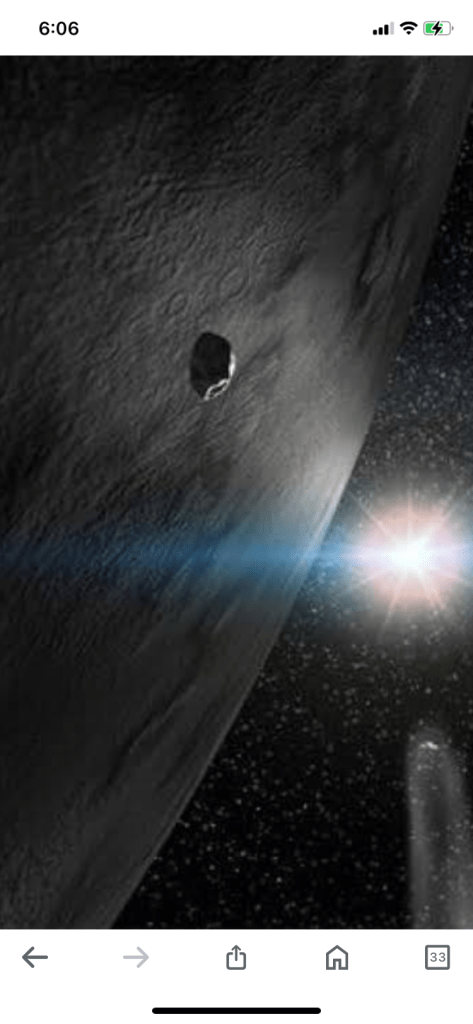
recent study using data from the Stratospheric Observatory for Infrared Astronomy (SOFIA) discovered water on the asteroids Iris and Massalia. This is the first time water has been discovered on an asteroid’s surface.
The research team, led by Dr. Anicia Arredondo, used SOFIA’s FORCAST instrument to analyze four asteroids. The tool isolated mid-infrared spectral signatures that pointed to the presence of molecular water on Iris and Massalia.
The discovery could provide insight into the conditions necessary for life to exist elsewhere in the universe. It could also help us understand the history and evolution of our celestial neighborhood.
The team will now use the James Webb Space Telescope to learn more about the distribution of water across the Solar System.
In the new study, scientists discovered “unambiguous” features of molecular water on the asteroids Iris and Massalia. They used data from the retired Stratospheric Observatory for Infrared Astronomy (Sofia) – a joint project conducted by Nasa and the German Space Agency – to make the discovery
Scientists have discovered water molecules on the surface of the asteroids Iris and Massalia for the first time. The discovery was made using data from the Stratospheric Observatory for Infrared Astronomy (SOFIA), a joint project between NASA and the German Space Agency.
The discovery is a significant step in space exploration and understanding. It was previously thought that any water on asteroids would have evaporated long ago.
The majority of water in the solar system is expected to be in minor planets, such as Kuiper belt objects and Centaurs. However, a significant amount of water is also found inside the snow line, including in near-earth objects (NEOs).
Some geochemical studies have concluded that asteroids are the primary source of Earth’s water. Carbonaceous chondrites, a subclass of the oldest meteorites in the Solar System, have isotopic levels most similar to ocean water.
In October 2023, NASA announced that a sample from the 4.5 billion-year-old asteroid Bennu contains abundant water and carbon. The sample also contains trace amounts of carbon and water, which are essential elements for life.
The discovery could provide more evidence for the theory that life on Earth was seeded from outer space. The findings could also help scientists understand how the solar system formed and how life on Earth began
The discovery of water ice on asteroids 4.6 billion years after the solar system’s birth suggests that asteroids may have delivered much of the water that fills Earth’s oceans.
Here are some other significant discoveries about asteroids:
- Bennu NASA discovered that the Bennu asteroid sample contains carbon and water. This discovery can provide insights into the conditions and materials that existed during the formation of our Solar System over 4.6 billion years ago.
- Themis The discovery of water and organics on Themis adds information that helps support the long-held hypothesis that the basic materials came to Earth from outside sources some 4 to 4.3 billion years ago.
- Chondritic meteorites Newcombe and co-authors discovered that, contrary to popular belief, not all outer solar system objects are rich in water. They concluded that water was likely delivered to Earth via unmelted, or chondritic, meteorites.
Scientists have discovered “unambiguous” features of molecular water on the asteroids Iris and Massalia. This is the first time water molecules have been confirmed on the surface of asteroids.
The research team used data from the Stratospheric Observatory for Infrared Astronomy (SOFIA), a joint project between NASA and the German Space Agency. The team analyzed the data using the FORCAST instrument to isolate mid-infrared spectral signatures that indicated the presence of molecular water.
The research team was led by Dr. Anicia Arredondo, and based their research on the discovery of molecular water on the sunlit surface of the moon
Please like subscribe comment your precious thoughts on universe discoveries
Full article source google
Best pet supplies on discount on Amazon Universe discoveries