
Kepler-186f is an exoplanet that is about 10% larger than Earth and orbits the red dwarf star Kepler-186. It is the outermost of five planets discovered around the star by NASA’s Kepler spacecraft
Kepler-186f is located about 580 light-years from Earth in the constellation of Cygnus. It was discovered by Elisa Quintana on April 17, 2014, and has an orbital period of 130 days.
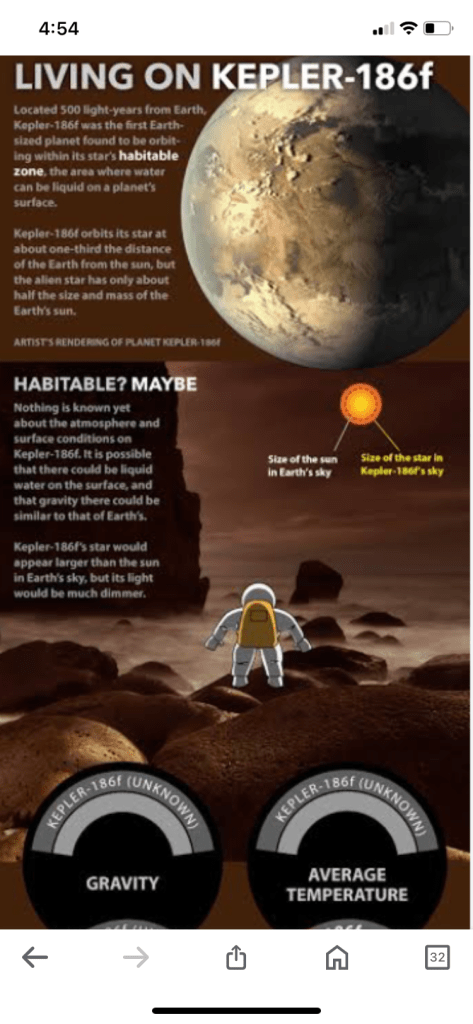
Kepler-186f is the first Earth-size planet discovered in the potentially “habitable zone” around another star, where liquid water could exist on the planet’s surface. The star is much cooler and redder than our Sun
Scientists aren’t sure if Kepler-186f can support life, but they believe it’s more likely to than any other known planet outside of Earth.
Scientists believe Kepler-186f is a rocky planet with a solid surface and atmosphere, similar to Earth. If it has an atmosphere, it could potentially have liquid water and oxygen, which could support life.
Scientists can’t say for sure if Kepler-186f can support life because they don’t know what its atmosphere is made of. However, if it has both methane and oxygen, that would suggest life.
Kepler-186f, the first Earth-sized extrasolar planet to be found within its star’s habitable zone—the orbital region where an Earth-like planetcould possess liquid water on its surface and thus possibly support life
It’s possible that Kepler-186f has liquid water on its surface. However, Kepler-186f is on the outer edge of its star’s habitable zone, so its water could freeze. However, its larger size could mean it has a thicker atmosphere that insulates the planet
According to James Webb Discoveries, researchers believe Kepler-186f’s atmosphere could be mostly nitrogen, with trace amounts of other gases like carbon dioxide, water vapor, and oxygen.
However, it’s unlikely that humans could breathe on Kepler-186f unless there’s life on the planet. Earth’s air didn’t have oxygen until photosynthetic life evolved.
To conclude that Kepler-186f is habitable, scientists would need to discover the following:
- Water: Organisms need water as a component and as a medium for transporting nutrients.
- Atmosphere: The atmosphere should be able to block harmful radiation while providing nutrients like nitrogen, oxygen, and carbon dioxide.
- Sunlight or other energy source: Organisms can use energy as fuel for chemical and biological processes.
- Nutrients: Kepler-186f needs nutrients like nitrogen to support life
Kepler-186f is believed to be slightly larger than Earth and to have a similar composition to it. It is not known whether the planet has an atmosphere, but if it does, its position in its star system’s habitable zone means that it could potentially have oxygen and liquid water and thus be able to support life
Kepler-186f’s primary source of sunlight is from its own star, Kepler-186. Kepler-186 is a red dwarf star, which means it’s much cooler than our sun and about half its size. Kepler-186f orbits its star every 129.9 days at a distance of 53.2 million km (33.1 million miles
Kepler-186f receives only 32 percent of the amount of light that Earth receives from the Sun. If you could stand on the surface of Kepler-186f, the brightness of its star at high noon would appear as bright as our sun is about an hour before sunset on Earth.
NASA confirms the discovery of an Earth-sized planet that may have potential for life, but its sun is dimmer than ours. Here’s what an evening stroll on a beach on Kepler-186f might be like. Eric Mack has been a CNET contributor since 2011
Yes, Kepler-186f is an exoplanet, meaning it orbits a star outside of our solar system.
Kepler-186f is located in the constellation Cygnus, about 580 light-years from Earth. It’s one of five planets discovered around the red dwarf star Kepler-186
Very little is known about Kepler-186f’s surface features. The planet is too far away, and its star is too dim for telescopes to determine if it has an atmosphere
However, scientists believe that Kepler-186f is likely to be rocky, based on its size. The planet’s placement and size suggest that it may have water on its surface.
Kepler-186f’s estimated equilibrium temperature, which is the surface temperature without an atmosphere, is around −121°F. This is somewhat colder than the equilibrium temperature of Mars. However, a greenhouse effect can help heat the surface up, and make it warmer
It’s believed that Kepler-186f has a thin atmosphere similar to Mars’. However, its size and mass suggest it could have a substantial atmosphere.
Some scientists believe that Kepler-186f’s larger size could mean it has a thicker atmosphere that could insulate the planet and keep its water liquid.
Planets with thick atmospheres could potentially host liquid water and life on their surfaces
Kepler-186f has a stable climate and regular seasons, similar to Earth. It has seasons due to its axial tilt and elliptical orbit, but the duration and intensity of the seasons may differ from Earth’s.
Kepler-186f’s effective temperature is about 50 degrees below the freezing point of water, making it uninhabitable in its current state. To make it habitable, scientists would need to increase the greenhouse effect and introduce heat sources. This could be done by introducing greenhouse gases into the atmosphere, such as carbon dioxide (CO2) or methane (CH4). These gases trap heat from the sun, leading to a warmer climate
While Kepler-186f is located within the habitable zone of its star, it’s not guaranteed to have a habitable atmosphere. Scientists can’t conclusively determine whether it has breathable air.
According to James Webb Discoveries, a crucial aspect of Kepler-186f’s atmosphere is the role played by greenhouse gases. Researchers are interested in how these gases, such as carbon dioxide and methane, might influence the exoplanet’s climate.
However, there is not enough information on the planet’s atmosphere to even make a solid guess at whether it’s breathable
It’s unclear what it would be like to live on Kepler-186f, as scientists don’t know what the planet’s atmosphere is like. If Kepler-186f had an Earth-like atmosphere, sunrises and sunsets would be more “enhanced” than Earth’s.
Scientists plan to search for biosignatures on Kepler-186f, which could include the presence of certain gases, such as oxygen or methane. These gases are closely associated with biological activity on Earth.
Kepler-186f is 580 light-years away, so it would take 580 years to get there, even traveling at the speed of light. Since travel at the speed of light is theoretically impossible, and no human spacecraft is capable of such speeds, there is no possibility of anyone alive today traveling to Kepler-186f
Kepler-186f has a surface gravity of 1.2499 times that of Earth. However, it’s not possible to pinpoint the exoplanet’s gravity without knowing its composition.
Kepler-186f has a mass of 1.44+2.33 −1.12 times that of Earth, and a mean radius of 1.17 times that of Earth. It orbits its star closer than Earth orbits the sun
According to arXiv, Kepler-186f has a median Mmax larger than Earth’s current dipole moment. However, it’s unknown if Kepler-186f has a magnetic field to protect its atmosphere from the solar wind.
Most detected exoplanets have very weak magnetic fields, which is an important factor when searching for potentially habitable planets
According to James Webb Discoveries, Kepler-186f is tidally locked to its star, meaning one side always faces the star while the other is in darkness. However, Britannica says that Kepler-186f is far enough away from its star that it may not be tidally locked.
According to Wikipedia, there is a roughly 50-50 chance that Kepler-186f is tidally locked. The proximity of the inner four planets to Kepler-186 suggests that they are likely tidally locked. However, Kepler-186f is at a large enough distance from the star that its rotation rate cannot be determined
According to a 2018 study, Kepler-186f may have seasons and a climate similar to Earth’s. The study found that the exoplanet has a fixed obliquity similar to Earth, which could mean it has regular seasonal patterns.
Kepler-186f’s axial tilt is also stable, similar to Earth’s. This means it likely has regular seasons and a stable climate
This artist’s concept depicts Kepler-186f, the first validated Earth-size planet to orbit a distant star in the habitable zone — a range of distance from a star where liquid water might pool on the planet’s surface. The discovery of Kepler-186f confirms that Earth-size planets exist in the habitable zones of other stars and signals a significant step closer to finding a world similar to Earth.
The size of Kepler-186f is known to be less than ten percent larger than Earth, but its mass, composition and density are not known. Previous research suggests that a planet the size of Kepler-186f is likely to be rocky. Prior to this discovery, the “record holder” for the most “Earth-like” planet went to Kepler-62f, which is 40 percent larger than the size of Earth and orbits in its star’s habitable zone.
Kepler-186f is a history-making find
Kepler-186f is the first Earth-size alien planet found in the habitable zone of its star. That means the planet, which is only slightly larger than Earth, is in the part of its star system where liquid water could exist on the planet’s surface
the habitable zones of their stars, but this is the first time a planet this close in size to Earth has ever been found in the habitable zone of its star.
“This is an historic discovery of the first truly Earth-size planet found in the habitable zone around its star,” University of California, Berkeley astronomer Geoff Marcy, who is unaffiliated with the new research, said. “This is the best case for a habitable planet yet found. The results are absolutely rock solid. The planet itself may not be [rocky], but I’d bet my house on it. In any case, it’s a gem.”
Life could thrive … maybe
Because of Kepler-186’s location in the habitable zone around its star, the planet might be a place where life can thrive. It’s possible that the planet has an atmosphere that can help keep water in liquid form on the surface, a prerequisite for life as it is known on Earth
It is one of five planets in the Kepler-186 star system
Kepler-186f is one of five planets found in the extrasolar system located about 490 light-years from Earth. The newly discovered exoplanet orbits about 32.5 million miles (52.4 million kilometers) from its sun. It takes Kepler-186f about 130 days to orbit its red dwarf star.
The other four planets orbiting the star, however, are not in that “Goldilocks zone.”
“The four companion planets — Kepler-186b, Kepler-186c, Kepler-186d and Kepler-186e — whiz around their sun every four, seven, 13 and 22 days, respectively, making them too hot for life as we know it,” NASA officials said in a statement. “These four inner planets all measure less than 1.5 times the size of Earth.”
Its star is cooler than the sun
The Kepler-186 star is about half the mass of the sun, and the newly discovered planet is far enough away from its star that powerful flares may not greatly affect the planet, scientists have said. Stars like Kepler-186 also have long stellar life spans
In the vast cosmos, Kepler-186f is a celestial gem that has captured the imagination of astronomers, space enthusiasts, and dreamers of extraterrestrial life. Discovered by NASA’s Kepler Space Telescope, Kepler-186f is a remarkable exoplanet that has sparked countless questions and intriguing possibilities
Significance for Astrobiology
Kepler-186f holds great significance in the field of astrobiology—the study of life beyond Earth.
The exoplanet represents a tantalizing prospect for the search for extraterrestrial life. A subsurface ocean could be a viable habitat for diverse ecosystems, including extremophiles
Please like subscribe comment your precious thoughts on universe discoveries
Full article source google
Best pet supplies on discount on Amazon Universe discoveries