
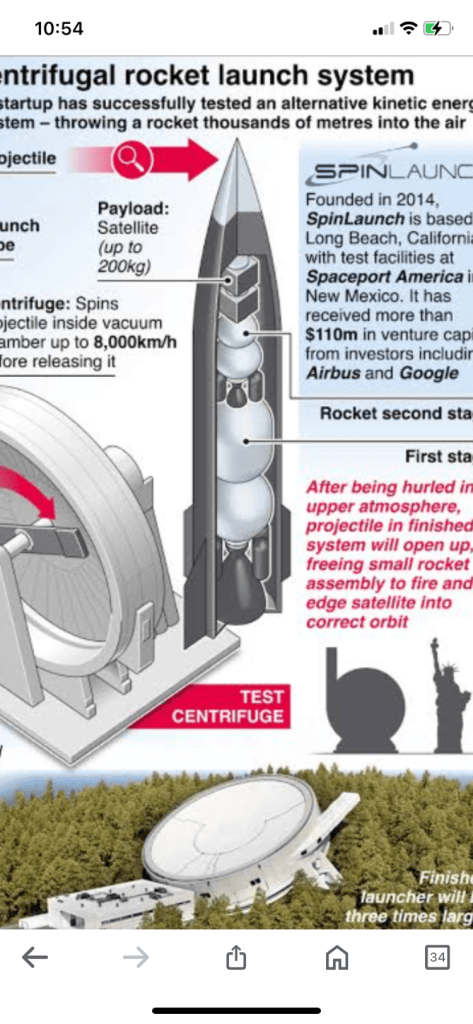
SpinLaunch is a space technology company that uses a high-speed spinning machine to launch satellites into space
SpinLaunch’s Orbital Launch System uses a ground-based, electric-powered kinetic launch system. The system includes a vacuum-sealed centrifuge that spins a rocket at up to 4,700 mph (7,500 km/h). The rocket then ignites its engines at an altitude of roughly 200,000 ft (60 km) to reach orbital speed of 17,150 mph (27,600 km/h). The rocket can carry a payload of up to 200 kg.
SpinLaunch’s system has several benefits over traditional rocket launches:
- Reduced fuel: The velocity boost provided by the accelerator’s electric drive reduces the fuel required to reach orbit by a factor of four.
- Reduced cost: The system reduces the cost by a factor of ten.
- Multiple launches: The system allows for multiple launches per day.
SpinLaunch’s technology can also lead to cleaner, more frequent space launches. The company aims to achieve a launch frequency of up to once every hour.
SpinLaunch’s technology is also environmentally sustainable. Since it uses electricity instead of traditional fuel, it reduces the need for an expensive, pollutant first stage of launch
By reducing reliance on combustible fuels, SpinLaunch’s technology shows potential for cleaner, cost-effective, and more frequent space launches
SpinLaunch faces several disadvantages, including:
- Payload damage The high rotation speed could damage the payload before it leaves the accelerator. The payload and second stage must be hardened against the g-forces during the spin, which makes them heavier than they would need to be otherwise. This negates a good chunk of the advantage.
- Atmospheric drag The payload will experience a tremendous atmospheric drag force.
- Incompatibility SpinLaunch’s technology is incompatible with traditional liquid rocket fuels.
- Piercing the mylar sheet Piercing the mylar sheet preserving SpinLaunch’s vacuum could destroy the payload.
- Sudden changes The abrupt transition between the vacuum and air environments could subject the payload to sudden changes potentially causing damage to hardware and internal functions.
- Gravity and atmospheric resistance Overcoming gravity and atmospheric resistance presents ongoing challenges for any system, including the spin launch accelerator.
- Lack of updates SpinLaunch has faced difficulties in finding a location for an orbital accelerator, leading to a lack of updates on their progress. Other disadvantages include:
- Problems with massive spinning objects
- Potential for catastrophic damage to the payload
According to Big Think, a spacecraft needs to reach altitudes of around 300 kilometers (186 miles) and orbital speeds of 25,000 kph (16,000 mph) to successfully enter low-Earth orbit. SpinLaunch’s test flights have reached altitudes of up to 30,000 feet (9,100 m). SpinLaunch’s Sub-Orbital Accelerator is built to propel the rocket to near-Earth orbit, which is generally considered to be at an altitude of about 2,000 kilometers above Earth’s surface. SpinLaunch plans to expand its technology and equipment to be able to send space objects into higher orbit
SpinLaunch’s full-scale orbital system has a maximum speed of 5,000 mph (8,100 km/h). To reach this speed, the subscale suborbital accelerator spins at about 1,300 rpm
The technology uses a vacuum-sealed centrifuge to spin a rocket and then hurl it to space at up to 4,700 mph (7,500 km/h; 2.1 km/s). The rocket then ignites its engines at an altitude of roughly 200,000 ft (60 km) to reach orbital speed of 17,150 mph (27,600 km/h; 7.666 km/s) with a payload of up to 200kg
SpinLaunch’s prototype can launch dummy vehicles to altitudes of up to 30,000 feet. The company’s first 10 test flights have reached altitudes of 30,000 feet. In September 2022, a flight test vehicle launched using SpinLaunch’s Suborbital Accelerator reached an altitude of 25,000 feet
According to SpinLaunch, its system can reduce the cost of a single space launch by a factor of 20 to under $500,000. SpinLaunch claims that its system will also reduce the use of fuel by 70% compared to chemical rockets.
As of 2021, the cost of launching a payload into low Earth orbit (LEO) can range from around $10 million to $100 million or more
The SpinLaunch Orbital Launch System is a fundamentally new way to reach space. The velocity boost provided by the accelerator’s electric drive results in a 4x reduction in the fuel required to reach orbit, a 10x reduction in cost, and the ability to launch multiple times per day
SpinLaunch’s system uses kinetic energyas its first stage engine. The system’s 12-meter Lab Accelerator at its headquarters in Long Beach, California, can accelerate payloads up to 10,000 times the force of gravity
Unlike traditional fuel-based rockets, SpinLaunch uses a ground-based, electric powered kinetic launch system that delivers a substantially less expensive and environmentally sustainable approach to space access
Yes, SpinLaunch has successfully launched a test vehicle at supersonic speeds on October 22, 2021. The test launch, which took place at Spaceport America in New Mexico, used 20% of the accelerator’s full power capacity. The test launched a 10-foot-long projectile to an altitude of “tens of thousands of feet”. The reusable flight vehicle was also recovered.
SpinLaunch’s prototype has also launched dummy vehicles at speeds of up to 1,000 miles-per-hour and to altitudes of up to 30,000 feet
By reducing reliance on combustible fuels, SpinLaunch’s technology shows potential for cleaner, cost-effective, and more frequent space launches
SpinLaunch is a US company that uses a high-speed spinning machine to launch satellites into space. SpinLaunch’s system uses a vacuum-sealed centrifuge to spin a rocket at speeds of more than five times the speed of sound. The rocket is then propelled through a tube into near-Earth orbit.
SpinLaunch’s system is an alternative to traditional chemical rockets, which use fuel-based rockets. SpinLaunch’s goal is to reduce the cost of access to space while increasing launch frequency
SpinLaunch’s system is more environmentally sustainable and less expensive than traditional fuel-based rockets. SpinLaunch’s system replaces the expensive and polluting first stage of launch with electricity.
According to SpinLaunch, their system will result in a 10-fold reduction in launch costs and a 70% reduction in the use of fuel compared to chemical rockets.
Here are some other advantages of SpinLaunch’s system:
- Cost efficiency SpinLaunch’s technology has the potential to significantly reduce launch costs.
- Environmental sustainability Traditional rocket launches emit substantial amounts of greenhouse gases that can contribute to Earth’s pollution problems.
- High speeds The high speeds generated by the SpinLaunch system allow the payload to reach orbit without the need for traditional rocket fuel.
- Electric drive The velocity boost provided by the accelerator’s electric drive results in a 4x reduction in the fuel required to reach orbit.
By sidestepping the use of expensive and polluting rocket fuel, the technology aims to cut down fuel consumption by a factor of four. Moreover, it’s anticipated to reduce the costs of similar launches by a whopping tenfold, a financial boon that could significantly accelerate the pace of space exploration.
Please like subscribe comment your precious thoughts on universe discoveries
Full article source google
Best travel products on heavy discount on Amazon Universe discoveries