
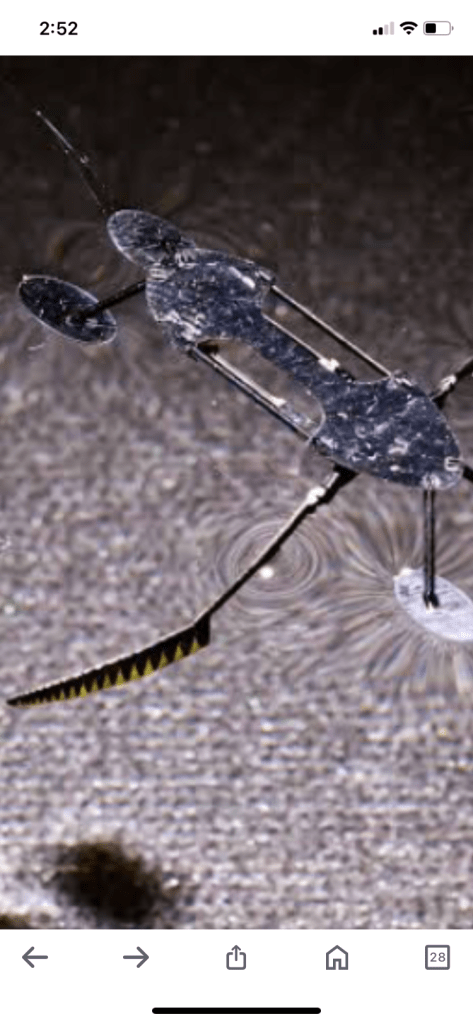
Two insect-like robots, a mini-bug and a water strider, developed at Washington State University, are the smallest, lightest and fastest fully functional micro-robots ever known to be created.
In January 2024, researchers at Washington State University announced that they have created the world’s smallest, lightest, and fastest fully functional micro-robots:
- Mini-bug: Weighs eight milligrams
- Water strider: Weighs 55 milligrams and moves at 6 millimeters per second
The robots are made of two thin shape memory alloy wires that heat up and cool down quickly when an electric current passes through them.
The robots are inspired by mini-bugs and water striders and could have many applications, including:
- Artificial pollination
- Search and rescue operations
- Environmental monitoring
- Micro-fabrication
- Robotic-assisted surgery The details of the research were published in the journal IEEE Xplore in December 2023.
Microrobots can be divided into three types based on their motion: Crawling robots, Flying robots, Swimming robots.
Microrobots are often inspired by small animals and insects, mimicking their appearance and movement.
Here are some other types of microrobots:
- Biohybrid microrobots These microrobots are made of biological cells and synthetic materials. They can be actuated through biological and artificial means.
- Biohybrid micro- and nanorobots These tiny machines are made of biological and artificial components. They can sense, control, and implement medical tasks like cell microsurgery, single-cell manipulation, and targeted drug delivery.
- Magnetically driven microrobots These microrobots are powered by magnetic fields, which are harmless to the human body and can be operated remotely. They have been studied for cargo transportation and cell manipulation.
- Magnetotactic bacteria These bacterial microrobots can be remotely controlled using magnetic fields. Their internal chain of iron-oxide nanoparticles acts like a compass needle.
Microrobots are used in many applications, including:
- Medical Microrobots can diagnose diseases, measure blood sugar levels, and deliver drugs to specific targets in the body. They can also clean arteries, map brains, and more.
- Biotech Microrobots can help develop diagnostic and therapeutic tools to monitor and treat disease.
- Environmental Microrobots can help with environmental monitoring and remediation.
- Search and rescue Microrobots can help search for survivors in collapsed buildings after an earthquake.
- Engine inspection Microrobots can be used to test, control, and inspect small parts such as buttons and screens.
- Agricultural research Microrobots can be used in agricultural research.
- Drug delivery Microrobots can be used to deliver drugs to specific targets in the body such as a tumor. For example, biocompatible microalgae-based microrobots can be used to deliver drugs in the lungs and the gastrointestinal tract.
- Cell manipulation Microrobots can be used for cell manipulation, microassembly, and biosensing.
- Acoustic actuation Microrobots can be actuated by sound waves that travel through a fluid and produce forward pressure.
Here are some examples of microrobots:
- μRobotex This is a microrobot system that can build the world’s smallest house inside a vacuum chamber.
- Micro scallops These miniature robots are less than a millimeter in size and can deliver drugs to targeted areas in the body.
- Anthrobots These tiny living robots are made from human cells and can move around in a lab dish. They may one day be able to help heal wounds or damaged tissue.
- Solar-powered microbots These microbots are the size of a human hair and can walk autonomously without external control. They could be used in bacterial tracking, oil spill cleanup, and non-invasive micro surgery.
Microrobotics is the field of miniature robotics, which is defined as mobile robots that are less than 1 mm in size. Microrobots are built to perform tasks that require navigating a small space or may be harmful for humans to carry out
Microrobots combine the miniature sizes and/or resolution of microsystems with the precise trajectory control of robotics. They can perform microscale tasks such as: Drug delivery, Cell manipulation, Microassembly, Biosensing.
Microrobots are usually visible, whereas some nanobots are not immediately visible to the human eye.
Micro robotics is the field of miniature robotics, which includes microrobots that are less than 1 millimeter in size. Microrobots can also be robots that can handle micrometer-sized components
Nanorobotics is the field of creating very small robots. It combines the engineering requirements of robotics with the scale of nanotechnology to build machines that are as small as the molecules that make up matter. Nanorobots are defined as robots that are smaller than a micron in size.
Nanorobots can be used in fields like medicine, industry, and environmental science. Some examples of nanorobots include:
- Respirocyte: An artificial oxygen carrier nanorobot
- Chromallocyte: A cell-repair robot
- Pharmacyte: A nanorobot that can carry drugs in its tanks
- Microbivores: A nanorobot that can destroy certain types of bacteria
- Clottocyte: A nanorobot that plays a role comparable to platelets in human blood
Robotics is the field of engineering and computer science that creates robots to assist humans. Nanorobotics is the field of technology that designs and uses robots at the nanoscale, which is one billionth of a meter
Robotics combines science, engineering, and technology to create machines that can replicate or replace human actions. Robots can perform basic and repetitive tasks with greater efficiency and accuracy than humans.
Nanorobotics combines the principles of robotics, nanotechnology, and material science to develop robots at the nanoscale. Nanorobots are nanoscale in size, and nanorobotic manipulators are large robots that can manipulate objects at the nanoscale
Please like subscribe comment your precious thoughts on universe discoveries
Full article source google
https://2cc67gop5yzvhtenzjgr0cr19u.hop.clickbank.net
Best sports and outdoor products on heavy discount on Amazon
 Universe discoveries
Very nice article with sharing information about useful 💥
LikeLiked by 1 person
Thanks a lot dear friend 🌹
LikeLiked by 1 person